A free Premium account on the FCL.055 website! Read here
Sign up to unlock all our services and 15164 corrected and explained questions.
Question 228-1 : Icao doc 9613 defines the concept of pbn and its components these components include the term rnav 2 and rnp 2 these are examples of… ? [ Certification weather ]
Navigation specifications
Question 228-2 : Consider rnav and rnp system functions an offset flight path is ?
A lateral offset from a defined route which is specified in increments of 1 nm up to 20 nm.
Rnav and rnp systems may provide the capability for the flight crew to specify a lateral offset from a defined route generally lateral offsets can be specified in increments of 1 nm up to 20 nmwhen a lateral offset is activated in the rnav or rnp system the aircraft will leave the defined route and typically intercept the offset at an angle of 45 degrees or lesswhen the offset is cancelled the aircraft returns to the defined route in a similar mannerA variable lateral offset from a defined route that can be applied for the entire length of the route, including the approach procedure. a lateral offset from a defined route, and the offset must be intercepted at an angle of 45 degrees or more. a parallel path that is offset only to the left of the original active route.
Question 228-3 : Icao doc 9613 defines a set of navigation specifications for different airspace concepts the navigation specification rnp 2 is for… ?
The en route phase of flight in oceanicremote and continental areas.
06207020306 state that rnp 2 is used in the en route and oceanicremote phases of flightnavigation specifications rnav and rnp specifications rnav 10 rnp 10 and rnp 4 for oceanic and remote continental navigation applicationsrnav 1 and rnp 1 for arrival and departure phases of flightrnav 2 for en route continental arrival and departure phases of flightrnp 2 for en route continental and oceanicremote phases of flightrnav 5 for en route flight phasesrnp apch for approach phase of flightrnp 03 for various phases of flight except for oceanicremote and final approach primarily for helicopter note even though the learning objective does not specifically say 'en route continental' it can be assumed as it mentions 'en route' and 'oceanicremote' which means it covers all the different en route phases of flight it is a badly written and potentially misleading learning objective but you can see in the table above that rnp 2 covers both the different en route typesArrival, approach (except for the final approach), and departure phases of flight. en-route, arrival, and departure phases of flight. arrival, approach, and departure phases of flight.
Question 228-4 : In the context of pbn operations what is navigation system error nse ?
It refers to the difference between the aircraft’s estimated position and its actual position.
Performance based navigation pbn the inability to achieve the required lateral navigation accuracy may be due to navigation errors related to aircraft tracking and positioning the three main errors in the context of on board performance monitoring and alerting are path definition error pde flight technical error fte and navigation system error nse path definition error pde occurs when the path defined in the rnav system does not correspond to the desired path ie the path expected to be flown over the ground rnav system is unable to accurately define the desired path path definition error pde is constrained through database integrity and functional requirements on the defined path and is considered negligible flight technical error fte relates to the air crew or autopilot’s ability to follow the defined path or track including any display error eg course deviation indicator cdi centring error on board performance monitoring and alerting of flight technical error fte is managed by on board systems ie autopilot or crew procedures ie sops navigation system error nse refers to the difference between the aircraft’s estimated position and actual position it is the error in the accuracy in determining actual aircraft coordinatesNse occurs when the path defined in the rnav system does not correspond to the desired path, that is, the path expected to be flown over the ground. nse is part of the total system error, which relates to the air crew or autopilot’s ability to follow the defined path or track, including any display error. it is a system error that relates specifically to longitudinal accuracy.
Question 228-5 : The performance based navigation pbn concept expresses performance requirements using specific terms what is the term that defines the trust that can be placed in the correctness of the information supplied by the total system and which includes the ability of a system to provide timely and valid ?
Integrity.
Continuity the capability of the system to perform its function without unscheduled interruptions during the intended operationintegrity a measure of the trust that can be placed in the correctness of the information supplied by the total system integrity includes the ability of a system to provide timely and valid alerts to the useravailability the percentage of time annually during which the system is available for useAvailability. accuracy. continuity.
Question 228-6 : Consider pbn operations what is one advantage of navigating using computed data compared to raw data the area navigation system will ?
Check the validity and in some cases consistency of sensor data before use.
Conventional radio navigation is based on raw data pbn requires an integrated or computed navigation solution that is not sensor specific the navigation solution being derived from information from multiple sensors the advantage is the reduced requirement of maintaining sensor specific routes and the additional operational costs new routes and airspace operations also do not need installation of new sensors reducing costs and making airspaces much more efficientthe rnav system will confirm the validity of the individual sensor data and in most systems will also confirm the consistency of the various sets of data before they are usedProvide 3d navigation for the whole route. give a more accurate position, regardless of the sensor data that is being used. only use data from one sensor for navigation.
Question 228-7 : 3d approach operations are very common nowadays which of the following options belongs to this type of approach 1 rnp apch gnss and baro vnav 2 gls 3 par 4 rnp 1 5 ils 6 rnp apch sbas ?
1 2 3 5 and 6.
‘three dimensional 3d instrument approach operation’ means an instrument approach operation using both lateral and vertical navigation guidance1 rnp apch gnss and baro vnav uses gnss for lateral guidance and baro vnav for vertical guidance2 gls stands for gbas ground based augmentation system landing system gbas is used to improve gps receiver position and intends to provide an alternative to ils the improved gps position provides both lateral and vertical guidance and it is regarded as a precision approach3 par stands for precision approach radar it uses primary radar equipment to determine information of aircraft that includes distance to touch down deviation from runway centreline and glide path these data are used to aid the aircraft in the approach till touchdown therefore it is a 3d approach since both later and vertical guidance are present not to be confused with surveillance radar approach which also uses primary radar equipment but only provides lateral guidance 4 rnp 1 is a navigation specification that requires aircraft to maintain lateral total system error within 1 nm for at least 95% of the flight time it is not an approach at all not to be confused with rnp aprch which includes gnss for lnav minimum gnss + baro vnav for lnavvnav minimum and gnss augmented by sbas5 ils stands for instrument landing system it uses localiser for lateral guidance and glideslope and vertical guidance6 rnp apch sbas are approaches based on gnss positioning augmented by sbas not to be confused with gbas if it is down to lp minima it is 2d approach if it is down to lpv minima it is 3d approach since all choices include this option it should be referring to the lpv minima combining all the information above all the options available are 3d approaches except rnp 1 therefore the correct answer is 1 2 3 5 and 62, 3, 4, 5 and 6 only 1, 5 and 6 1, 3, 4 and 6
Question 228-8 : Why is strict adherence to flight director guidance important when manually flying a radius to fix rf leg the flight director… ?
Is required to provide the necessary level of guidance and precision during the turn.
Refer to figure radius to fix legs rf legs pbn components in pbn performance based navigation systems use various specific components pbn components to create routings some of these routings have to be curved rather than being from fix to fix these are called fixed radius paths frps of which there are two types radius to fix legs rf for terminalapproach procedures and fixed radius transitions frts for en route legs this question refers to the former of these two rf legsduring any pbn procedure the actual navigational performance has to be kept smaller and therefore more accurate than the required navigational performance this is usually accomplished better when flown with autopilot engaged as it can provide very precise control inputs to maintain the correct track but without autopilot engaged flight directors are the next best thing to provide the necessary guidance during the turning manoeuvresnote the answer which refers to the current tas and bank angle is referring to different pbn components which are know as fly by and fly over turns but are not fixed radiusMust be used in place of the autopilot as it provides more precise guidance. provides guidance based on a fixed radius calculated with current tas and bank angle. allows the pilot to cross-check the dme arc guidance along the rf procedure.
Question 228-9 : In pbn operations rnav 2 can be used for which of these phases of flight ?
En route continental arrival and departure.
Refer to figure the above annex gives the usage for different levels of rnav and rnp systems where different systems can give different navigational accuracies which are required for different stages of flightEn-route oceanic, en-route continental, and approach. arrival, departure, and approach. en-route remote, intermediate approach, and final approach.
Question 228-10 : A pilot is planning to conduct a flight under the specifications of pbn an rnp approach to lnavvnav minima may only be flown with vertical guidance… ?
Certified for the purpose.
Learning objective 06207050504 state that an rnp apch to lnavvnav minima may only be conducted with vertical guidance certified for the purposernp approach rnp apch lnavvnav incorporates lnav lateral with vertical path guidance for systems and operators capable of either barometric or sbas vertical pilots are required to use sbas to fly to the lpv or lp minima rf turn capability is optional in rnp apch eligibilityFrom a barometric altimeter. from a radio altimeter. from an ils or mls glide slope.
Question 228-11 : In order to navigate an aircraft under the specifications of pbn the pilot must ensure that the onboard navigation database… ?
Is valid for the current airac cycle.
One of the most important requirements of rnavrnp is that the data being used is up to date indeed every pbn navigation specification requires that the navigational database is up to date operationally significant changes are revised on a fixed cycle known as the airac aeronautical information regulation and control cycle every 28 days changes are published well in advance so that users of aeronautical data can update their databases the pbn navigation database must be valid for the current airac cycle meaning that if a new airac cycle is published every 28 days the pbn cycle must also be updated every 28 daysIs updated by notams via acars. contains an up-to-date wgs-84 model. contains the latest gps navigation message.
Question 228-12 : The icao pbn manual doc 9613 defines a set of navigation specifications for different airspace concepts where may a pilot encounter the specification rnp ar apch ?
Approaches that require a specific authorisation to fly.
Rnp specificationsthe international civil aviation organization’s icao pbn manual identifies seven navigation specifications under the rnp family rnp4 rnp2 rnp1 advanced rnp rnp apch rnp ar apch and rnp 03 rnp 4 is for oceanic and remote continental navigation applications rnp 2 is for en route oceanic remote and en route continental navigation applications rnp 1 is for arrival and initial intermediate and missed approach as well as departure navigation applications advanced rnp is for navigation in all phases of flight rnp apch and rnp ar authorisation required apch are for navigation applications during the approach phase of flight rnp 03 is for the en route continental the arrival the departure and the approach excluding final approach phases of flight and is specific to helicopter operationsnote rnp ar approaches are expected to cover those cases where the procedure design limitations of rnp approaches do not allow to replace visual and circle to land proceduresEn-route and approach segments requiring augmented navigation capability. en-route segments requiring augmented navigation capability. a route or part of a route that is airway-regulated.
Question 228-13 : Which of the following navigation aspects are related to the rnp specification for terminal and en route phases of flight ?
Lateral navigation.
Learning objective 06207010301 state that in oceanicremote en route and terminal phases of flight pbn is limited to operations with linear lateral performance requirements and time constraintsthis learning objective looks to have been taken directly from icao doc 9613 the pbn manual which states this in a very similar wording it is important to note that vertical guidance is not technically a part of 'pbn' even in the approach phaseLateral and vertical navigation vertical navigation full 3d navigation
Question 228-14 : You are flying in imc at night above the 73°north latitude because of the high latitude and the gnss satellite positions you elect to fly an rnp apch to lnavvnav minima based on barometric vnav with gnss horizontal guidance the minimum published temperature for the approach is 8°c and your aircraft ?
The temperature has fallen below 8°c invalidating the indicated altitudes of the current barometric vnav setup.
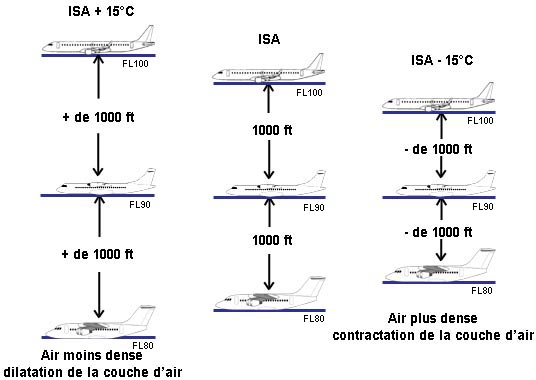
06207050505 los explain why an rnp apch to lnavvnav minima based on baro vnav may only be conducted when the aerodrome temperature is within a promulgated range if the barometric input is not automatically temperature compensatedlnavvnav minima based on baro vnav – the approach horizontal guidance is managed based on gnss and the vertical profile is guided by barometric altitude as opposed to using gps sbas altitude these 3d approaches conducted in the vertical plane based on barometric reference require certification of altimeters with adequate accuracy to enable completion of the approach barometric descents are prone to effects of the atmospheric parameters affecting altimetry it is crucial to have the correct qnh altimeter setting to avoid offset altitudes during final approach temperature effects also influence terrain clearance on final approach segment altimeters are calibrated in accordance with the international standard atmosphere isa in case of low temperature the pressure layers in the atmosphere move closer together resulting in a lower true altitude than indicated consequently obstacle clearance minima may be jeopardised if temperatures are below a certain limit the majority of rnp approaches will have an oat minimum temperature limit and the approach plate will state ‘uncompensated baro vnav not authorised below x°c’ in this case that limit is 8°c and it is very likely that this is what caused atc to call for a go around as the oat was only 2°c warmer during the last atisAtc has detected interference from the glide slope signals of the parallel runway. the gbas signal has been lost. loss of the gnss signal because of the low satellite elevations above the horizon.
Question 228-15 : An aircraft is being flown under the specifications of rnp using a suitable area navigation system at the start of the approach phase of the flight the rnp specifications might change from ?
Rnp 1 to rnp apch.
Refer to figure available rnp specifications for the terminal arrival phase of flight designated apr on the annex above are rnp 1 advanced rnp or rnp 03 as advanced rnp actually covers multiple specifications so is not the answer here rnp 03 is used for heliocpter operations therefore rnp 1 is the correct specification to use in the terminal arrival phase of flight with this the required navigational performance rnp is 1 nm laterally and longitudinally and must be kept within this at least 95% of the timewhen the aircraft enters the approach phase the aircraft area navigation system must switch from rnp 1 to rnp apch unless it is specified as an ar authorisation required approach again advanced rnp is not part of this question as it is a type of multi specification that would not need to switch between arrival and approach looking at the annex above we can see which rnavrnp specifications can be used in what type of airspace and the navigational performance that they requireRnav 10 to rnp 1. rnp ar to rnp apch. rnav 5 to rnav 1.
Question 228-16 : You are established on a 10 nm parallel track to your airway what will happen if your aircraft now turns by more than 90 degrees ?
The rnav system will discontinue the offset.
Refer to figureicao doc 961355 offset flight path rnav systems may provide the capability for the flight crew to specify a lateral offset from a defined route generally lateral offsets can be specified in increments of 1 nm up to 20 nm when a lateral offset is activated in the rnav system the rnav aircraft will depart the defined route and typically intercept the offset at a 45 degree or less angle when the offset is cancelled the aircraft returns to the defined route in a similar manner such offsets can be used both strategically ie fixed offset for the length of the route or tactically ie temporarily most rnav systems discontinue offsets in the terminal area or at the beginning of an approach procedure at an rnav hold or during course changes of 90 degrees or greater the amount of variability in these types of rnav operations should be considered as operational implementation proceeds see figure i a a1 8 The aircraft will return to the defined route. lnav will disengage and control wheel steering mode will engage. the rnav system will command a holding.
Question 228-17 : A flight management system fms can provide an estimated position error epe that is often used to check against the required navigation performance rnp value of a procedure or airspace which of these best describes the epe ?
A measure of the reasonableness and accuracy of the given flight management position by applying a specific set of rules to the available navigation inputs.
Refer to figure learning objective 06207040203 state that dependent on the navigation sensor the estimated position error epe is compared with the required navigation specification learning objective 06207040204 explain how a navigation system assesses the epeparaphrased from icao doc 9613 pbn manual the inability to achieve the required lateral navigation accuracy may be due to navigation errors related to aircraft tracking and positioning the three main errors in the context of on board performance monitoring and alerting are path definition error pde flight technical error fte and navigation system error nse as shown in figure ii a 2 1 these errors are combined in a mathematical way to form the total system error tse 1 path definition error pde occurs when the path defined in the rnav system does not correspond to the desired path ie the path expected to be flown over the ground 2 flight technical error fte relates to the air crew or autopilot's ability to follow the defined path or track including any display error eg course deviation indicator cdi centring error 3 navigation system error nse refers to the difference between the aircraft's estimated position and actual positionthe navigation accuracy of the whole system depends on the tsean rnp system requires on board performance monitoring and alerting which includes the system making a judgement about the potential errors at any one time some errors are easier to judge than others and the system usually produces something called the anp actual navigation performance or epe estimated position error which alerts the pilots also if this becomes less accurate than the required positionthe flight management system fms has an algorithm for calculating and making reasonable guesses and assumptions as to the amount of pde nse and fte at any time and therefore can give us our actual accuracy readoutA sum of all the navigational errors accumulated over time that may be used as a measure of the performance of the navigation system after a flight. an average of the navigation errors computed by two or more fmss when compared against each other and subsequently applied as a correction to improve position accuracy. a measure of the accuracy of the flight management system for navigation, and is demonstrated during initial certification of the aircraft.
Question 228-18 : During the final approach segment of an rnp apch using sbas augmentation the signal in space errors cause a lateral position error that is beyond the limits of the approach what must the aircraft navigation equipment provide in this scenario ?
An alert within six seconds.
Learning objective 06206020209 explain that integrity and safety are improved by alerting sbas users within 6 seconds if a gps malfunction occursicao doc 9613 pbn manual 5331512 after sequencing the fap and during operations on the fas of an rnp apch operation down to lp or lpv minima a the aircraft navigation equipment shall provide an alert within 6 seconds if the sis errors causing a lateral position error are greater than 40 m with a probability of 1 210 7 in any approach annex 10 volume i table 3724 1 andb the aircraft navigation equipment shall provide an alert within 6 seconds if the sis errors causing a vertical position error is greater than 50 m or 35 m for lpv minima down to 200 ft with a probability of 1 210 7 in any approach annex 10 volume i table 3724 1 satellite based augmentation systems sbas sbas uses the idea of differential gps dgps and spreads it over a much wider area than gbas can do the geosynchronous orbits of the sbas satellites mean that they stay over the same place on the earth all the time and can increase signal availability accuracy and integrity over a wide areain particular for this question integrity is enhanced by the sbas network of ground antennas quickly detecting satellite signal errors and sending alerts to receivers that they should not track the failed satellite the usual integrity of the navstargps system for example is up to 3 hours before an alert will be sent out but with sbas used the alerting time is just 6 seconds making it acceptable for an approach it is not just a failed satellite which is alerted but if the gnss signals become out of limits this is also a loss of integrity and would be alerted within the same 6 secondssbas can be used to make aircraft gnss systems far more accurate on approaches to allow for lower minimums on instrument approaches using this system they are able to give vertical guidance on approaches also similar to the role of baro vnav on lnavvnav approaches sbas systems are even better than baro vnav and can make the gnss signal acceptable for lpv approaches localiser performance with vertical guidance which have decision heights as low as 200ftA warning within ten seconds. guidance to the missed approach. a reversion to a conventional approach.
Question 228-19 : An operator operates multiple of the same type of aircraft however some of the aircraft are able to fly to lpv localizer performance with vertical guidance minima while others are not able to do so the reason for this difference in capability is that the… ?
Fms requires an additional final approach segment fas data block function to fly lpv minima.
Refer to figurelearning objective 06207050509 state that rnp apch to lpv minima requires a final approach segment fas data blockan lpv approach is a type of rnp approach that is named after its localiser performance with vertical guidance meaning that the final approach segment gets gradually smaller towards the runway the same as a localiser on an ils this type of approach also gives very precise vertical guidance through the use of sbas augmentation such as egnos in europe the complexity of the final approach segment means that an additional data block will be required to define the limits of the approach path fas data block is a standard data format to describe the final approach pathlpv approaches are very precise and can therefore go down to minimums as low as 200 ft the same as a cat i ilsit is important to note that an lpv approach does not require any ils input so the other three possible answers are immediately wrongFms requires a localiser and glideslope input from the ils receiver in order to achieve ils performance. ils receiver does not include the enhanced localiser and glideslope function for cat iii operations. ils, sbas and/or gbas signals are not integrated to achieve a similar performance standard.
Question 228-20 : When conducting an rnp apch to lnavvnav minima an aircraft's lateral guidance is based on gnss and its vertical guidance can be based on either… ?
Sbas or baro vnav.
Refer to figure prior to pbn performance based navigation and the excellent accuracy and integrity of gnss systems that we have today there were 2 types of approach those with vertical guidance precision approaches and those without non precision approaches when pbn approaches initially were certified they were simply lnav lateral navigation and were a non precision 2 dimensional 2d approach lnav approaches still exist and are widely used however now the technology is now good enough to give vertical guidance also and now exist 2 more categories of approach lnavvnav lateral and vertical navigation and lpv localiser performance with vertical guidance these are known as apv approaches approaches with vertical guidance and are 3d approaches that sit in between non precision and precision approacheslnavvnav uses at least a barometric vnav system to give vertical guidance on the approach and is a 3 dimensional 3d approach with lower minimums than lnav onlylpv minimums are even lower still as low as 200ft ils cat i due to the narrowing effect of the allowed track like a localiser and the incredibly accurate position data and integrity gained by using sbas augmentationyou can of course use a better system for one of the less stringent approaches such as using sbas for an approach to lnavvnav minima as is being asked in this questionmore recently lnav lnavvnav and lpv approaches are all the same type rnp apch they just operate to different minima depending on which system is being usedcommonly confused is the gbas landing system gls which is actually not a form of rnp apch and is a seperate type of precision approach that just happens to use ground based augmentation on gnss signals a localised version of sbasGbas or sbas. rad alt or baro-vnav. gbas or rad alt.
Question 228-21 : In the pbn concept which of the following factors are used to define aircraft rnav or rnp system performance requirements 1 accuracy 2 procedures 3 integrity 4 redundancy 5 continuity ?
1 3 and 5.
Refer to figure learning objective 06207010101 list the factors used to define area navigation rnav or required navigation performance rnp system performance requirements accuracy integrity and continuity each rnav and rnp specification has a different job for example rnp 4 is used mostly for oceanic and remote continental operations so needs good availabilitycontinuity but not so much accuracy or integrity just enough to get by rnp apch on the other hand requires high accuracy and good integrity but not as much availabilitycontinuity as it is only used over a small area which often have good access to navigational aids and gnssthere are of course quantified amounts of each but we only see the accuracy in the number of nautical miles accuracy they must maintain the number after the rnav or rnp to find out the others you have to read up on the specification2, 3, and 5. 2, 3, and 4. 1, 2, and 3.
Question 228-22 : Which term refers to the difference between the aircraft's estimated position and actual position in the context of pbn ?
Navigation system error nse.
Refer to figureparaphrased from icao doc 9613 pbn manual the inability to achieve the required lateral navigation accuracy may be due to navigation errors related to aircraft tracking and positioning the three main errors in the context of on board performance monitoring and alerting are path definition error pde flight technical error fte and navigation system error nse as shown in figure ii a 2 1 these errors are combined in a mathematical way to form the total system error tse 1 path definition error pde occurs when the path defined in the rnav system does not correspond to the desired path ie the path expected to be flown over the ground2 flight technical error fte relates to the air crew or autopilot's ability to follow the defined path or track including any display error eg course deviation indicator cdi centring error 3 navigation system error nse refers to the difference between the aircraft's estimated position and actual positionthe navigation accuracy of the whole system depends on the tsean rnp system requires on board performance monitoring and alerting which includes the system making a judgement about the potential errors at any one time some errors are easier to judge than others and the system usually produces something called the anp actual navigation performance or epe estimated position error which alerts the pilots also if this becomes less accurate than the required accuracyEstimated position error (epe) path definition error (pde) flight technical error (fte)
Question 228-23 : Which of the following statements is correct with regards to the scope of the pbn concept ?
In the approach phases of flight pbn accommodates both linear and angular laterally guided operations.
Refer to figure learning objective 06207010301 state that in oceanicremote en route and terminal phases of flight pbn is limited to operations with linear lateral performance requirements and time constraints learning objective 06207010302 state that in the approach phases of flight pbn accommodates both linear and angular laterally guided operations and explain the difference between the twoicao doc 9613 114 scope of performance based navigation 1141 lateral performancefor oceanicremote en route and terminal phases of flight pbn is limited to operations with linear lateral performance requirements and time constraints due to legacy reasons associated with the previous rnp conceptin the approach phases of flight pbn accommodates both linear and angular laterally guided operations the guidance to fly the ilsmlsgls procedure is not provided by the rnp system consequently ilsmlsgls precision approach and landing operations are not included in this manualthe difference between lnavvnav and lpv approaches is a good way to see this as lnavvnav approaches are based on linear lateral guidance but lpv approaches have an angular lateral guidance to act the same as an ils localiser shown in the annex aboveFor oceanic/remote, en-route and terminal phases of flight, pbn accommodates both linear and angular laterally guided operations. for oceanic/remote, en-route and terminal phases of flight, pbn is limited to operations with angular laterally guided operations. in the approach phases of flight, pbn is limited to operations with guidance to fly the ils procedure.
Question 228-24 : An aeroplane is following a terminal procedure requiring the use of rnp 1 the following message appears on the navigation display nd accompanied by an aural signal 'nav accur downgrad'what is the significance of this message ?
The navigation accuracy is less than required accuracy of + 1 nm.
Refer to figure the navigation accuracy of the whole system depends on the total system error tse which is made up of 3 seperate errors path definition error pde flight technical error fte and navigation system error nse an rnp system requires on board performance monitoring and alerting which includes the system making a judgement about the potential errors at any one time some errors are easier to judge than others and the system will produce something called the anp actual navigation performance or epe estimated position error which then alerts the pilots also if this becomes less accurate than the required accuracyin this question rnp 1 is the required specification so the system needs to be more accurate therefore a smaller number than + 1 nm at least 95% of the time and the performance monitoring and alerting will make the pilots aware whenever this is not achievedthe message that is shown on the screen in this question is a shortened version of navigational accuracy downgraded Some gnss signals have been lost and raim is no longer available. the aeroplane is outside the coverage of navigation aids. the fms position is now based on the irs position alone; epe may be less than 1 nm.
Question 228-25 : Within the pbn concept how can accuracy be defined ?
A comparison between the required position and the true position.
Refer to figurelearning objective 06207010104 define accuracy as the conformance of the true position and the required positionaccuracy is often referred to as the tse total system error which is defined exactly as in the learning objective above the tse is made up of 3 different errors 1 path definition error pde occurs when the path defined in the rnav system does not correspond to the desired path ie the path expected to be flown over the ground2 flight technical error fte relates to the air crew or autopilot's ability to follow the defined path or track including any display error eg course deviation indicator cdi centring error 3 navigation system error nse refers to the difference between the aircraft's estimated position and actual position together they make up the total distance between where we are required to be and where we actually areBeing in compliance with the reference ellipsoid wgs-95. having total system error that is expected to be achieved at least 50% of the time. being within 1 nm laterally and within 200 ft vertically of the required position.
Question 228-26 : Within pbn operations what is the make up of the total system error tse pde = path definition error fte = flight technical error nse = navigation system error ?
Pde + fte + nse.
Refer to figure learning objective 06207040104 define 'total system error' tse and state that the geometric sum of the pde fte and nse equals the tseparaphrased from icao doc 9613 pbn manual the inability to achieve the required lateral navigation accuracy may be due to navigation errors related to aircraft tracking and positioning the three main errors in the context of on board performance monitoring and alerting are path definition error pde flight technical error fte and navigation system error nse as shown in figure ii a 2 1 these errors are combined in a mathematical way to form the total system error tse 1 path definition error pde occurs when the path defined in the rnav system does not correspond to the desired path ie the path expected to be flown over the ground 2 flight technical error fte relates to the air crew or autopilot's ability to follow the defined path or track including any display error eg course deviation indicator cdi centring error 3 navigation system error nse refers to the difference between the aircraft's estimated position and actual position the navigation accuracy of the whole system depends on the tsetechnically there are some complex mathematical algorithms at work calculating the tse from the 3 components but it is effectively a mathematical addition of the 3 components with a thought given to the statistical accuracy of each this is why icao produce the annex above which shows the tse as the addition of pde fte and nsemore information can be found in icao doc 9613 pbn manual page ii a 2 1 but will most likely be above the level of the syllabus(pde + fte) / nse pde x fte x nse pde + fte - nse
Question 228-27 : Within the performance based navigation concept rnp requires on board performance monitoring and alerting an advanced navigation system such as a flight management system fms will assess its own position and calculate an estimated position error epe how can this be achieved ?
The fms will use several sources of navigation information and depending on their expected accuracy create a comparison between these position data and the fms position.
Learning objective 06207040204 explain how a navigation system assesses the epe learning objective 06207040206 state that on board performance monitoring and alerting of path definition error is managed by gross reasonableness checks of navigation datarefer to figure paraphrased from icao doc 9613 pbn manual the inability to achieve the required lateral navigation accuracy may be due to navigation errors related to aircraft tracking and positioning the three main errors in the context of on board performance monitoring and alerting are path definition error pde flight technical error fte and navigation system error nse as shown in figure ii a 2 1 these errors are combined in a mathematical way to form the total system error tse 1 path definition error pde occurs when the path defined in the rnav system does not correspond to the desired path ie the path expected to be flown over the ground 2 flight technical error fte relates to the air crew or autopilot's ability to follow the defined path or track including any display error eg course deviation indicator cdi centring error 3 navigation system error nse refers to the difference between the aircraft's estimated position and actual position the navigation accuracy of the whole system depends on the tse an rnp system requires on board performance monitoring and alerting which includes the system making a judgement about the potential errors at any one time some errors are easier to judge than others and the system usually produces something called the anp actual navigation performance or epe estimated position error and alerts the pilots also if this becomes less accurate than the required position accuracythe epe is calculated through quite a complex process of measuring other navigational data using anticipated inaccuracies for that section of routing any expected gnss and irs errors for that point in flight statistically it works very well to tell us when we are outside of the required navigational performance rnp for more than the acceptable 5% window we must be within the rnp for 95% of the time it is important to note that no singular navigational aid is perfect so there is no ultimate reference and multiple have to be checked for the epe to be calculated effectivelyThe inertial reference system (irs) provides the ultimate reference for the aircraft's position; the position determined by radio navigation will be a measure of the error of the fms position. this process requires at least two independent fmss in order for them to compare each other's position, thereby calculating a correction to be applied to the fms positions. aircraft with a single fms will compare the fm position with the irs position and will use the difference, if any, to calculate a bias that is applied to the fms position to improve its accuracy.
Question 228-28 : Icao doc 9613 pbn manual defines a set of navigation specifications applicable to different airspace concepts which navigation specifications may a pilot expect to be under in the north atlantic high level airspace nat hla ?
Rnav 10 rnp 10 and rnp 4 only.
Refer to figurelearning objective 06207020303 state that rnav 10 and rnp 4 are used in the oceanicremote phase of flightthe international civil aviation organization's icao pbn manual identifies seven navigation specifications under the rnp family rnp4 rnp2 rnp1 advanced rnp rnp apch rnp ar apch and rnp 03 there is a further list for the 4 rnav set of specifications which are more outdated now they are rnav 10 rnp 10 rnav 5 rnav 2 and rnav1 all their various airspace applications are given in the annex aboveas nat hla north atlantic high level airspace is oceanic then rnavrnp 10 and rnp 4 will be the required specificationsnote rnav 10 and rnp 10 are the same specification rnav 10 is the name that should be used because it does not have on board performance monitoring and alerting but in the past some countries have begun using rnp 10 as the designation which technically is not correct it is considered a waste of resources to change the name only so icao accept the designation rnp 10 alsoRnp 4 and rnp 1 only rnav 10 / rnp 10 only rnp 1 only
Question 228-29 : Within the pbn concept what is the flight technical error ?
It is part of the total system error which relates to the air crew or autopilot's ability to follow the defined path or track including any display error.
Refer to figure learning objective 06207040102 define 'flight technical error' fte and state that the fte is the error in following the prescribed path either by the auto flight system or by the pilotparaphrased from icao doc 9613 pbn manual the inability to achieve the required lateral navigation accuracy may be due to navigation errors related to aircraft tracking and positioning the three main errors in the context of on board performance monitoring and alerting are path definition error pde flight technical error fte and navigation system error nse as shown in figure ii a 2 1 these errors are combined in a mathematical way to form the total system error tse 1 path definition error pde occurs when the path defined in the rnav system does not correspond to the desired path ie the path expected to be flown over the ground 2 flight technical error fte relates to the air crew or autopilot's ability to follow the defined path or track including any display error eg course deviation indicator cdi centring error 3 navigation system error nse refers to the difference between the aircraft's estimated position and actual positionthe navigation accuracy of the whole system depends on the tseFte is the difference between the aircraft's estimated position and its actual position. it is a system error that relates to longitudinal accuracy. fte occurs when the path defined in the rnav system does not correspond to the desired path, that is the path expected to be flown over the ground.
Question 228-30 : A pilot is planning to fly an rnp 1 star standard terminal arrival but notices that one of the waypoints is missing in the fms readout of the procedure when comparing to the chart it appears that due to an error the missing waypoint is not defined in the fms database as a result of this error the ?
Not fly the planned procedure and must request an alternative star.
Refer to figure the annex above contains the relevant learning objectives los for this question with the main lo being the last one 06207050303these learning objectives dictate that as rnp 1 amongst others procedures are so important to program and fly accurately it is not allowed for pilots to add their own waypoints into the fms to replace any waypoints that are incorrectly formatted or missing within the database the navigation database has to be approved by the relevant authorities and any additions to it by pilots would not be approved as such and could therefore be unsafe or could mask another issue within the procedure or the databasethe fms procedure loaded directly from the database must be exactly the same as the charted procedure or it cannot be flownCreate a waypoint based on the known latitude and longitude of the missing waypoint. create a waypoint based on a radial and distance from a nearby vor dme station. fly the star provided there are no gaps in the coding of the arrival.
Question 228-31 : Within the pbn concept 'availability' is a measure of the ability of the system to provide usable services within the specified coverage area it is defined as ?
The percentage of time during which the system is to be used for navigation during which reliable navigation information is presented.
Learning objective 06207010109 define availability as the percentage of time annually during which the system is available for usethe availability of pbn is easy to understand it is simply 'how often that specification can be reliably used' and because aircraft fly to different areas by their very nature also includes some measurement of where a particular pbn specification is available within a certain coverage area for instance gps doesnt work well at the poles and if a specification requires many ground nav aids it will not work as well in oceanic areas these contribute to availability alsoThe ability of a system to provide timely warnings to users when the system should not be used for navigation. the capability of the total system, comprising all elements necessary to maintain aircraft position within the defined airspace, to perform its function without non scheduled interruptions during the intended operation. a method of navigation that permits aircraft operation on any desired flight path.
Question 228-32 : You are flying in imc at night above the 73°north latitude because of the high latitude and the gnss satellite positions you elect to fly an rnp apch to lnavvnav minima based on barometric vnav with gnss horizontal guidance the minimum published temperature for the approach is 8°c and your aircraft ?
The wrong vnav barometric data for the given conditions is being used.
Learning objective 06207050505 explain why an rnp apch to lnavvnav minima based on baro vnav may only be conducted when the aerodrome temperature is within a promulgated range if the barometric input is not automatically temperature compensated lnavvnav minima based on baro vnav – the approach horizontal guidance is managed based on gnss and the vertical profile is guided by barometric altitude as opposed to using gps sbas altitudethese 3d approaches conducted in the vertical plane based on barometric reference require certification of altimeters with adequate accuracy to enable completion of the approach barometric descents are prone to effects of the atmospheric parameters affecting altimetry it is crucial to have the correct qnh altimeter setting to avoid offset altitudes during final approach this is what atc have given you previously and they will update you if it changes just change it in the system no need to go around temperature effects also influence terrain clearance on final approach segment altimeters are calibrated in accordance with the international standard atmosphere isa in case of low temperature the pressure layers in the atmosphere move closer together resulting in a lower true altitude than indicated consequently obstacle clearance minima may be jeopardised if temperatures are below a certain limit the majority of rnp approaches will have an oat minimum temperature limit and the approach plate will state ‘uncompensated baro vnav not authorised below x°c’ in this case that limit is 8°c and it is very likely that this is what caused atc to call for a go around as the oat was only 2°c warmer during the last atis so it may now be out of limits in this case the baro vnav profile is now out of limits and the approach is no longer legalThe wrong qnh was given, leading to reduced terrain separation due to indicated altitude being higher than true altitude. the temperature has increased above the limiting value. incorrect fms setup.
Question 228-33 : Why is temperature correction important on the approach ?
Cold temperatures cause a decrease in the effective glide path angle.
Note we are not exactly sure as to the wording of the question and our initial feedback did not even mention being on approachfrom context we know that the examiner is asking about approach temperature correction and therefore most likely about an rnp apch to lnavvnav minima using baro vnav as per the learning objectives rnp apch to lnavvnav minima based on baro vnav – the approach horizontal guidance is managed based on gnss and the vertical profile is guided by barometric altitude as opposed to using gps sbas altitudethese 3d approaches conducted in the vertical plane based on barometric reference require certification of altimeters with adequate accuracy to enable completion of the approachbarometric descents are prone to effects of the atmospheric parameters affecting altimetry it is crucial to have the correct qnh altimeter setting to avoid offset altitudes during final approach temperature effects also influence terrain clearance on final approach segmentaltimeters are calibrated in accordance with the international standard atmosphere isa in case of low temperature the pressure layers in the atmosphere move closer together resulting in a lower true altitude than indicatedthis means that the approach path flown by an aircraft would be shallower than expected with a lower glide path angleconsequently obstacle clearance minima may be jeopardised if temperatures are below a certain limitthe majority of rnp approaches will have an oat minimum temperature limit and the approach plate will state uncompensated baro vnav not authorised below x°c Hot temperatures cause a decrease in the glide path angle. cold temperatures cause a higher elevation. hot temperatures cause a lower elevation.
Question 228-34 : A helicopter crew are to fly in rnp 2 airspace what must they be aware of to make this flight ?
The helicopter and the crew must be approved to fly in rnp 2 airspace.
Refer to figure rnp 2 is a navigation specification as part of pbn performance based navigation rnp 2 can be used for en route continental and en route oceanicremote continentalit is therefore very versatile but also quite accurate having a required accuracy 95% of the time of only 2 nm the question and options are quite vague but in that case it is sometimes best to go as vague as possiblelet us consider the 4 options the aircraft and the crew must be approved to fly in rnp 2 airspace both the aircraft equipment and crew must be suitably approved to fly under any navigation specificationthis airspace requires the use of rnp 2 so the crew and the aircraft must be certified to fly under rnp 2 the pilot must confirm that they are able to maintain the required lateral accuracy along the route this is quite close to being correct but we think that all of the route is indicating that the aircraft must be within the required accuracy for 100% of the time which is not correctrnav and rnp specifications require an aircraft to be within the required navigational performance 95% or more of the timethis is to deal with minor anomalies and statistical marginsalso in many cases the pilot will not be able to confirm that they are able to meet the accuracy as unforseen circumstances can occur the pilot and aircraft must be certified for rnp 2 rnp 1 or rnp 03 these are totally different rnp specifications and aircraft and crew must be certified for the exact specification they will be using the equipment must comply to rnav2rnp2 specifications the difference between rnav and rnp is the need for on board performance monitoring and alerting which rnp requires but rnav does notother than that they are very similarhowever these two specifications are different so we cannot just say rnavrnp 2 as if they are the same specification note due to the broken feedback of this question we are relying on further feedback from other students to modify and verify both the question and options presentThe pilot must confirm that they are able to maintain the required lateral accuracy along the route. the pilot and aircraft must be certified for rnp 2, rnp 1 or rnp 0.3. the equipment must comply to rnav2/rnp2 specifications.
Question 228-35 : Aircraft 1 is flying using a pbn navigation specification aircraft 2 is flying based on conventional navigation aids one of the main differences between the aeroplanes is that aircraft 1 ?
Is using computed data instead of raw data.
Refer to figurelearning objective 06207010108 explain the difference between raw data and computed datapbn performance based navigation refers to the concept of using area navigation rnav which allows an aircraft navigation system to know where it is and be able to fly on tracks that do not need to go via ground based nav aids this allows aircraft to fly more direct tracks and greatly reduces traffic density in some major conventional airways by creating new routes not via ground nav aidsaircraft 1 is using pbn allowing it to calculate its own location using multiple sources these include gnss on board irss vors and dmes these inputs are then computed into an estimated position with a calculated level of accuracy how certain the aircraft is of its position we call this computed data aircraft 2 from our scenario is not using pbn however and is instead navigating via conventional nav aids such as vors dmes and ndbs this is what we call raw data flying as there is no internal calculations occurring the pilot is doing any calculations themselves and the avionics are just telling them pieces of raw data about their position relative to the ground nav aids this is more restrictive for where an aircraft can fly and usually more complex for the pilots to fly as wellIs using raw data instead of computed data. is always using gps. is reliant on the presence of vors and ndbs.
Question 228-36 : You are approaching an aerodrome on an rnp apch to lnavvnav minima using baro vnav the approach has a minimum temperature of 8ºc the oat is +10ºc during final approach atc tells you to go around immediately due to loss of terrain separation what could have happened ?
You made a mistake inputting barometric data.
Learning objective 06207050505 state that the correct altimeter setting is critical for the safe conduct of an rnp apch using baro vnavlnavvnav minima based on baro vnav – the approach horizontal guidance is managed based on gnss and the vertical profile is guided by barometric altitude as opposed to using gps sbas altitude these approaches require certification of altimeters with adequate accuracy to enable completion of the approach barometric descents are prone to atmospheric effects and altimetry it is crucial to have the correct qnh altimeter setting to avoid offset altitudes during final approach temperature effects also influence terrain clearance on final approach segment altimeters are calibrated in accordance with the international standard atmosphere isa in case of low temperature the pressure layers in the atmosphere move closer together resulting in a lower true altitude than indicated consequently obstacle clearance minima may be jeopardised if temperatures are below a certain limit in this case the oat is nowhere near the lower limit of 8ºc so either the oat is wrong which is unlikely or the qnh has been inputted incorrectly into the avionics in the aircraft meaning that the aircraft could be flying a much lower approach than it should be atc may notice this on their surveillance system and call for a go aroundtip this question can be solved very quickly by thinking of what atc can see for instance they do not monitor satellites or raim and we are not using gbas so the other 3 options cannot be correctRaim error. gbas signal has been lost. loss of the gnss signal because of the low satellite elevations above the horizon.
Question 228-37 : An aircraft is approved for rnp apch will this mean that it is automatically approved for rnp 2 why ?
No because the aircraft may not meet all requirements for rnp 2 approval.
Refer to figure learning objective 06207020302 state that aircraft approved to the more stringent accuracy requirements may not necessarily meet some of the functional requirements of the navigation specification that has a less stringent accuracy requirementnavigation specifications should be considered different from one another not better or worse based on the described lateral navigation accuracy it is this concept that requires each specification eligibility to be listed separately in the avionics documents or afm for example rnp 1 is different from rnav 1 and an rnp 1 eligibility does not mean automatic rnp 2 or rnav 1 eligibilityfurthermore the differences include airspace and procedures which require different levels of accuracy integrity and availability and continuity rnp 2 is used as remotely as en route oceanic and remote continental so requires totally different integrity and availability to rnp apch which needs to be highly accurate but only in the vicinity of aerodromesYes, because rnp 2 is less stringent, so it is automatically included under any stricter approvals. no, because an aircraft can either be approved for rnp 2 or rnp apch, but it can never be approved for both. yes, because the navigation databases are the same for all rnp flights.
Question 228-38 : Regarding the pbn specification rnp ar apch what requires specific authorisation ?
The published instrument approach.
Rnp ar apch is very similar to the rnp apch specification but with the extra addition of ar authorisation required this means that rnp ar apch is used for approaches only but can be allowed to perform approaches with complex components such as curved approaches circle to land procedures and those approaches with low terrain clearance or where much greater efficiency can be gained using rnp ar apchtherefore in the context of this question it is the whole instrument approach which requires authorisation for an approach under rnp ar apch these approaches are very strict with their rules hence the need for authorisation from the authority aircraft approval flight crew training etcPerforming an approach without onboard performance monitoring and alerting. any arrival route directly to the initial approach fix. a continuous descent final approach to the final approach fix.
Question 228-39 : An aircraft plans to fly an rnp apch to lnavvnav minima based on barometric vnav in which segment s of the approach can temperature compensation systems with an airworthiness approval provide corrections to the baro vnav guidance ?
Final approach segment.
Refer to figure rnp apch is a specification that allows approaches down to 3 different minima lnav lnavvnav or lpv lnav is a 2d non precision approach similar to a vordme approach lnavvnav is a 3d apv approach with vertical guidance approach which allows for a decision heightaltitude to be used for vertical navigation it uses barometric vnav baro vnav as a minimum sbas can also be used if approved by the authority lpv is a 3d apv approach to minimums as low as 200ft due to its higher accuracy and integrity and narrowing lateral navigation it uses sbas augmentation onto te gnss signal for high accuracy both laterally and verticallybaro vnav is the topic of this question and it has a couple of issues to overcome it uses an onboard digital altimeter for vertical guidance which must be set to the correct barometric pressure and be within temperature limitsthis is because the altimeter suffers from the same effects as all altimeters which are barometric and temperature discrepancies if the temperature is too low outside the altimeter will indicate higher than it actually is meaning true altitude is too low and the glide path is too low reducing obstacle clearancethis is why approaches using baro vnav have a minimum temperature included on the approach chart below which obstacle clearance is too low to make an approach without temperature correction see annex abovea temperature correction system which must be approved for use can take the temperature and change the barometric inputs to the baro vnav accordingly meaning that the aircraft's glide path follows the intended glide path and that obstacle clearance is not compromised even at very low temperaturesaccording to icao doc 9613 'temperature compensation systems systems that provide temperature based corrections to the barometric vnav guidance must comply with rtcado 236b appendix h2 this applies to the fas'in plain words this means that the approved temperature correction systems apply to the final approach segment fas as asked in this questionAll stages of the flight, for terrain clearance. initial and final approach segments. initial and intermediate approach segments.
Question 228-40 : A flight crew is in the cruise preparing to fly an rnp apch which of the following should they do 1 load the procedure from a valid aircraft navigation database 2 individually insert each waypoint's coordinates into the navigation system 3 cross check the waypoint sequence with a valid approach ?
1 and 3.
Learning objective 06207050501 state that pilots must not fly an rnp apch unless it is retrievable by procedure name from the on board navigation database and conforms to the charted procedurernp apch is the main navigation specification for making approaches using pbn performance based navigation other than rnp ar apch which is the same but requires specific authorisation and is used for more complex approachesas per the learning objective above rnp apch is a very accurate procedure and therefore can only be used when the procedures are retrieved by name from the internal aircraft database within validity of course it should then be checked against a published approach chart to check the waypoints altitudes etc to make sure the fms is programmed correctlythe waypoints cannot be changed or addedremoved for rnp apch as this would invalidate the approval and pilots should not create the approach manually as this would allow potential for errors to occuroverlay approaches are a different kind of approach and are not relevant to this question1 and 4 2 and 3 2 and 4
Exclusive rights reserved. Reproduction prohibited under penalty of prosecution.