A free Premium account on the FCL.055 website! Read here
Sign up to unlock all our services and 15164 corrected and explained questions.
Question 271-1 : A rotating propeller blade element produces an aerodynamic force f that may be resolved into two components a force t perpendicular to the plane of rotation thrust a force r generating a torque absorbed by engine power the diagram representing a rotating propeller blade element during reverse ? [ Analysis topography ]
Diagram 2
Question 271-2 : A rotating propeller blade element produces an aerodynamic force f that may be resolved into two components a force t perpendicular to the plane of rotation thrust a force r generating a torque absorbed by engine power the diagram representing a windmilling propeller is err a 081 1006 ?
Diagram 4.
com encom080 1001gifDiagram 3. diagram 2. diagram 1.
Question 271-3 : The variation of propeller efficiency of a fixed pitch propeller with tas at a given rpm is shown in err a 081 1019 ?
Figure 4.
com encom080 1018jpgvariation of propeller efficiency of a fixed pitch propellerFigure 1. figure 2. figure 3.
Question 271-4 : Which statement is correct regarding a propeller i increasing tip speed to supersonic speed does not affect propeller noiseii increasing tip speed to supersonic speed increases propeller efficiency ?
I is incorrect ii is incorrect.
A propeller must be able to absorb all the shaft power developed by the engine and also operate with maximum efficiency throughout the required performance envelope of the aircraft the critical factor is tip velocity if tip velocity is too high the blade tips will approach the local speed of sound and compressibility effects will decrease thrust and increase rotational drag supersonic tip speed will considerably reduce the efficiency of a propeller and greatly increase the noise it generatesin most installations increasing the number of blades helps to reduce noise cockpit noise comes from a variety of sources engine exhaust slipstream and the propeller vibrations are also perceived as noise in the cockpit a two blade propeller produces an inherent once per revolution vibration that shakes the airframe so a three blade propeller will be inherently smoother and therefore quieter etcI is correct, ii is correct. i is incorrect, ii is correct. i is correct, ii is incorrect.
Question 271-5 : Which statement is correct i at a given rpm the propeller efficiency of a fixed pitch propeller is maximum at only one value of tasii a constant speed propeller maintains near maximum efficiency over a wider range of aeroplane speeds than a fixed pitch propeller ?
I is correct ii is correct.
For a fixed pitch propeller the pitch angle cannot be changed it varies from root to tip to maintain near constant angle of attack along the blade at a given rpm the propeller efficiency of a fixed pitch propeller is maximum at only one value of tas when a constant speed propeller maintains near maximum efficiency over a wider range of aeroplane speeds com encom080 1175png constant speed propeller pitch control coarse pitch is large blade angle low rpm and high forward airspeed fine pitch is small blade angle high rpm and low forward airspeed I is correct, ii is incorrect. i is incorrect, ii is correct. i is incorrect, ii is incorrect.
Question 271-6 : Which statement is correct when comparing a fixed pitch propeller with a constant speed propeller i a constant speed propeller reduces fuel consumption over a range of cruise speedsii a constant speed propeller improves take off performance as compared with a coarse fixed pitch propeller ?
I is correct ii is correct.
A constant speed propeller maintains near maximum efficiency over a wider range of aeroplane speeds than a fixed pitch propeller therefore a constant speed propeller reduces fuel consumption over a range of cruise speeds com encom080 1175png pitch control coarse pitch is large blade angle low rpm and high forward airspeed fine pitch is small blade angle high rpm and low forward airspeed a coarse fixed pitch propeller improves cruise performance not take off and climb performancesI is correct, ii is incorrect. i is incorrect, ii is correct. i is incorrect, ii is incorrect.
Question 271-7 : Which statement is correct regarding a propeller i increasing tip speed to supersonic speed increases propeller noiseii increasing tip speed to supersonic speed decreases propeller efficiency ?
I is correct ii is correct.
A propeller must be able to absorb all the shaft power developed by the engine and also operate with maximum efficiency throughout the required performance envelope of the aircraft the critical factor is tip velocity if tip velocity is too high the blade tips will approach the local speed of sound and compressibility effects will decrease thrust and increase rotational drag supersonic tip speed will considerably reduce the efficiency of a propeller and greatly increase the noise it generatesin most installations increasing the number of blades helps to reduce noise cockpit noise comes from a variety of sources engine exhaust slipstream and the propeller vibrations are also perceived as noise in the cockpit a two blade propeller produces an inherent once per revolution vibration that shakes the airframe so a three blade propeller will be inherently smoother and therefore quieter etcI is correct, ii is incorrect. i is incorrect, ii is correct. i is incorrect, ii is incorrect.
Question 271-8 : Which statement about propeller icing is correct i propeller icing increases blade element drag and reduces blade element liftii propeller icing reduces propeller efficiency ?
I is correct ii is correct.
I is correct, ii is incorrect. i is incorrect, ii is incorrect. i is incorrect, ii is correct.
Question 271-9 : A windmilling propeller ?
Produces drag instead of thrust.
A windmilling propeller produces drag roughly equivalent to that of a solid disk of the same diameter as the propeller itself drag from a windmilling propeller is high it is being driven by the relative airflow and is generating both drag and torque a feathered propeller generates the least drag there is no torque because it is not rotating and the parasite drag is a minimum because the blades are edge on to the relative airflowImproves the glide performance of an aeroplane. has a greater blade angle than a feathered propeller. produces neither thrust nor drag.
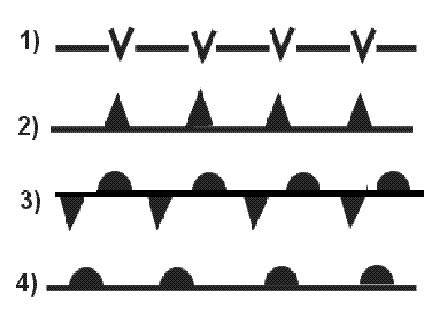
Question 271-10 : The correct sequence of cross sections representing propeller blade twist is err a 081 1283 ?
Sequence 2.
Img com encom080 16658jpgthe reason a propeller is 'twisted' is that the outer parts of the propeller blades like all things that turn about a central point travel faster than the portions near the hubSequence 3. sequence 4. sequence 1.
Question 271-11 : An aeroplane is in a level turn at a constant tas of 300 kt and a bank angle of 45° its turning radius is given g= 10 ms² ?
2381 metres.
Radius m = v² ms gtan bank angle 300 kt = 15433 ms1543² = 2381877radius m = 2381877 10 x tan 45°radius = 2381877 m4743 metres. 9000 metres. 3354 metres.
Question 271-12 : By what percentage does the lift increase in a level turn at 45° angle of bank compared with straight and level flight ?
41%.
Load factor = 1 cos bank angleload factor = 1 cos45°load factor = 141compared with straight and level flight your load factor increases by 141 or 41% thus you must increase lift by 41% to counteract and stay in level19%. 31%. 52%.
Question 271-13 : In a steady level co ordinated turn the load factor n and the stall speed vs will be ?
N greater than 1 vs higher than in straight and level flight.
N smaller than 1, vs lower than in straight and level flight. n greater than 1, vs lower than in straight and level flight. n smaller than 1, vs higher than in straight and level flight.
Question 271-14 : Two identical aircraft a and b with the same mass are flying steady level co ordinated 20 degree bank turns if the tas of a is 130 kt and that of b is 200 kt ?
The rate of turn of a is greater than that of b.
com encom080 222jpgv in ms aircraft a radius = 65² 10 x tan 20 = 1160 maircraft b radius = 100² 10 x tan 20 = 2747 maircraft a rate of turn = 65 20 x 314 x 1160 = 89° aircraft b rate of turn = 100 20 x 314 x 2747 = 58° notice tas in nm can be divided by 2 to get an approximate speed in meters per second 130 kt 2 = approximately 65 ms The load factor of a is greater than that of b. the turn radius of a is greater than that of b. the lift coefficient of a is less than that of b.
Question 271-15 : The bank angle in a rate one turn depends on ?
Tas.
Rule of thumb angle of bank rate 1 at tas 120 kt = 120 + 1202 = 18°Weight. load factor. wind.
Question 271-16 : The stall speed in a 60° banked turn increases by the following factor ?
141.
1 square root cos 60 = 1411.07. 1.30. 2.00.
Question 271-17 : If an aeroplane carries out a descent at 160 kt ias and 1000 ftmin vertical speed ?
Weight is greater than lift.
Lift is equal to weight. lift is less than drag. drag is less than the combined forces that move the aeroplane forward.
Question 271-18 : What is the approximate value of the lift of an aeroplane at a gross weight of 50000 n in a horizontal co ordinated 45 degrees banked turn ?
70000 n.
Lift = weight cos bank anglelift = 50000 cos 45 = 70710 n bjacoby it is nearer to 80000 than 70000 no it is nearer to 71000 than 8000060000 n. 50000 n. 80000 n.
Question 271-19 : Assuming zero thrust the point on the diagram corresponding to the value for minimum sink rate is err a 081 323 ?
Point c.
com encom080 323jpgPoint d point a point b
Question 271-20 : Assuming zero thrust the point on the diagram corresponding to the minimum glide angle is err a 081 324 ?
Point b.
com encom080 323jpgPoint a point c point d
Question 271-21 : Which point in the diagram gives the lowest speed in horizontal flight err a 081 325 ?
Point d.
com encom080 323jpgPoint c point b point a
Question 271-22 : What is the correct relationship between the true airspeed for i minimum sink rate and ii minimum glide angle at a given altitude ?
I is less than ii .
The minimum sink rate speed is vmp velocity for minimum power the minimum glide angle occurs at vmd velocity for minimum drag 1135vmp is a lower speed than vmd minimum sink rate is less than minimum glide angle (i) is equal to (ii). (i) is greater than (ii). (i) can be geater than or less than (ii) depending on the type of aeroplane.
Question 271-23 : Why is vmcg determined with the nosewheel steering disconnected ?
Because the value of vmcg must also be applicable on wet andor slippery runways.
Vmcg the minimum control speed on the ground is the calibrated airspeed during the take off run at which when the critical engine is suddenly made inoperative it is possible to maintain control of the aeroplane using the rudder control alone without the use of nosewheel steering as limited by 667 n of force 150 lbf and the lateral control to the extent of keeping the wings level to enable the take off to be safely continued using normal piloting skillthe nosewheel steering is disconnected because the value of vmcg must also be applicable on wet andor slippery runwaysin the determination of vmcg assuming that the path of the aeroplane accelerating with all engines operating is along the centreline of the runway its path from the point at which the critical engine is made inoperative to the point at which recovery to a direction parallel to the centreline is completed may not deviate more than 91 m 30 ft laterally from the centreline at any pointBecause it must be possible to abort the take-off even after the nosewheel has already been lifted off the ground. because nosewheel steering has no effect on the value of vmcg. because the nosewheel steering could become inoperative after an engine has failed.
Question 271-24 : By what approximate percentage will the stall speed increase in a horizontal co ordinated turn with a bank angle of 45° ?
19%.
The stalling speed of an airplane increases as the angle of bank increasesload factor in a turn is 1cos bank angleload factor is 1cos45° = 10707 = 1414stall speed increases with the square root of the load factor square root 1414 = 1189example your aircraft has a stall speed of 100 kt in straight and level flight it will stall at 100 kt x 1189 = 1189 kt in a horizontal co ordinated turn with a bank angle of 45°thus we can say that stall speed has gone up by 19%31%. 41%. 52%.
Question 271-25 : An aeroplane has a stall speed of 100 kt when the aeroplane is flying a level co ordinated turn with a load factor of 15 the stall speed is ?
122 kt.
Stall speed increases with the square root of the load factor vs = 100 kt x square root 15vs = 100 kt x 122vs = 122 kt141 kt. 82 kt. 150 kt.
Question 271-26 : An aeroplane has a stall speed of 100 kt at a load factor n=1 in a turn with a load factor of n=2 the stall speed is ?
141 kt.
Stall speed increases with the square root of the load factor vs = 100 kt x square root 2vs = 100 kt x 141vs = 141 kt282 kt. 70 kt. 200 kt.
Question 271-27 : How does vmcg change with increasing field elevation and temperature ?
Decreases because the engine thrust decreases.
If conditions are hot high and humid the air is less dense this reduces thrust and means when you lose the critical engine on takeoff there is less yawing effect from asymmetric thrust than there would be in denser airvmcg concerns the calibrated airspeed for minimum control on the ground ie using primary aerodynamic controls only to correct the yawing tendency we know that flying surfaces are more effective the faster air flows over them so if the yaw is less pronounced the required airspeed for counteracting it need not be so highas elevation and temperature increase hot high and humid vmcg decreases increases because at a lower density a larger ias is necessary to generate the required rudder force is incorrect because at high altitudes versus low altitudes you fly at the same ias for same amount of lift only tas changes with air density increases because vmcg is related to v1 and vr and those speeds increase if the density decreases is incorrect because vmcg will determine v1 decreases because vmcg is expressed in ias which decreases with constant tas and decreasing density is incorrect because the ias is not decreasing at constant tas and decreasing air density suppose unlimited engine power Decreases, because vmcg is expressed in ias which decreases with constant tas and decreasing density. increases, because at a lower density a larger ias is necessary to generate the required rudder force. increases, because vmcg is related to v1 and vr and those speeds increase if the density decreases.
Question 271-28 : The lift coefficient cl of an aeroplane in steady horizontal flight is 042 an increase in angle of attack of 1 degree increases cl by 01 a vertical up gust instantly changes the angle of attack by 3 degrees the load factor will be ?
171.
1° => 013° => 03 042 + 03 042 = 1710.74 1.49 2.49
Question 271-29 : When an aeroplane performs a straight steady climb with a 20% climb gradient the load factor is equal to ?
098.
Climb gradient% = climb gradient° 06climb gradient° = climb gradient% x 06it works for small angles only here is the exact formula tan alpha = 20 100 = 02alpha = cotan 02alpha = 11309°angle of climb = 20% = 1131°n load factor = lift x cos1131 massassuming mass = lift in level flight = 1lift = mass ==> n = cos1131n = 0981.02. 1 0.83.
Question 271-30 : What is the approximate diameter of a steady level co ordinated turn with a bank angle of 30 degrees and a speed tas of 500 kt ?
23 km.
Radius = tas² g x tan bank angle tas in ms1 kt = 0515 ms500 kt = 2575 msradius = 2575² 10 x tan30° radius = 66306 5773 = 11484 mdiameter = 2 x 11484 = 22968 m 22968 km 17 km. 13 km. 7 km.
Question 271-31 : Which of the following statements is correct i vmcl is the minimum control speed in the landing configurationii the speed vmcl can be limited by the available maximum roll rate ?
I is correct ii is correct.
Vmcl is the minimum ias at which directional control can be maintained with the aircraft in the landing configuration but with the added ability of being able to roll the aircraft from an initial condition of steady flight through an angle of 20 degrees in the direction necessary to initiate a turn away from the inoperative engine s in not more than 5 secondsI is incorrect, ii is incorrect. i is correct, ii is incorrect. i is incorrect, ii is correct.
Question 271-32 : Which statement is correct about an aeroplane that has experienced a left engine failure and continues afterwards in straight and level cruise flight with wings level ?
Turn indicator neutral slip indicator neutral.
2385 turn and slip indicator the wings and therefore the instrument and the central portion of the tube are levelthe aircraft is not accelerating laterally so the tube isn't being snatched away sidewayds leaving the ball deflected by lagging behindthe balls weight is acting towards the earth as per usual and is opposed by the ball being held up by the bottom edge of the central part of the tube again no unbalanced forcesso there is no mechanism to cause the ball to be deflected so it isn'tTurn indicator neutral, slip indicator left of neutral. turn indicator left of neutral, slip indicator left of neutral. turn indicator left of neutral, slip indicator neutral.
Question 271-33 : Which statement about minimum control speed is correct ?
Vmca depends on the airport density altitude and the location of the engine on the aeroplane aft fuselage or wing .
cs 25 e vmcg the minimum control speed on the ground is the calibrated airspeed during the take off run at which when the critical engine is suddenly made inoperative it is possible to maintain control of the aeroplane using the rudder control alone without the use of nosewheel steering as limited by 667 n of force 150 lbf and the lateral control to the extent of keeping the wings level to enable the take off to be safely continued using normal piloting skill in the determination of vmcg assuming that the path of the aeroplane accelerating with all engines operating is along the centreline of the runway its path from the point at which the critical engine is made inoperative to the point at which recovery to a direction parallel to the centreline is completed may not deviate more than 91 m 30 ft laterally from the centreline at any point vmcg must be established with 1 the aeroplane in each take off configuration or at the option of the applicant in the most critical take off configuration 2 maximum available take off power or thrust on the operating engines 3 the most unfavourable centre of gravity 4 the aeroplane trimmed for take off and5 the most unfavourable weight in the range of take off weightsThe nose wheel steering control may used to determine vmcg. crosswind is taken into account to determine vmcg. vmcl is determined by maximum rudder only.
Question 271-34 : Which of the following statements is correct i when the critical engine fails during take off the speed vmcl can be limitingii the speed vmcl is always limited by maximum rudder deflection ?
I is incorrect ii is incorrect.
I when the critical engine fails during take off the speed vmcl can be limiting incorrect vmcl does not apply to take offvmcl is the minimum control speed during landingapproach with all engines operating it is the calibrated airspeed at which when the critical engine is suddenly made inoperative it is possible to maintain control of the airplane with that engine still inoperative and maintain straight flight with an angle of bank of not more than 5 degreesii the speed vmcl is always limited by maximum rudder deflection incorrect vmcl can be limited by maximum rudder deflection in order to maintain control of the airplane with critical engine fails and maintain straight flight with an angle of bank of not more than 5 degrees but this is not always the caseI is correct, ii is correct. i is correct, ii is incorrect. i is incorrect, ii is correct.
Question 271-35 : Given an initial condition in straight and level flight with a speed of 14 vs the maximum bank angle attainable without stalling in a steady coordinated turn whilst maintaining speed and altitude is approximately ?
60°.
Stalling speed vs in a steady coordinated turn = stalling speed vs in level flight x squared root of load factorload factor = 1cos bank angleload factor = 141 ² = 196bank angle = cos^ 1 1196 bank angle = cos^ 1 051 = 5933°the question states approximately so answer 60° is the right oneexample stall speed in straight and level flight is 100 kt we are at 140 kt 14 vs whilst maintaining speed and altitude we can turn until a bank angle of 60° approximately without stalling44°. 32°. 30°.
Question 271-36 : Given aeroplane mass 50 000kgliftdrag ratio 12thrust per engine 28 000nassumed g 10ms²for a straight steady wings level climb of a four engine aeroplane the one engine inoperative climb gradient is ?
85%.
Weight = 50000 x 10 = 500000 newtonstotal thrust only 3 engines = 3 x 28000 n = 84000 nclimb gradient % = 100 total thrustweight 1 liftdrag ratio climb gradient % = 100 84000n500000n 112 climb gradient % = 100 0168 008333 climb gradient % = 100 x 0084667 = 84667%8.0%. 9.7%. 2.9%.
Question 271-37 : During a steady horizontal turn the stall speed ?
Increases with the square root of the load factor.
Increases linearly with the load factor. increases inversely with the load factor. increases with the square of the load factor.
Question 271-38 : For shallow climb angles the following formula can be used gamma = climb angle ?
Sin gamma = tw cdcl.
This formula for small angles and for simple calculations gives the relationship between flight path angle thrust weight drag and liftsin gamma = thrust drag weightorsin gamma = thrust weigth drag weightfor small climb angles lift equals weight the formula can be written as sin gamma = thrust weigth drag liftorsin gamma = thrustweigth cdclSin gamma = w/t - cd/cl. sin gamma = w/t - cl/cd. sin gamma = t/w - cl/cd.
Question 271-39 : For a given aeroplane which two main variables determine the value of vmcg ?
Airport elevation and temperature.
The vmcg is calculated at full rudder deflection this is not a variable but a fact airport elevation and temperature the two variables which determine the value of vmcg the vmcg speed is calculated at the maximum thrust available this is a predetermined parameter Engine thrust and rudder deflection. air density and runway length. engine thrust and gear position.
Question 271-40 : Given aeroplane mass 50 000 kgliftdrag ratio 10thrust per engine 60 000nassumed g 10ms²for a straight steady wings level climb of a twin engine aeroplane the all engines climb gradient is ?
14%.
Aerazur 50000kg = 500000 n500000n 10 = 50000 with 10 the liftdrag ratio airplane thrust = 2 x 60000n = 120000n 120000 50000 500000 x 100 = 14%3.7%. 15.7%. 11.7%.
Exclusive rights reserved. Reproduction prohibited under penalty of prosecution.