A free Premium account on the FCL.055 website! Read here
Sign up to unlock all our services and 15164 corrected and explained questions.
Question 273-1 : Given aeroplane mass 50 000kgliftdrag ratio 12thrust per engine 28 000nassumed g 10ms²for a straight steady wings level climb of a three engine aeroplane the one engine inoperative climb gradient is ? [ Analysis topography ]
29%
Question 273-2 : Given aeroplane mass 50 000kgliftdrag ratio 10thrust per engine 30 000nassumed g 10ms²for a straight steady wings level climb of a three engine aeroplane the all engines climb gradient is ?
80%.
Climb gradient = thrust drag weight x 100liftdrag ratio 10 > when lift is 1 drag is 01total trust = 3 x 30000 n = 90000 nweight = 50000 kg x 10ms² = 500 000 nlift = 500000 x 1 = 500000 ndrag = 500000 x 01 = 50000 nclimb gradient = 90000 50000 500000 x 100climb gradient = 8%9.7%. 2.9%. 8.5%.
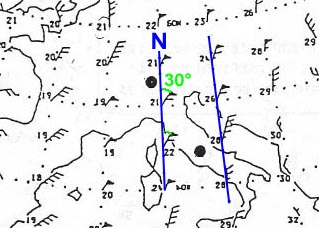
Question 273-3 : What is the heading change after 10 seconds of an aeroplane performing a rate one turn ?
30 degrees.
A standard rate turn is defined as a 3° per second turn which completes a 360° turn in 2 minutes this is known as a 2 minute turn or rate one = 180°minute 10 secondes x 3°sec = 30 degrees90 degrees. 180 degrees. 10 degrees.
Question 273-4 : An aeroplane has a stall speed of 78 kt at its mass of 6850 kg what is the stall speed when the mass is 5000 kg ?
67 kt.
Change in mass ratio = new mass old mass = 50006850 = 073stall speed of an aircraft changes in proportion to the square root of the change in mass square root of 073 = 0855original stall speed = 78 ktstall speed for a weight of 5000 kg ==> 78 x 0855 = 67 kt91 kt. 78 kt. 57 kt.
Question 273-5 : In order to fly a rate one turn at a higher airspeed the bank angle must be ?
Increased and the turn radius will increase.
A standard rate turn is defined as a 3° per second turn which completes a 360° turn in 2 minutes this is known as a 2 minute turn or rate one = 180°minute turn radius = tas² ms gtan bank angle rate of turn = tas kt 20 x 314 x turn radius in order to maintain a 3° per second turn at a higher speed you must increase the bank angle your turn radius will increaseDecreased and the turn radius will increase. increased and the turn radius will decrease. decreased and the turn radius will decrease.
Question 273-6 : Which of these statements about vmcg determination are correct or incorrect i during vmcg determination nose wheel steering may be usedii during vmcg determination the cg should be on the forward limit ?
I is incorrect ii is incorrect.
Vmcg the minimum control speed on the ground is the calibrated airspeed during the take off run at which when the critical engine is suddenly made inoperative it is possible to maintain control of the aeroplane using the rudder control alone without the use of nosewheel steering as limited by 667 n of force 150 lbf and the lateral control to the extent of keeping the wings level to enable the take off to be safely continued using normal piloting skillthe nosewheel steering is disconnected because the value of vmcg must also be applicable on wet andor slippery runwaysin the determination of vmcg assuming that the path of the aeroplane accelerating with all engines operating is along the centreline of the runway its path from the point at which the critical engine is made inoperative to the point at which recovery to a direction parallel to the centreline is completed may not deviate more than 91 m 30 ft laterally from the centreline at any pointvmc must be established with the most unfavourable centre of gravity at take off the cg should be on the aft limitI is correct, ii is correct. i is correct, ii is incorrect. i is incorrect, ii is correct.
Question 273-7 : An aeroplane maintains straight and level flight at a speed of 2 * vs if a vertical gust causes a load factor of 2 the load factor n caused by the same gust at a speed of 13 vs would be ?
N = 165.
1 x 132 = 065 g065g + 1g = 165g in straight and level flight load factor is 1g N = 1.69. n = 4. n = 1.3.
Question 273-8 : When is a turn co ordinated ?
When the longitudinal axis of the aeroplane at the cg is tangential to the flight path.
If no aileron deflection is required during the turn. if no rudder deflection is required during the turn. when only minor elevator pull force is required.
Question 273-9 : An aeroplane flying at 100 kt in straight and level flight is subjected to a disturbance that suddenly increases the speed by 20 kt assuming the angle of attack remains constant the load factor will initially ?
Increase to 144.
Load factor is proportional to lift and lift is proportional to v²new load factor old load factor = new speed old speed ²new load factor = old load factor x 120 100 ² = 1 x 12² = 144Increase to 1.21. remain unchanged, since the angle of attack does not change. increase to 1.10.
Question 273-10 : Regarding the lift formula if airspeed doubles lift will ?
Be 4 times greater.
Not change. halve. also double.
Question 273-11 : Whilst maintaining straight and level flight with a lift coefficient cl = 1 what will be the new approximate value of cl after the speed is increased by 30% ?
060.
Aircraft is maintaining level flight only the speed will change by 30% lift will not change lift = cl 12rho v² s rho = density v was 1 now v is 130lift = cl 12rho 130² slift = cl 12rho 169 sin order to maintain lift to its original value when v was 1 we can only divide cl by 169 surface and 12rho can't be changed cl was 1 now cl = 1169 = 05917 approximate value 060 0.50. 0.30. 0.25.
Question 273-12 : The centre of pressure is the point ?
On the chord line of an aerofoil section through which the resultant of the lift forces acts.
The centre of pressure moves with the angle of attack 669At which the extended rotor axis intersects the plane of rotation. of maximum pressure on the under surface of the aerofoil. through which the four forces acting on a helicopter act.
Question 273-13 : The angle of attack of an aerofoil is the angle between the ?
Chord line and the relative airflow.
Bottom surface of the aerofoil and the relative airflow. of maximum pressure on the under surface of the aerofoil. through which the four forces acting on a helicopter act.
Question 273-14 : The forward speed of helicopters is limited by ?
Retreating blade stall and advancing blade tip speed.
Induced power. the effect of main rotor torque exceeding the capabilities of the tail rotor. flap back limitations.
Question 273-15 : Reverse airflow over part of the rotor is associated with ?
Flight at high forward speed.
Question 273-16 : In forward flight if the rotor rpm increase above that specified ?
The large centrifugal forces impose severe and possibly excessive loads on the hub.
The resultant increase in blade drag will automatically cause the rpm to decay to their original level. the increase in centrifugal force will decrease blade coning and reduce rpm to their original level. it will induce retreating blade stall at a reduced forward speed.
Question 273-17 : In the case of a symmetrical aerofoil ?
Pitching moment variations due to centre of pressure movement are small.
Induced drag will not be generated at any angle of attack due to the symmetrical pressure distribution. there is no downwash at any angle of attack. its characteristics make it totally unsuitable for main rotor applications although it is frequently used for tail rotors.
Question 273-18 : In still air hover ground cushion is normally of practical value up to a rotor height above ground ?
Equal to the diameter of the main rotor.
Question 273-19 : A 'vortex ring state' ?
Encountered when descending with power causes an even higher rate of descent.
Question 273-20 : During autorotative descent main rotor rpm are maintained by ?
The lift force created by the upflow of air.
Form drag acting as torque after the reversal of air upwards. the inertia of the rotor head and blades. coanda effect of air flowing round the descending fuselage.
Question 273-21 : In hovering for a single rotor helicopter whose main rotor turns clockwise from above the thrust of the main rotor will be mainly vertical but with a slight orientation towards the ?
Right.
Left. right or the left according to side balance. front or back of the machine according to longitudinal balance.
Question 273-22 : The center of the pressure of a symmetrical aerofoil section is behind the leading edge approximately at the following % of the section chord at ?
25%.
Question 273-23 : The forces acting on a symmetrical aerofoil element when the upstream airflow is parallel to the chordline is ?
Only drag.
Only lift. zero. lift and drag are at a ratio 2/3
Question 273-24 : Thicknesschord ratio of an aerofoil section is expressed in percentage of ?
Chord.
Thickness. blade surface. wingspan.
Question 273-25 : The center of pressure of an aerofoil element ?
Is the point where the resultant aerodynamic force is applied.
Question 273-26 : The blades of a rotor are in track an upward bent outboard trim tab of one of one of the blades influences the rotor blade in rotation as follows ?
The blade rotates above the plane of rotation with neutral trim tab position.
Bending the tab up on the trailing edge of the blade would tend to increase pitch angle the track of the blade would be higher 1628Blade track is not influenced. the blade rotates below the plane of rotation with neutral trim tab position. produces a wave-like movement of the blade.
Question 273-27 : The formula take off massrotor disc area is used to calculate ?
Rotor disc loading.
Disc area density power ratio kw to m². the coning angle.
Question 273-28 : The angle of attack is the angle determined by ?
The chord line and the relative airflow.
The rotor speed plus the speed of the helicopter. the rotor speed and the inclination of the reference plane. the aerofoil chord and the shaft axis.
Question 273-29 : The coning angle of a fully articulated rotor is defined by ?
Lift centrifugal force and weight of the blade.
Take-off mass thrust, take-off mass and rotational speed. relative wind and centrifugal forces.
Question 273-30 : The resulting rolling moment on the main rotor hub due to the asymmetrical airflow on the blades in forward flight is reduced by ?
Blade flapping.
Rotor blade lead-lag blade twist counter-action by cockpit crew
Question 273-31 : For an autogyro the power from engines provided to the rotor is ?
Nil.
Equal to 30% of the total power provided by the engines equal to 70% of the total power provided by the engines equal to 85% of the total power provided by the engines
Question 273-32 : In an autogyro the lift force comes from ?
The forward movement.
The engine power to the rotor the propeller slipstream passing over the wing the propeller slipstream turning the rotor
Question 273-33 : On an autogyro the engine power output is used ?
To ensure forward motion.
For the lift of the machine to ensure forward motion and for the lift of the machine to make the rotor turn
Question 273-34 : An anti torque rotor is necessary on ?
A single rotor helicopter.
An autogyro a synchropter a dual-rotor helicopter
Question 273-35 : The rotor thrust is always ?
Perpendicular to the tip path plane.
Parallel with the main rotor shaft perpendicular to the hub plane perpendicular to the plane which contains the swash plate
Question 273-36 : On an articulated rotor variations in attitude of the tip path plane are due to ?
Blades flapping angles.
Blades setting angles. collective pitch. blades angle of attack.
Question 273-37 : The rotation axis of the main rotor is always ?
Perpendicular to the hub plane.
The hub plane also called the reference plane is always 90° to the shaft axis it does not move and is not affected by different types rotor head 1610Perpendicular to the tip path plane. perpendicular to the plane of the swash plate. perpendicular to the virtual plane of rotation.
Question 273-38 : Helicopter rotor blades are designed with twist or taper to incorporate washout a design that ?
Ensures adequate lift distribution along the span of the blade.
Allows for acceleration or dragging of the blade at the root allows for the difference of pressure along the span of the blade provides the same angle of attack along the span of the blade
Question 273-39 : In autorotation the blades are free to rotate because ?
A freewheel unit disengages the rotor from the engine.
A clutch is fitted between the engine and the transmission a governor is fitted between the rotor and the engine of a descent airflow through the disc
Question 273-40 : The effect of ground cushion on a hovering helicopter is greatest on ?
Level ground with no wind.
Level ground with a strong wind sloping ground with an upslope wind sloping ground with no wind
Exclusive rights reserved. Reproduction prohibited under penalty of prosecution.