A free Premium account on the FCL.055 website! Read here
Sign up to unlock all our services and 15164 corrected and explained questions.
Question 79-1 : The maximum zero fuel mass is a mass limitation for the ? [ Attainment AIM ]
Strength of the wing root
Question 79-2 : In order to provide an adequate stall margin in level flight a speed of 13vs is used at a mass of 120000 kg this is a cas of 180 kt if the mass of the aeroplane is increased to 135000 kg the value of 13vs will be ?
Increased to 191 kt drag will increase and air distance per kg of fuel will decrease.
135000120000 = 1125180 x square root of 1125 = 191 ktif speed increases drag increases thus for a same unit of fuel the air distance will be lesserUnaffected as vs always occurs at the same angle of attack. increased to 191 kt, drag will decrease and air distance per kg of fuel will increase. increased to 202 kt but, since the same angle of attack is used, drag and range will remain the same.
Question 79-3 : What are the effects of a cg in front of the forward limit range ?
And absolute ceiling decrease.
A forward cg means that the pitch down moment is high the elevator must provide a moment opposing this pitch down moment adding a high downward force to the weight of the aircraft which is then increased therefore the climb performance and ceiling will be decreased the increased drag of the elevator will cause a higher fuel consumption for a given airspeed thus decreasing range and enduranceAnd absolute ceiling increase. increases and absolute ceiling decreases. decreases and absolute ceiling increases.
Question 79-4 : The centre of gravity of an aircraft ?
Can be allowed to move between defined limits.
Centre of gravity cg is that point through which the force of gravity is said to act on a mass and always acts parallel to the gravity vectorIs in a fixed position and is unaffected by aircraft loading. must be maintained in a fixed position by careful distribution of the load. may only be moved if permitted by the regulating authority and endorsed in the aircraft's certificate of airworthiness.
Question 79-5 : Which statement regarding the relationship between traffic load and range is correct ?
The traffic load can be limited by the desired range.
Traffic load might be exchanged for fuel to extend rangeThe maximum traffic load is not limited by the reserve fuel quantity. the maximum landing mass is basically equal to the maximum zero fuel mass. the maximum zero fuel mass limits the maximum quantity of fuel.
Question 79-6 : The term useful load as applied to an aircraft includes ?
Traffic load and usable fuel only.
Pilot, operating items, passengers, baggage, cargo and usable fuel. the revenue-earning portion of load plus usable fuel. the revenue-earning portion of load only.
Question 79-7 : If other factors are unchanged the fuel mileage nautical miles per kg is ?
Lower with a forward centre of gravity position.
With a forward cg the aircraft is nose heavy it has a nose down moment thus the downforce on the tail on a steady flight must be increasedthe total aircraft weight increases and therefore more weight = more drag = more powerthe fuel mileage nautical miles per kg is lower with a forward centre of gravity positionexample with a aft cg fuel mileage = 10 nm for 100 kg with a forward cg fuel mileage = only 8 nm for 100 kgIndependent from the centre of gravity position. higher with a forward centre of gravity position. lower with an aft centre of gravity position.
Question 79-8 : The stalling speed of an aeroplane will be highest when it is loaded with a ?
High gross mass and forward centre of gravity.
A forward cg requires more lift and generates more drag the stalling speed will be greater than with an aft cgalso for a higher gross mass it is mandatory to generates more lift which generates more induced drag the stalling speed increasesLow gross mass and forward centre of gravity. high gross mass and aft centre of gravity. low gross mass and aft centre of gravity.
Question 79-9 : With the centre of gravity on the forward limit which of the following is to be expected ?
A decrease in range.
The most forward the cg is the more down force the tail needs to generate to compensate and keep the airplane from pitching down this increased down force must be counteracted by increased lift from the wing that of course means an increase in angle of attack or airspeed = the stall speed increases = consumption increases = range decreasesA decrease in the landing speed. a decrease of the stalling speed. a tendency to pitch-up on take-off.
Question 79-10 : If the centre of gravity of an aeroplane moves forward during flight the elevator control will become ?
Heavier making the aeroplane more difficult to manoeuvre in pitch.
When the centre of gravity moves forward during flight the aeroplane will be more stable but requires more forces to change pitch elevator control will become heavier Lighter making the aeroplane more difficult to manoeuvre in pitch. heavier making the aeroplane more easy to manoeuvre in pitch. lighter making the aeroplane more easy to manoeuvre in pitch.
Question 79-11 : The determination of the centre of gravity in relation to the mean aerodynamic chord consists of defining the centre of gravity longitudinally in relation to the ?
Length of the mean aerodynamic chord and the leading edge.
Longitudinal cg location is normally expressed as a percentage of the mean aerodynamic chord mac from its leading edgeLength of the mean aerodynamic chord and the trailing edge. position of the aerodynamic convergence point. position of the aerodynamic centre of pressure.
Question 79-12 : The maximum zero fuel mass ?
Is calculated for a maximum load factor of +25 g.
Is calculated for a maximum load factor of +3.5 g. can be increased by stiffening the wing. imposes fuel dumping from the outer wings tank first.
Question 79-13 : When has the centre of gravity to be computed ?
Prior to every flight.
At least every four years. during every yearly inspection. after every 400 hours inspection.
Question 79-14 : What is a possible consequence of loading an aircraft incorrectly so that the centre of gravity is positioned ahead of the forward limit ?
The aircraft becomes excessively stable and requires larger control inputs.
This question is asking about the effect on performance with a forward cg position with the increase in trim drag and the extra main wing lift required as shown in the figure the effects include higher stalling speed increased fuel consumption reduced range and endurance reduced climb performance increased stability increase in take off and landing speedslooking at the answers the aircraft may become excessively manoeuvrable and beyond control > incorrect with a forward cg the aircraft becomes very stable as the tail plane has a long arm to the cg this makes the aircraft hard to control and manoeuvre the aircraft becomes excessively stable and requires larger control inputs > correct the tail plane has a long arm to the cg and becomes very stable and heavy on the controls there may be insufficient forward pitch control available to keep the aircraft level > incorrect with a forward cg the pilot will need to hold the nose up by applying back pressure to the control column and trimming forward pitch control will not be a problem there may be a tendency to over pitch the aircraft during the flare just before landing > incorrect with a forward cg the aircraft becomes nose heavy and the tendency would be to under pitch during the flareThe aircraft may become excessively manoeuvrable and beyond control. there may be insufficient forward pitch control available to keep the aircraft level. there may be a tendency to over-pitch the aircraft during the flare just before landing.
Question 79-15 : What happens when the centre of gravity cg is moved in a forward direction ?
A reduction in rate of climb capability.
When the center of gravity is moved to forward limit this gives us a pitch down moment this pitch down moment has to be corrected by an up deflection of the elevator to keep straight and level flight this up deflection increases the drag increasing drag reduces the endurancethe up deflection of the elevator which is used to compensate for the nose heavy moment is the same deflection we use to pitch up to increase the rate of climb when part of it is used already for compensation this result in reduction of climb capabilityA increase in rate of climb capability. a decrease in induced drag. a reduction in the specific fuel consumption.
Question 79-16 : What are the effects of a cg in front of the forward limit range… ?
And absolute ceiling decrease.
When the center of gravity is outside the forward limit this gives a pitch down moment this pitch down moment has to be corrected by an up deflection of the elevator to keep straight and level flight this increases the aircraft's weight by adding a high downward forceas a consequence climb performance and ceiling will be decreasedIncreases and absolute ceiling decreases. decreases and absolute ceiling increases. and absolute ceiling increase.
Question 79-17 : Which cg position is used when determining minimum control speeds in performance a cg… ?
At the aft limit.
Aft cg provides the shortest moment arm relative to the rudder this gives the least restoring moments with regard to maintaining directional control that make it favourable in determination of minimum control speedsAt the forward limit. mid of the aft and forward limits. at the average position.
Question 79-18 : Why is it important to have accurate information about the airplane mass and cg position during flight ?
Allow selection of the real optimum cruising flight level.
Looking at the answers 'allow airlines to better compute navigation and route charges' > incorrect knowledge of the aircraft's mass and cg position allows for performance planning in the vertical rather than horizontal'allow selection of the real optimum cruising flight level' > correct this will depend on the aircraft's weight cg position & air temperature and will vary as fuel is burnt'are only required for take off and landing to comply with load sheet requirements' > incorrect knowledge of the mass and cg of the aircraft are essential in flight for a number of reasons including selection of optimum flight levels diversion planning fuel management think a380 moving fuel from the tail tank in flight to control the cg position etc'are unimportant since all performance decisions are based on expected masses on the operational flight plan' > incorrect expected masses are used for planning only in flight any operational decision will be based on actual conditionsAllow airlines to better compute navigation and route charges. are only required for take-off and landing, to comply with loadsheet requirements. are unimportant since all performance decisions are based on expected masses on the operational flight plan.
Question 79-19 : What is the effect if the centre of gravity is behind the aft limit in level and forward flight ?
The stability is decreased.
This question is asking about the effect on performance with a rearwards cg position with the decrease in trim drag and also less main wing lift being required the effects include lower stalling speed decreased fuel consumption increased range and endurance increased climb performance decreased stability increased controllability decrease in take off and landing speedslooking at the answers the stability is increased > incorrect with an aft cg the tail has a shorter arm and so the aircraft is left stable the controllability is decreased > incorrect with an aft cg the short arm to the tail means less stability and so the aircraft is easier to control ie manoeuvre the control forces are increased > incorrect with an aft cg the short arm to the tail means less stability and so the control forces required reduce and the aircraft is easier to manouvre the stability is decreased > correct with an aft cg the tail has a shorter arm and is less effective stability reduces in all aspects as the tailplane and fin rudder act around the cgThe stability is increased. the control forces are increased. the controllability is decreased.
Question 79-20 : If the centre of gravity is outside the forward limit in level and forward flight the drag… ?
Increases and endurance decreases.
When the center of gravity is outside the forward limit this gives us a pitch down momentthis pitch down moment has to be corrected by up deflection of elevator to keep straight and level flightthis down deflection increase the drag increasing drag reduce the endurancecorrect answer drag increases endurance decreasesDecreases, and the range decreases. increases, and endurance increases. decreases, and the fuel consumption decreases.
Question 79-21 : A pilot has finished the pre planning shortly before departure an additional container with a mass of 3000 kg of traffic load is accepted the pilot forgets to calculate the new performance values of the aircraft take off and climb is accomplished without any problems how will the performance of the ?
Rate of climb and range will be decreased.
In this scenario the aircraft weighs 3000 kg more than planned despite a safe take off and climb the performance of the aircraft will be affected compared to the expected situation at the lighter weight the effects of a heavier aircraft include higher stalling speedincreased fuel consumptionreduced range and endurancereduced climb performance both rate & gradient of climblooking at the answers 'angle of climb and obstacle clearance will be improved' > incorrect both of these will reduce with the extra weight on board'fuel flow and endurance will be reduced' > incorrect endurance will reduce but the fuel flow will increase the extra weight will require more lift which creates more drag = more thrust = more fuel burn'rate of climb and range will be decreased' > correct as shown above'fuel flow and specific range will be increased' > incorrect fuel flow will increase but the range will reduce due to the extra weight being carried on boardAngle of climb and obstacle clearance will be improved. fuel flow and endurance will be reduced. fuel flow and specific range will be increased.
Question 79-22 : An additional baggage container is loaded into the aft cargo compartment but is not entered into the load and trim sheetthe aeroplane will be heavier than expected and calculated take off safety speeds… ?
Will give reduced safety margin.
Increasing the aircraft mass also affects most of the factors associated with the cg particularly fuel consumptiona and stalling speed an increase in weight requires increased lift more lift equals more drag and more drag means higher fuel consumption increasing mass also affects the stall speed vs which is roughly proportional to the square root of weightmany speeds used in performance calculations such as the rotate speed vr and the safety spped v2 are extracted through graphs and tables and are based on the stalling speed from which they differ by a standard safety margin according to the rules and regulations so they also increase as the aircraft weight increases so as to keep the safety margin constantin case an additional baggage container is loaded into the aft cargo compartment without being entered into the load and trim sheet then the vs will increase but the take off safety speeds will remain the same thus reducing their difference from the vs and as a result the safety margin will also reduceWill be greater than required are unaffected but v1 will be increased will not be achieved
Question 79-23 : What are the effects on stability and controllability of a cg behind the aft limit longitudinal stability… ?
Is reduced and controllability is increased.
This question is asking about the effect on performance with a rearwards cg position the cg is behind the aft limit which could lead to various issues but easa only want to know about the general effects of a rear cg with the decrease in trim drag and also less main wing lift being required the effects include lower stalling speed decreased fuel consumption increased range and endurance increased climb performance decreased stability increased manoeuvrability decrease in take off and landing speedsIs increased and controllability is reduced. and controllability are increased. and controllability are reduced.
Question 79-24 : If the aircraft was loaded with the centre of gravity in front of the forward cg limit counteracting the nose pitching down moment will lead to… ?
Increased drag.
When the center of gravity is outside the forward limit this gives us a pitch down momentthis pitch down moment has to be corrected by down deflection of elevator to keep straight and level flight this down deflection increase the drag increasing drag reduce the endurancecorrect answer increased dragIncreased manoeuvrability. a lower stalling speed. decreased required landing distances.
Question 79-25 : If the centre of gravity is further forward than the forward limit is the aircraft's horizontal surfaces have a… ?
Longer than usual moment arm and the fuel consumption is increased.
When the center of gravity is outside the forward limit this gives us a pitch down moment this pitch down moment has to be corrected by up deflection of elevator to keep straight and level flightthis up deflection increase the drag increasing drag reduce the endurance increase fuel consumption correct answer longer than usual moment arm and the fuel consumption is increasedLonger than usual moment arm and the fuel consumption is decreased. shorter than usual moment arm and the drag is decreased. shorter than usual moment arm and the range is increased.
Question 79-26 : Comparing a forward cg position with an aft one the forward cg position will cause a… ?
Decrease in range.
In the normal flight condition the main wing creates lift and the elevator creates drag due to a forward cg position more downward force drag is necessary at the elevator drag increases = range decreases = rate of climb capability decreasesDecrease of the stalling speed. tendency to yaw to the right on take-off. decrease in the landing speed.
Question 79-27 : Prior to departure an aircraft is loaded with 16 500 litres of fuel at a fuel density of 780 kgm3 this is entered into the load sheet as 16 500 kg and calculations are carried out accordingly as a result of this error the aircraft is… ?
Lighter than anticipated and the calculated safety speeds will be too high.
Fuel volume 16 500fuel density 780 kgm3fuel mass = 16 500 x 078 = 12 870 kgload entered in load sheet is higher than actual load of airplane airplane is lighter than anticipated and calculated safety speeds is too highHeavier than anticipated and the calculated safety speeds will be too high. heavier than anticipated and the calculated safety speeds will be too low. lighter than anticipated and the calculated safety speeds will be too low.
Question 79-28 : If during flight a considerable amount of fuel was transferred from a fuel tank located in the forward fuselage section to a fuel tank located at the rear section of the fuselage what effect would this have on the aircraft ?
Increase in range and decrease in stall speed.
The total mass of the aircraft can be said to act through one point called the centre of gravity cg and the total lift acts through the centre of pressure cp the position of the cp changes with speed and as alpha changes whilst the position of cg changes as load and fuel change when this happens new balancing forces and trim changes will be neededthe relative positions of the cg and cp affect the longitudinal stability of the aircraft in practice the cg is usually forward of the cp thus the more forward the cg the more stable the aircraft in pitch some stability in pitch is desirable but not too much because the extra down force on the elevator effectively adds to the aircraft weight and requires the lift to be increased to counter it more lift means more drag created by the trim trim drag and more drag means higher fuel consumptionaircraft manufacturers determine a safe range for the cg the aft limit is usually just in front of the centre of pressure but it provides less stability than that provided by the forward limit but a smaller balancing tail moment will be requiredfor this question if during flight a considerable amount of fuel was transferred from a fuel tank located in the forward fuselage section to a fuel tank located at the rear section of the fuselage the aircraft's cg will be repositioned aftto sum up an aft cg increases the rate of climb and the climb gradient decreases torr todr asdr thus mtom can be increased the stick forces required will be less rotation will be easier stall speed decreases which permits a higher ceiling altitude makes flare easier during landing thus decreasing ldr and increasing mlm range and endurance increase due to the decreased fuel consumptionIncrease in range and stall speed. increase in stability and trim drag. increase in stability and decrease in trim drag.
Question 79-29 : Which one of the following describes a possible handling and performance problem encountered with a cg too far aft ?
Degradation or loss of nose wheel steering.
The efficiency of the nose wheel steering will decrease for an aft centre of gravity because the weight on the nose wheel is also decreased it results in degradation or even loss of nose wheel steeringDecreased tendency to skid. improvement in nose-wheel steering. no likelihood of a nose-up overbalance (on a tricycle gear aircraft) on the ground resulting in tail damage.
Question 79-30 : Which statement is correct i stall speeds are determined with the cg at the forward limit ii minimum control speeds are determined with the cg at the aft limit ?
I is correct ii is correct.
In a question borrowed heavily from pof the main thing to remember is that we test these values in the worst case scenario in short stalls cg forward = aircraft is effectively heavier as the tailplane is generating down force to balance the aircraft minimum control speed cg aft = shortest arm for the rudder to work within more detail 1 stall speeds are determined with the least favourable cg position for an aircraft this is the most forward point because then the main wing will be producing the most lift with the cg furthest ahead of the centre of pressure the horizontal stabiliser will be producing a downwards force which the main wings will have to compensate for by producing more lift the main wings will therefore have to be at a higher angle of attack and therefore be closer to the stall hence the stall will occur at higher speeds with a forward cg then with a rearward cg2 minimum control speeds are also determined with the least favourable conditions when considering an engine failure we know that the aircraft will rotate around its cg but the distance of the moment doesn't change when it moves fore or aft the engines moment would only change when we move it along the lateral axis of the aircraft however the position of the cg will influence the rudder arm and hence the rudder moment a cg on the af limit will provide a small arm and therefore the least ability to oppose the yawing moment of the engine failureI is incorrect, ii is incorrect. i is correct, ii is incorrect. i is incorrect, ii is correct.
Question 79-31 : What are the possible consequences when loading an aircraft incorrectly so that its cg is positioned behind the aft limit ?
There may be insufficient forward pitch control available to keep the aircraft level in straight flight.
The relative positions of the centre of gravity cg and centre of pressure cp affect the longitudinal stability of the aircraft most transport aircraft will usually have their aft cg limit just forward of the cp because that provides to an aircraft pitch stabilityif the cp is aft of the cg the increased lift vector will tip the aircraft nose down which is a stable result as it tends to restore the original pitch attitude in this case the aircraft has positive longitudinal static stabilityif the cg is aft of the cp thus positioned behind the aft limit the increased lift will tip the aircraft nose up leading to higher angles of attack and even more lift until the aircraft stalls this is an unstable result a negative longitudinal static stability where the control forces will be light the aircraft will be excessively manoeuvrable leading to a possible over rotation on take off and a possible tail scrape and during landing over pitching may occur during the flare insufficient forward pitch control will be available to keep the aircraft level in straight flightThere may be insufficient aft pitch control available to keep the aircraft level in straight flight. the aircraft will be extremely stable. there may be an inability to flare the aircraft on landing.
Question 79-32 : Some aircraft are equipped with fuel trim tanks located in the aeroplane's fin or horizontal stabiliser to actively manage cg position which of the following is an advantage of having a trim tank in the horizontal stabiliser ?
It allows the crew to keep the cg at an aft position.
The fuel tanks will generally be located in the wings outer and inner and in a central position in the fuselage but they may also be found in the fin and the horizontal stabiliserthe centre of gravity cg position does change as fuel is burnt off but within defined limits if it is burnt from a tank aft of the aircraft's cg then the cg will move forward conversely if the fuel is burnt from a tank positioned forward of the cg then it will move aftover the years fuel tanks in the tail fin and horizontal stabiliser called as trim tanks have been employed by different manufacturers for two main reasons to provide extra fuel capacity to maintain the aircraft cg position at the optimum aft position for minimum drag improved manoeuvrability and as a consequence for maximum fuel economy as less downforce on the horizontal stabiliser is requiredthe fuel in these tanks may automatically drain as fuel is used from the centre and wing tanks or may be actively controlled by the crew through transfer systemsIt increases the structural mass. it decreases the maximum range. it increases the efficiency of the elevator during slow flight.
Question 79-33 : What will be the effect on the longitudinal static stability if the centre of gravity cg is located behind the aft cg limit ?
Stability decreases beyond acceptable limits.
The relative positions of the centre of gravity cg and centre of pressure cp affect the longitudinal stability of the aircraft most transport aircraft will usually have their aft cg limit just forward of the cp because that provides to an aircraft pitch stabilityif the cp is aft of the cg the increased lift vector will tip the aircraft nose down which is a stable result as it tends to restore the original pitch attitude in this case the aircraft has positive longitudinal static stabilityif the cg is aft of the cp thus positioned behind the aft limit the increased lift will tip the aircraft nose up leading to higher angles of attack and even more lift until the aircraft stalls this is an unstable result a negative longitudinal static stability where the control forces will be light the aircraft will be excessively controllable leading to a possible over rotation on take off and a possible tail scrape and during landing over pitching may occur during the flare insufficient forward longitudinal control will be available to keep the aircraft level in straight flightif the cg is too far aft the moment arm between it and the cp diminishes reducing the inherent stability of the airplane beyond acceptable limits and in the extreme going negative and rendering the airplane longitudinally unstablegenerally the less stable the aircraft the more controllable and vice versaLongitudinal stability is not related to the position of the cg. there is a significant increase in stability. the flight control forces increase.
Question 79-34 : On an aeroplane with a mass just below mzfm when is the wing load at its maximum ?
On landing.
The main loads on a wing are bending loads incorporating tension and compression both in flight and on the groundin flight the weight of the aircraft is supported by the lift of the wings on the ground by the landing gearalthough the normal loads tend to bend the wing upwards on landing and in turbulence the wing flexes downwards so the spar has to take bending loads in both directionstherefore the wing load is at a maximum at the wing root on landing and in turbulenceOn take-off. during cruise. at the brake release point.
Question 79-35 : What is a possible consequence of loading an aircraft incorrectly so that the centre of gravity is positioned ahead of the forward limit ?
There may be insufficient aft pitch control available to keep the aircraft level.
The aircraft can be considered to be nose heavy with a forward cg the pilot will need to pull the control column to keep the nose up if the cg moves too far forward the pilot can run out of aft pitch control and the nose will drop this question is asking about the effect on performance with a forward cg position with the increase in trim drag and the extra main wing lift required as shown in the figure the effects include higher stalling speed increased fuel consumption reduced range and endurance reduced climb performance increased stability increase in take off and landing speedsThe aircraft may become excessively manoeuvrable and beyond control. there may be a tendency to over-pitch the aircraft during the flare just before landing. there may be insufficient forward pitch control available to keep the aircraft level.
Question 79-36 : The performance limited take off mass pltom is defined as the ?
Take off mass subject to departure aerodrome limitations.
As quoted from cap 696 performance limited take off mass pltom is the take off mass subject to departure aerodrome limitationssuch factors include runway length terrain around the airport climb out requirements ambient conditions such as humidity and temperature etcnote do not confuse structural limits with performance limits in these definition questionsMaximum permissible mass of an aeroplane but excluding fuel. mass subject to the landing aerodrome limitations. maximum permissible total aeroplane mass at the start of the take-off run.
Question 79-37 : The performance limited landing mass is defined as… ?
The landing mass subjected to airport normal conditions.
The performance limited landing mass pllm is the mass subject to the landing aerodrome limitations also taking the current metrological conditions into account this limit is not a set figure and needs to be calculated for each sector if the pllm is exceeded the aircraft may overrun the landing distance available tyre temperature limits could be exceeded and a go around might not be achievablethe regulated landing mass rlm is the is the lowest of the performance limited landing mass and maximum structural limited landing mass the actual landing mass must not exceed this limitthe maximum structural landing mass mslm is the maximum permissible total aeroplane mass on landing in normal circumstances and given the most favourable conditions anywhere in the world it is a set structural limitation and does not change for a particular aircraft if the mslm is exceeded structural damage can occur to the aircraftThe lowest of the performance limited landing mass and maximum structural limited landing mass. the landing mass subjected to strength at the wing root. the maximum permissible mass of an aeroplane but excluding fuel.
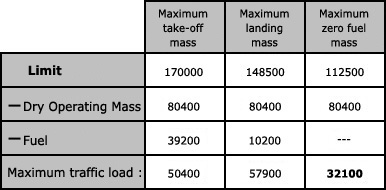
Question 79-38 : Given dry operating mass= 29 800 kgmaximum take off mass= 52 400 kgmaximum zero fuel mass= 43 100 kgmaximum landing mass= 46 700 kgtrip fuel= 4 000 kgfuel quantity at brakes release= 8 000 kgthe maximum traffic load is ?
12 900 kg.
Traffic load is the total mass of passengers baggage and cargo including any non revenue load 127the lowest mass is our limitation13 300 kg. 9 300 kg. 14 600 kg.
Question 79-39 : The take off mass of an aircraft is 117 000 kg comprising a traffic load of 18 000 kg and fuel of 46 000 kgwhat is the dry operating mass ?
53 000 kg.
Dry operating mass = the total mass of an aircraft ready for a specific type of operation excluding all usable fuel and traffic loadthis mass includes items suchas + crew and crew baggage+ catering and removable passenger service equipment food beverages potable water lavatory chemicals etc + special operational equipment eg stretchers rescue hoist cargo sling dry operating mass = take off mass traffic load fueldry operating mass = 117000 18000 46000 = 53000 kg71 000 kg. 99 000 kg. 64 000 kg.
Question 79-40 : The dry operating mass includes ?
Crew and crew baggage catering removable passenger service equipment potable water and lavatory chemicals.
Please download the following document used as a reference at the exam pdf031 mass definitionspdfUnusable fuel and reserve fuel. fuel and passengers baggage and cargo. passengers baggage and cargo.
Exclusive rights reserved. Reproduction prohibited under penalty of prosecution.