A free Premium account on the FCL.055 website! Read here
Sign up to unlock all our services and 15164 corrected and explained questions.
Question 87-1 : When an aircraft is stationary on the ground its total weight will act vertically ? [ Procedure Manual ]
Through its centre of gravity
Question 87-2 : The weight of an aircraft which is in level non accelerated flight is said to act ?
Vertically through the centre of gravity.
Centre of gravity cg is that point through which the force of gravity is said to act on a mass and always acts parallel to the gravity vectorVertically through the centre of pressure. vertically through the datum point. always along the vertical axis of the aircraft.
Question 87-3 : The distance from the datum to the centre of gravity of a mass is known as ?
The moment arm or balance arm.
Balance arm is the distance from the datum to the centre of gravity of a massThe index. the force. the moment.
Question 87-4 : During take off you notice that for a given elevator input the aeroplane rotates much more rapidly than expectedthis is an indication that ?
The centre of gravity may be towards the aft limit.
If a very small up deflection of the horizontal stabilizer generates a downward force on the tail sufficiently strong to raise the airplane nose this is an indication that the centre of gravity may be towards the aft limitThe aeroplane is overloaded. the centre of gravity is too far forward. the centre of pressure is aft of the centre of gravity.
Question 87-5 : The mass displacement caused by landing gear extension ?
Creates a longitudinal moment in the direction pitch up or pitch down determined by the type of landing gear.
The mass displacement caused by landing gear extension creates a longitudinal moment in the direction pitch up or pitch down determined by the type of landing gearCreates a pitch-up longitudinal moment. does not create a longitudinal moment. creates a pitch-down longitudinal moment.
Question 87-6 : The datum used for balance calculations is chosen on the longitudinal axis of the aircraft ?
But not necessarily between the nose and the tail of the aircraft.
And necessarily situated between the nose and the tail of the aircraft. between the leading edge and trailing edge of the wing, or at rotor mast for an helicopter. and always at the fire-wall level.
Question 87-7 : The centre of gravity is the ?
Point where all the aircraft mass is considered to be concentrated.
Centre of gravity cg is that point through which the force of gravity is said to act on a mass and always acts parallel to the gravity vectorCentre of thrust along the longitudinal axis, in relation to a datum line. focus along the longitudinal axis, in relation to a datum line. neutral point along the longitudinal axis, in relation to a datum line.
Question 87-8 : For the purpose of aeroplane mass and balance calculations the datum point is defined as ?
A fixed point from which all balance arms are measured it may be located anywhere on the aeroplane's longitudinal axis or on the extensions to that axis.
The datum point is the point on the aircraft designated by the manufacturer from which all centre of gravity measurements and calculations are made in most cases the datum is located in the vicinity of the aircraft nose usually the firewall it is not necessarily a point 'on' the aircraftThe point through which the sum of the mass values (of the aeroplane and its contents) is assumed to act vertically. a point near the centre of the aeroplane. it moves longitudinally as masses are added forward and aft of its location. a variable point, that is dependent on the load distribution for its location, from which all balance arms are measured.
Question 87-9 : In calculations with respect to the position of the centre of gravity a reference is made to a datum the datum is ?
A reference plane which is chosen by the aircraft manufacturer its position is given in the aircraft flight or loading manual.
The datum is that point on the longitudinal axis or extension thereof from which the centre of gravity of all masses are referenced its position is determined by the manufacturer and found in the loading manual and operating data manualCalculated from the loading manifest. an arbitrary reference chosen by the pilot which can be located anywhere on the aircraft. calculated from the data derived from the weighing procedure carried out on the aircraft after any major modification.
Question 87-10 : The mass of an item multiplied by it's distance from the datum is it's ?
Moment.
Arm moment arm is the horizontal distance in inches from the reference datum line to the center of gravity of an itemmoment is the product of the weight of an item multiplied by its arm moments are expressed in pound inches lb in total moment is the weight of the airplane multiplied by the distance between the datum and the cgCentre of gravity. moment arm. force.
Question 87-11 : The moment for an item is ?
The mass of the item multiplied by it's distance from the datum.
The moment is the product of the mass and the balance armThe mass of the item divided by it's distance from the datum. the distance the item is from the datum divided by it's mass. the square of the distance the item is from the datum divided by it's mass.
Question 87-12 : The reference about which centre of gravity moments are taken is the ?
Datum.
The datum is the point on the aircraft designated by the manufacturer from which all centre of gravity measurements and calculations are madeCentre of pressure. centre of mass. chord line.
Question 87-13 : The datum is a reference from which all moment balance arms are measured its precise position is given in the control and loading manual and it is located ?
At a convenient point which may not physically be on the aircraft.
At or near the forward limit of the centre of gravity. at or near the focal point of the aircraft axis system. at or near the natural balance point of the empty aircraft.
Question 87-14 : A load placed aft of the datum ?
Has a positive arm and therefore generates a positive moment.
Has a negative arm and therefore generates a negative moment and mass. has a negative arm and therefore generates a negative moment. has a positive arm and therefore generates a positive moment but negative mass.
Question 87-15 : A load placed forward of the datum ?
Has a negative arm and therefore generates a negative moment.
Question 87-16 : For the following see saw to be in balance 236 ?
Fb = a x fa b.
Fb x b = fa x atherefore fb = fa x a bFb = a + fa / b fb = a x b / fa fb = b x fa / a
Question 87-17 : For the following see saw to be in balance 237 ?
Fc = fa 3.
Fc x 3a = fa x athus fc = fa x a 3asimplification by a gives fc = fa 3Fc = 3fa fc = fa / 3a fc = 3 / fa
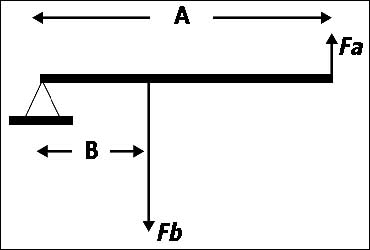
Question 87-18 : For the following boom to be in balance 238 ?
B = fa x a fb.
Fb x b = fa x atherefore b = fa x a fbB = fb x a / fa b = - (fa x a / fb) b = fb + a / fa
Question 87-19 : For the following boom to be in balance 239 ?
A = b x fb fa.
Fa x a = fb x btherefore a = fb x b faA = b + fb / fa a = b x fa / fb a = b ( fa + fb)
Question 87-20 : A tri wheel aircraft has its datum 25 inches aft of the nose wheel and 180 inches forward of the main wheelsif the nose jack shows 125 lb and each main wheel jack shows 3400 lb determine the bem and cg ?
6925 lbs and 2012 inches from the nose wheel of the aircraft.
25 x 125 = 3125180 x 2x3400 = 1224000total moment = 1224000+ 3125 = 1220875basic empty mass bem = 125 + 3400x2 = 6925 lbsthe cg will be total moment total mass = 12208756925= 1762 inches from the datumthe datum is located 25 inches aft of the nose wheel the cg is at 25 inches + 1762 = 2012 aft of the nose wheel6925 lbs and 176.3 inches from the nose wheel of the aircraft. 3525 lbs and 172.7 inches from the datum. 3525 lbs and 201.2 inches from the datum.
Question 87-21 : An aeroplane has a mac of 308 m and a leading edge mac lemac of 1472 m aft of datum if the cg position of that aeroplane is located 1613 m aft of datum what is the cg position in % mac ?
4578% mac.
Leading edge of mac from datum 1472 mmac length 308 mcg position 1613 from datumcenter of gravity is 141 m from the leading edge of maccg distance from leading edge = 1613 1472 = 141 mto know cg position % relative to mac = cg distance from leading edge mac lengthcg position % relative to mac = 141 308 = 4578 %correct answer 4578%52.03% mac 41.44% mac 32.16% mac
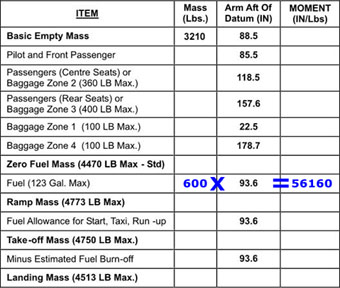
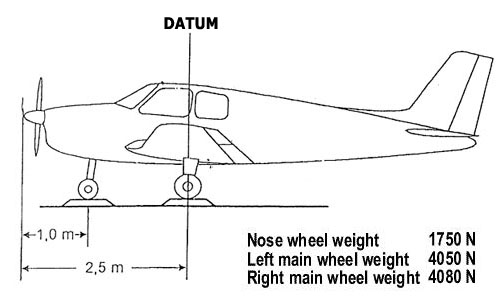
Question 87-22 : Calculate the basic empty mass and the centre of gravity item weight n arm cm moment nose wheel 1200 30 left main wheel 4100 210 right main wheel 4200 210 ?
9684 kg and 1797 cm.
Beware the trap the question gives us weight n but the answers use mass kg unless otherwise stated assume g = 981 ms2 in easa mass and balancenose wheel = 1200 n 981 = 122 kgleft main = 4100 n 981 = 418 kgright main = 4200 n 981 = 428 kgotherwise this question is testing your ability with mass x arm = momentstotal moments total mass = cg positionitemmass kg arm cm moments kgcm nose wheel122 30 3660left main41821087 780right main42821089 880total9681797174 000 total moments 174 000 total mass 968 = cg position 1797 cm9500 kg and 1 707 000 n.cm 968.4 kg and 1 707 000 n.cm 9500 kg and 179.7 cm
Question 87-23 : The loaded centre of gravity cg of an aeroplane is 713 mm aft of the datum the mean aerodynamic chord lies between station 524 mm aft and 1706 mm aftthe cg expressed as % mac mean aerodynamic chord is… ?
16%.
Mac length = 1706 524 = 1182 mmdistance between le and cg = 713 524 = 189 mmcg is 189 mm behind the le which is 189 1182 of the mac = 016 = 16% mac10%. 60%. 41%.
Question 87-24 : Calculate the centre of gravity in % mac mean aerodynamic chord with following data distance datum – centre of gravity 1253 mdistance datum – leading edge of the mac 963 mlength of mac 8 m ?
363% mac.
The %mac can be found if the length of the mac is known and how far back from the leading edge the cg iscg = 1253 mle mac = 963 mcg le mac = 1253 963 = 29 m% mac = 29 800 x 100 = 3625%63.4% mac 23.1% mac 47.0% mac
Question 87-25 : The centre of gravity of an aeroplane is at 25% of the mean aerodynamic chord this means that the centre of gravity of the aeroplane is situated at 25% of the length of… ?
The mean aerodynamic chord in relation to the leading edge.
Designers of straight winged aircraft usually express the centre of gravity cg as a distance relative to a datum or reference point those that design swept wing aircraft find it convenient for aerodynamic reasons to relate the longitudinal cg location with the mean aerodynamic chord mac of a wing the cg is expressed as a percentage of its position along the mac %mac from the leading edge also called lemacthe mean aerodynamic chord is the chord at the aerodynamic centre of the wing not exactly half way to the tip but close to it generally most swept wing aircraft will have acceptable handling characteristics if the cg is between 15% and 25% of the way back along the mac described as 15% to 25% macwhen the cg of an aeroplane is at 25% mac this means that the cg is situated at 25% of the length of the mac in relation to the lemac and is given from the formula %mac= cg lemac mac x 100The mean aerodynamic chord in relation to the trailing edge. the mean aerodynamic chord in relation to the datum. the aeroplane in relation to the leading edge.
Question 87-26 : An aeroplane with one nose landing gear and two main landing gears is weighed on jacks determine the aircraft bem and cg position using the following readouts nose landing gear located at 161 inches from datum reading 2300 kg each main landing gear located at 775 inches from datum reading 19 300 kg ?
40 900 kg and 7405 inches from datum.
Total mass of airplane = 2 x 19 300 + 2300= 40 900 kgmoment of airplane = 2300 x 161 + 2 x 19 300 x 775 = 30 285 300 kginchcg = moment masscg = 30 285 300 40 900 = 7405 inches aft of datum40 900 kg and 722.3 inches from datum. 21 600 kg and 0.71 inches from datum. 21 600 kg and 709.6 inches from datum.
Question 87-27 : A tri wheel aircraft has its datum 25 inches aft of the nose wheel and 180 inches forward of the main wheels if the nose jack shows 125 lb and each main wheel jack shows 3400 lb determine the bem and the cg position ?
6925 lb and 2013 inches from the nose wheel of the aircraft.
Total mass = 6925 lbs total moment = +1 220 875 lbin cg = momentmass => +1 220 8756925 = 176299 ins aft of the datumadd to this the distance of the nose wheel from the datum of 25 ins and we found answer of 201299 ins rounded to 2013 ins from the nose wheel6925 lb and 176.3 inches from the nose wheel of the aircraft. 3525 lb and 172.7 inches from the datum. 6925 lb and 177.2 inches from the datum.
Question 87-28 : Information about cg limits can be found… ?
In the aircraft flight manual.
An aircraft flight manual afm is a book containing the information required to safely operate the aircraft each afm is tailored for a specific aircraft though aircraft of the same make and model will naturally have very similar afmsthe information within an afm is also referred to a technical airworthiness data tawd a typical flight manual will contain the following operating limitations normalabnormalemergency operating procedures performance data and loading informationan afm will often include v speeds aircraft gross weight maximum ramp weight maximum takeoff weight manufacturer's empty weight operating empty weight center of gravity of an aircraft lift to drag ratio zero fuel weightcorrect answer in the aircraft flight manualIn the aircraft checklist. on the air operator certificate. in the aircraft's certificate of registration.
Question 87-29 : An aircraft with tricycle landing gear is weighed on jacks determine the bem and cg position aft of datum with the following data nose jack located at 161 in aft datum reads 6488 kgeach main wheel jack located at 775 in aft datum reads 17 783 kg ?
42 054 kg and 6803 in.
The moment is the turning force created around a datum by the mass over a distance or lever arm moment = mass x armmoments and arms forward of the datum are by convention negative and those aft of the datum are positivethe centre of gravity cg can be found by adding all the moments and then dividing by the total mass cg = total moment total massfor this question the following table would help itemmass kg arm in moment kgin nose wheel jack64881611 044 568left main wheel jack17 78377513 781 825right main wheel jack17 78377513 781 825bem42 054 kgcg = 6803 in28 608 218therefore the aircraft's bem is 42 054 kg and the cg position is 6803 in aft of datum42 054 kg and 570.3 in 24 271 kg and 936 in 24 271 kg and 610.9 in
Question 87-30 : An aeroplane has a basic empty mass of 1000 kg located at station 92 the pilot's mass is 80 kg located at station 100 the fuel mass is 120 kg located at station 130 the length of the mac is 60 inches 0% mac is at station 80what is the centre of gravity location of the loaded aeroplane in % mac ?
272% mac.
In order to solve the question step by step and not to get confused we will first determine the centre of gravity position in inches aft of datum and then relate this position to the macthe centre of gravity can be found by dividing the total moment by the total mass for that purpose the individual masses are added 1000 kg + 80 kg + 120 kg = 1200 kgthe total moment is found by adding the individual moments which are determined by multiplying the individual masses by their respective balance arms with reference to the datum point1000 kg x 92 in = 92 000 kgin80 kg x 100 in = 8000 kgin120 kg x 130 in = 15 600 kgin92 000 kgin + 8000 kgin + 15 600 kgin = 115 600 kgin115 600 kgin 1200 kg = 9633 inthe cg is therefore 9633 in aft of the datum pointthe mac is 60 inches and starts at station 80 80 inches aft of datum we therefore subtract the 80 in from the cg position at 9633 in9633 in – 80 in = 1633 inwe now have to determine to how much percent of the 60 inches of mac length this cg position corresponds 1633 in 60 in = 02716 272 % mac96.3% mac 20% mac 23.6% mac
Question 87-31 : Given the following aircraft weighing data determine the cg position mass on nose gear 435 kg mass on right main gear 2385 kg mass on left main gear 2415 kg distance between nose and main gear 583 cm ?
48 cm forward of main gear.
The choice of datum does not affect the result of the calculation below we will calculate for both if datum was at main gear and nose gear to show you that the result is not affected however it is up to you to choose which datum you want since the question does not specify a datum positioncg = total moment total massfor datum at nose total mass = 435 kg + 2385 kg + 2415 kg = 5235 kgmoment = mass x arm435 kg x 0 cm = 0 kgcm datum at nose therefore arm = 0 cm 2385 kg x 583 cm = 1 390 455 kgcm2415 kg x 583 cm = 1 407 945 kgcmtotal moment = 0 + 1 390 455 + 1 407 945 = 2 798 400 kgcmcg = 2 798 400 kgcm 5235 kg = 535 cm=> the cg is located 535 cm aft of the datum nose – this option is not available therefore we must relate it to the main gear main gear is 583 cm aft of the datum and the cg is 535 cm – 583 cm = 48 cm forward of the main gearfor datum at main gear total mass = 5235 kgmoment = mass x arm435 kg x 583 cm = 253 605 kgcm *2385 kg x 0 cm = 0 kgcm datum at main gear therefore arm = 0 cm 2415 kg x 0 cm = 0 kgcm datum at main gear therefore arm = 0 cm * because nose gear is located forward of the datumcg = 253605 kgcm 5235 kg = 48 cm=> the cg is located 48 cm forward of the main gear48 cm aft of main gear 1.06 m forward of main gear 530 cm aft of nose gear
Question 87-32 : Fuel is moved from the wing tanks to the horizontal stabilizer of an aircraft which change in aircraft characteristics can be expected ?
The range increases with the aft cg movement.
In this situation fuel load is moved aft => from the wing tanks to the horizontal stabilizer consequently an aft cg movement will be observeda tail down force created by the elevator exists to balance the moment created between the cg and cp of the wing essentially the tail works as an upside down wing which generates lift downwards the amount of lift it needs to generate will depend on cg position and aircraft weight consequently when the cg moves forward and aft tail down force and lift required for a stable flight will change as the cg moves rearward the aircraft will experience a reduced pitch down moment tendency resulting in less tail down force being required as a consequence drag decreases and so does stalling speed which improves performance since less drag needs to be overcome less thrust will be required and fuel consumption per nautical mile will reduce as a result the range will be increased for an aft cg movementnote an aft cg movement tail heavy aircraft results in a reduced longitudinal stabilityWith the aft cg movement, the total drag increases. with the forward cg movement, the stick force increases. longitudinal stability decreases with the forward cg movement.
Question 87-33 : Consider the risks associated with fuel tanks in horizontal stabilizer also known as trim tanks if the transfer mechanism fails during climb and isolates fuel in the trim tank… ?
Flight range will be reduced.
As the wing tanks fuel is consumed during flight the cg moves aft towards the trim tank since the fuel in the trim tank is isolated and not being burnt resulting in a tail heavy situation an aircraft with forward cg is heavier and consequently slower than the same aircraft with the cg further aft for a forward cg location a nose up trim is required in most aircraft to maintain level cruising flight nose up trim involves setting the tail surfaces to produce a greater down load on the aft portion of the fuselage which adds to the wing loading and the total lift required from the wing if altitude is to be maintained this requires a higher aoa angle of attack of the wing which results in more drag and in turn increases fuel burn and reduces flight range furthermore if the cg moves forward the airplane becomes more stable a forward cg with the increase in stability will make it easier to recover from a stall however maneuverability will be reduced the opposite occurs for an aft cg location for the same aircraft an aft cg location results in an increased flight range and maneuverability and a decrease in drag however in this case fuel will be isolated in the trim tank and the aircraft will be unable to use it therefore flight range will be reducednote that increasing stability about any axis decreases manoeuvrability and controllability and increases stick or pedal forcesnote please let us know if you come across this question and there's anything you'd like to addForward centre of gravity limit will be exceeded. manoeuvrability will be decreased. drag will increase.
Question 87-34 : When must the operator ensure an aircraft is weighed 1 on initial entry into service2 if the mass and balance records have not been adjusted for alterations or modification3 every 48 months after initial weighing unless fleet masses are utilized by the operator4 if the cumulative change in cg ?
1 2 3 4 and 5.
Easa air ops catpolmab100 mass and balance loading b the operator shall establish the mass and the cg of any aircraft by actual weighing prior to initial entry into service and thereafter at intervals of four years if individual aircraft masses are used or nine years if fleet masses are used the accumulated effects of modifications and repairs on the mass and balance shall be accounted for and properly documented aircraft shall be reweighed if the effect of modifications on the mass and balance is not accurately known c the weighing shall be accomplished by the manufacturer of the aircraft or by an approved maintenance organisationamc1 catpolmab100 b mass and balance loading weighing of an aircraft b the mass and centre of gravity cg position of an aircraft should be revised whenever the cumulative changes to the dry operating mass exceed ±05% of the maximum landing mass or for aeroplanes the cumulative change in cg position exceeds 05% of the mean aerodynamic chord this may be done by weighing the aircraft or by calculation if the afm requires to record changes to mass and cg position below these thresholds or to record changes in any case and make them known to the commander mass and cg position should be revised accordingly and made known to the commander1 and 3. 1, 2, 4 and 5. 1, 2 and 3.
Question 87-35 : Where may an aircraft be weighed ?
In an enclosed hangar.
Easa air ops amc1 catpolmab100 b mass and balance loading c when weighing an aircraft normal precautions should be taken consistent with good practices such as 1 checking for completeness of the aircraft and equipment 2 determining that fluids are properly accounted for 3 ensuring that the aircraft is clean and 4 ensuring that weighing is accomplished in an enclosed buildingIn a quiet parking area clear of the normal manoeuvring area. at a specified “weighing location” on the airfield. in an area of the airfield set aside for maintenance.
Question 87-36 : An aircraft has had modifications done to it that were known 3 years have passed since it was last weighed does it need to be reweighed ?
According to eu ops it doesn't have to be reweighed.
Easa air opscatpolmab100 mass and balance loading b the operator shall establish the mass and the cg of any aircraft by actual weighing prior to initial entry into service and thereafter at intervals of four years if individual aircraft masses are used or nine years if fleet masses are used the accumulated effects of modifications and repairs on the mass and balance shall be accounted for and properly documented aircraft shall be reweighed if the effect of modifications on the mass and balance is not accurately known since the modifications are known there is no need to reweigh the aircrafthowever note that the aircraft still has to be weighed at intervals of 4 years for individual masses or 9 years if fleet masses are used It has to be reweighed after every modification. it has to be reweighed every 12 months. it has to be reweighed in 6 years time.
Question 87-37 : The mass and balance information gives basic empty mass 1700 kg bem cg 400 m under these conditions the basic centre of gravity is at 27% of the mean aerodynamic chord the length of mac is 200 m in the mass and balance section of the flight manual the following information is given position arm ?
19 % mac.
Step 1 calculate the mass of fuel fuel volume 160 litres x sg 072 = 1152 kgstep 2 calculate the masses and their moments mass kg arm m moments kg m bem170046800pilot and pax85 x 2 = 17027459fuel11523236864total19852384762764note rear seats are not occupied according to the questionstep 3 deal with the %macthe cg has moved forwards from 4 m to 384 m a distance of 016 mthe length of mac is 200 mif 200 m = 100%then 016 m = 8% mac 1002 x 016 = 8% the position of the cg as a %mac at take off is 27% 8% = 19%25 % mac 36 % mac 45 % mac
Question 87-38 : The weighting of an aircraft must be performed… ?
Whenever the cumulative change to the dom exceeds plusminus 05% of the mlm.
Easa air ops catpolmab100 mass and balance loading b the operator shall establish the mass and the cg of any aircraft by actual weighing prior to initial entry into service and thereafter at intervals of four years if individual aircraft masses are used or nine years if fleet masses are used the accumulated effects of modifications and repairs on the mass and balance shall be accounted for and properly documented aircraft shall be reweighed if the effect of modifications on the mass and balance is not accurately known c the weighing shall be accomplished by the manufacturer of the aircraft or by an approved maintenance organisationamc1 catpolmab100 b mass and balance loading weighing of an aircraft b the mass and centre of gravity cg position of an aircraft should be revised whenever the cumulative changes to the dry operating mass exceed ±05% of the maximum landing mass or for aeroplanes the cumulative change in cg position exceeds 05% of the mean aerodynamic chord this may be done by weighing the aircraft or by calculation if the afm requires to record changes to mass and cg position below these thresholds or to record changes in any case and make them known to the commander mass and cg position should be revised accordingly and made known to the commanderWhenever the cumulative mass changes to the dom exceeds plus/minus 5% of the mstom. at the intervals of nine years if individual aircraft masses are used. whenever there is a modification applied to the aircraft.
Question 87-39 : The cg position of an aeroplane is 1240 m aft of the datum determine the cg position as % mac given leading edge of the wing root 1183 m aft of the datum leading edge of mac 1212 m aft of the datum leading edge of the wing tip 1281 m aft of the datum length of the wing root chord 155 m length of ?
2090% mac.
Mac length = 134 mdistance between le mac and cg = 1240 m 1212 m = 028 mcg is 028 m behind the le which is 028 134 x 100 of the mac = 2090% mac36.77% mac 86.94% mac 90.65% mac
Question 87-40 : What is the correct formula to calculate the cg position as a percentage of the mean aerodynamic chord if the cg is at a distance l from the datum mac the length of the mean aerodynamic chordlemac the distance of the mean aerodynamic chord leading edge from the datumtemac the distance of the mean ?
L lemac mac x 100.
Generally the centre of gravity cg is expressed as a distance l relative to a datum or reference point but cg is usually expressed in swept wing aircraft as a distance relative to the mean aerodyanmic chord mac of a wing to be more specific the cg is expressed as a percentage of its position along the mac %mac from the leading edge le also called lemacthe mac is the chord at the aerodynamic centre of the wing not exactly half way to the tip but close to itif the cg is at a distance l from the datum then the correct formula to calculate the cg position as a percentage of the mac is l lemac mac x 100((temac - l)/mac) x 100 ((temac - mac)/l) x 100 ((lemac - l)/mac) x 100
Exclusive rights reserved. Reproduction prohibited under penalty of prosecution.