A free Premium account on the FCL.055 website! Read here
Sign up to unlock all our services and 15164 corrected and explained questions.
Question 123-1 : When completing an atc flight plan for a flight commencing under ifr but possibly changing to vfr the letters entered in item 8 flight rules would be ? [ Preparation civilian ]
Y
Question 123-2 : In the atc flight plan item 19 if the number of passengers to be carried is not known when the plan is ready for filing ?
Tbn to be notified may be entered in the relevant box.
Icao doc4444 pans atm com encom033 368pngThe plan should be filed with the relevant box blank. an estimate may be entered but that number may not subsequently be exceeded. the plan may not be filed until the information is available.
Question 123-3 : An aircraft has a maximum certificated take off mass of 137000 kg but is operating at take off mass 135000 kg in item 9 of the atc flight plan its wake turbulence category is ?
Heavy h .
Icao doc4444 pans atm com encom033 537pngHeavy/medium “h/m”. medium “m”. medium plus “m+”.
Question 123-4 : In the appropriate box of an atc flight plan form corresponding to the estimated time of departure the time indicated is that at which the aircraft intends to ?
Go off blocks.
Take-off start-up pass the departure beacon
Question 123-5 : The planned departure time from the parking area is 1815 utc the estimated take off time is 1825 utc the flight plan must be filed with atc at the latest at ?
1715 utc.
Mastadans if the aerodrome is hj flight plan may be submitted 30 minutes before eobtno the exam is icao we are talking about icao flight plan ats flight plan icao annex 2 rules of the air 33 flight plans331 submission of a flight plan3314 unless otherwise prescribed by the appropriate ats authority a flight plan for a flight to be provided with air traffic control service or air traffic advisory service shall be submitted at least sixty minutes before departure or if submittedduring flight at a time which will ensure its receipt by the appropriate air traffic services unit at least ten minutes before the aircraft is estimated to reach a the intended point of entry into a control area or advisoryarea orb the point of crossing an airway or advisory route1725 utc 1745 utc 1755 utc
Question 123-6 : In the ats flight plan item 15 for a flight along a designated route where the departure aerodrome is not on or connected to that route 1522 ?
The letters 'dct' should be entered followed by the point of joining the ats route.
Item 15 flights along designated ats routes insert if the departure aerodrome is located on or connected to the ats route the designator of the first ats routeorif the departure aerodrome is not on or connected to the ats route the letters dct followed by the point of joining the first ats route followed by the designator of the ats route dct means direct It is not necessary to indicate the point of joining that route as it will be obvious to the ats unit. it is necessary only to give the first reporting point on that route. the words 'as cleared' should be entered.
Question 123-7 : An aircraft plans to depart london at 1000 utc and arrive at munich eddm at 1215 utc in the atc flight plan item 16 destinationeet should be entered with ?
Eddm0215.
Extract from icao doc4444 pans atm com encom033 406pngeet estimated elapsed timeEddm1415 eddm at 0215 eddm2h15
Question 123-8 : On an atc flight plan you are required to indicate in the box marked 'speed' the planned speed for the first part of the cruise or for the entire cruise this speed is ?
The true airspeed.
The equivalent airspeed the indicated airspeed the estimated ground speed
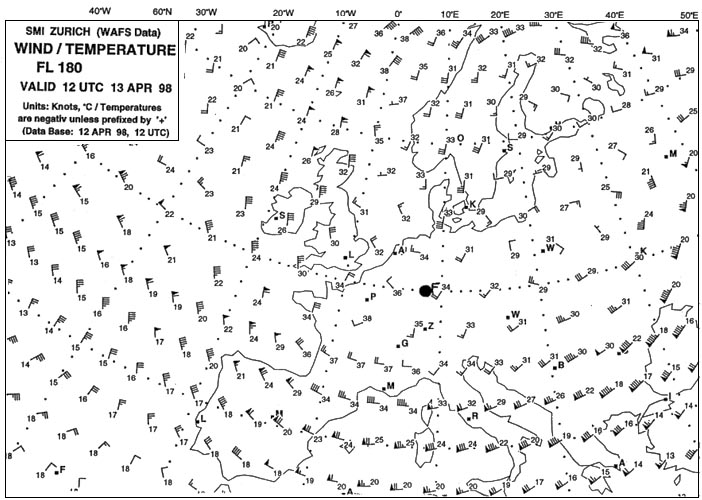
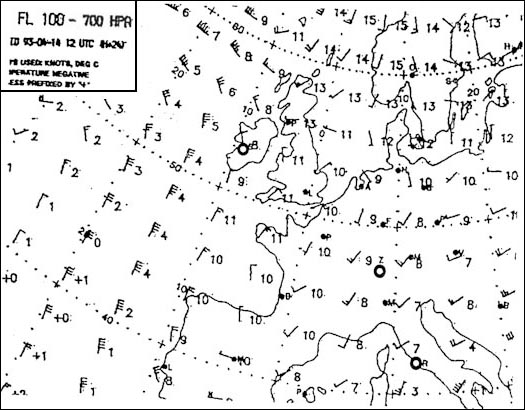
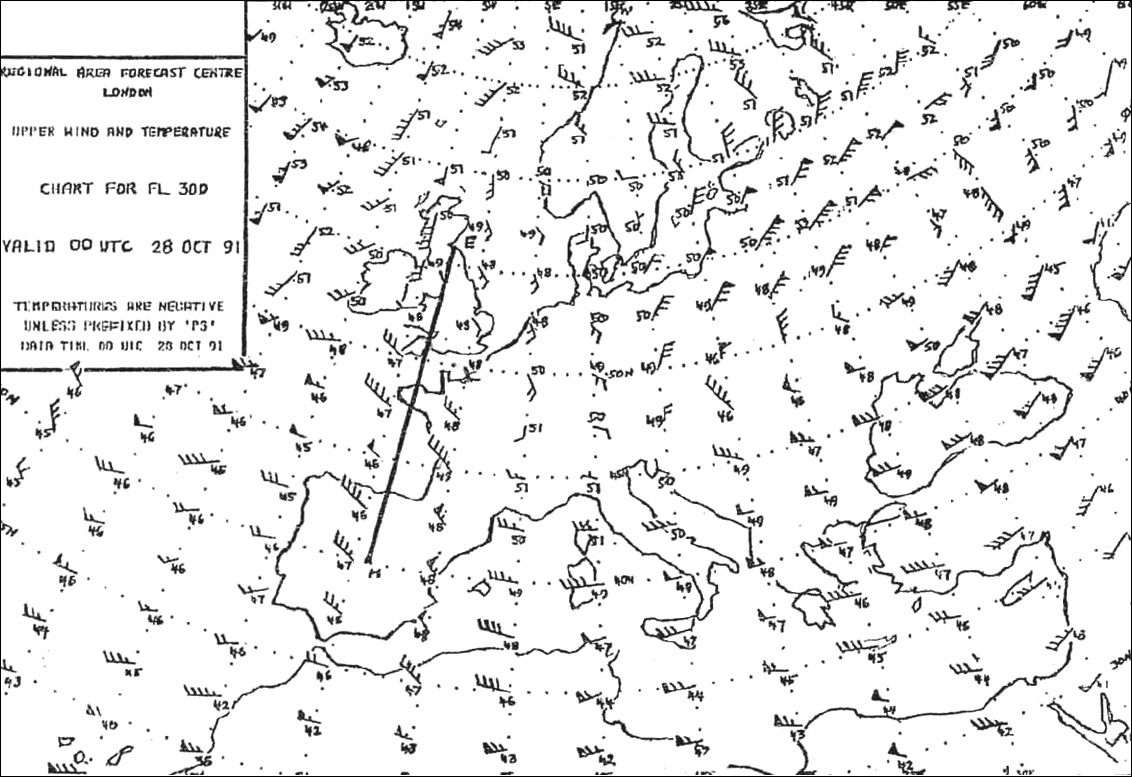
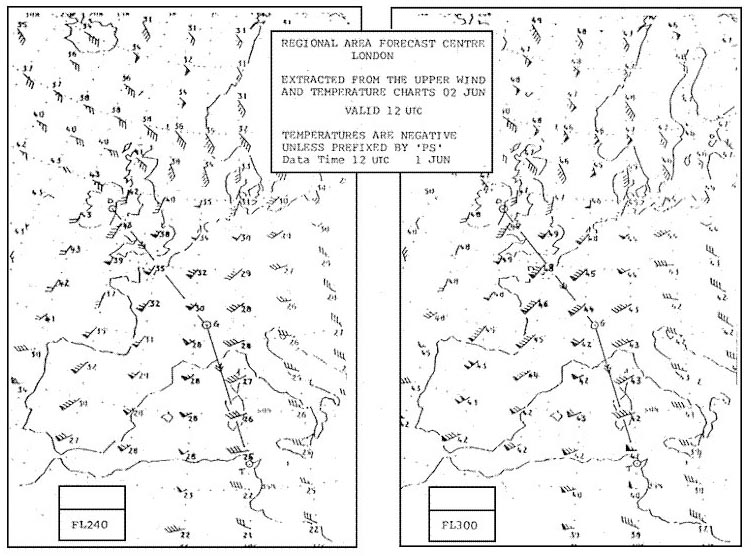
Question 123-9 : The wind direction and velocity °kt at 50°n 040°e err a 033 417 ?
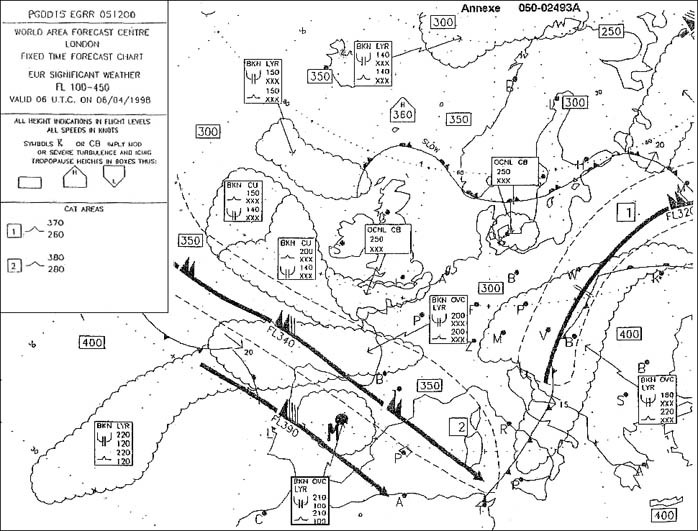
Is 02070.
Img com encom033 1067jpgIs 350/70. is 200/70. is 020/80.
Question 123-10 : In the appropriate box of an atc flight plan for endurance one must indicate the time corresponding to ?
The total usable fuel on board.
Julien35 in question 294 for example we have to remove from the useable fuel the reserve fuel to get the endurancedo you have a definition for endurance 'atc endurance' is different to 'safe endurance' for 'atc endurance' we are considering the total usable fuel on board the longest time you can fly until your engines are going to stop when calculating for the point of safe return psr you must come back or continue your flight and land at departure or destination with your fuel reserve on boardThe required fuel for the flight. the required fuel for the flight plus the alternate and 45 minutes. the total usable fuel on board minus reserve fuel.
Question 123-11 : Item 9 of the ats flight plan includes 'number and type of aircraft' in this case 'number' means err a 033 453 ?
The number of aircraft flying in a group.
Icao doc4444 pans atm com encom033 537pngThe registration number of the aircraft. the number of aircraft which will separately be using a repetitive flight plan (rpl). the icao type designator number as set out in icao doc 8643.
Question 123-12 : On a atc flight plan to indicate that you will overfly the waypoint romeo at 120 kt at flight level 085 you will write ?
Romeon0120f085.
Romeo/k0120fl085 romeo/fl085n0120 romeo/f085n0120
Question 123-13 : In the ats flight plan item 19 emergency and survival equipment carried on the flight should be indicated by 1522 ?
Crossing out the box relevant to any equipment not carried.
Img1315Placing a tick in the relevant box. circling the relevant box. listing the items carried on the 'remarks' line.
Question 123-14 : In the atc flight plan item 15 when entering a route for which standard departure sid and standard arrival star procedures exist ?
Both should be entered in the atc plan where appropriate.
Icao doc4444 pans atm com encom033 476apng example given in icao doc4444 com encom033 476bpngdeparture from amsterdam schipol eham on sid lek2b arriving at lisbon lppt on star fatim1aSids should be entered but not stars. stars should be entered but not sids. neither sid nor star should be entered.
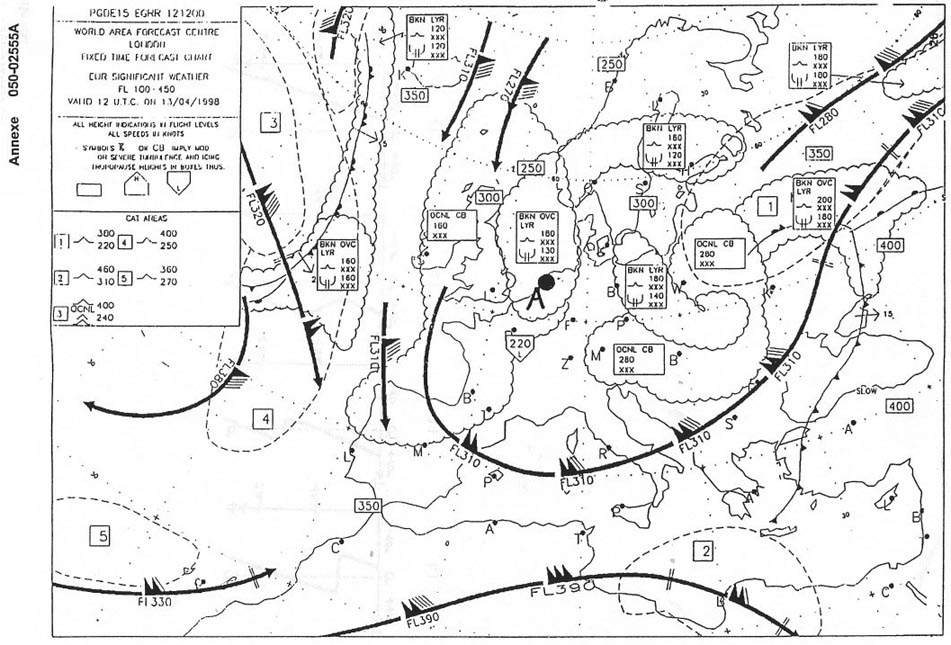
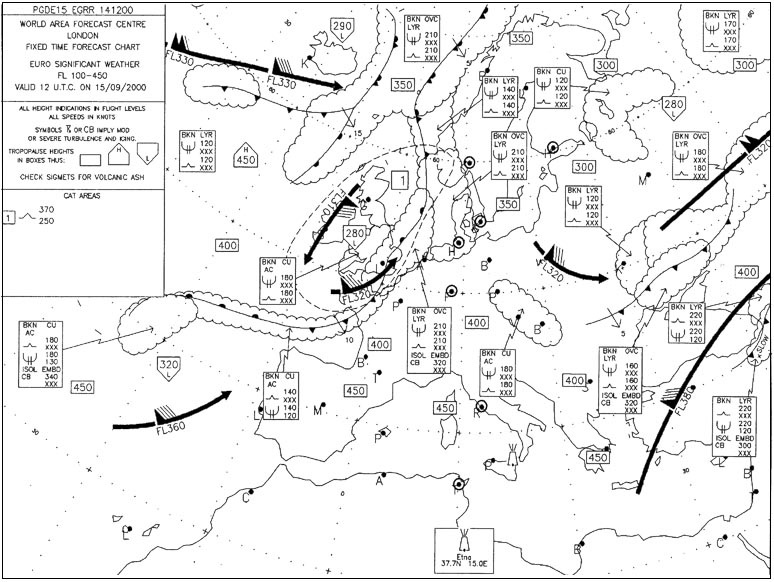
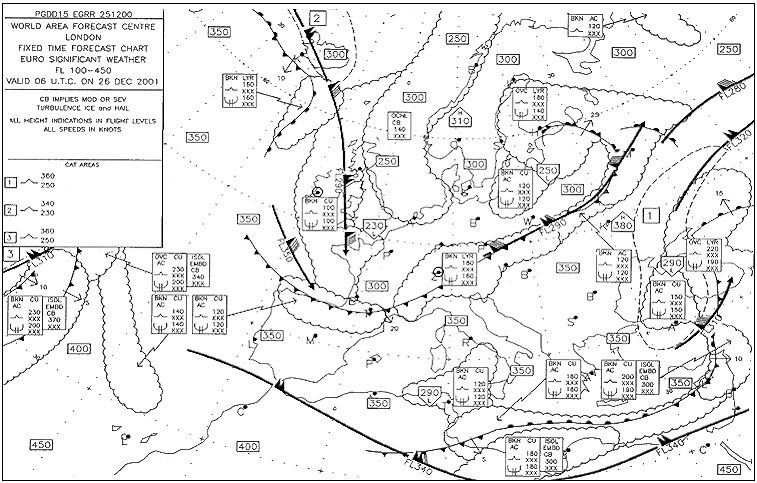
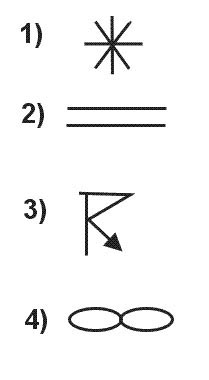
Question 123-15 : Which describes the maximum intensity of icing if any at fl180 in the vicinity of casablanca 33°n 008°w err a 033 481 ?
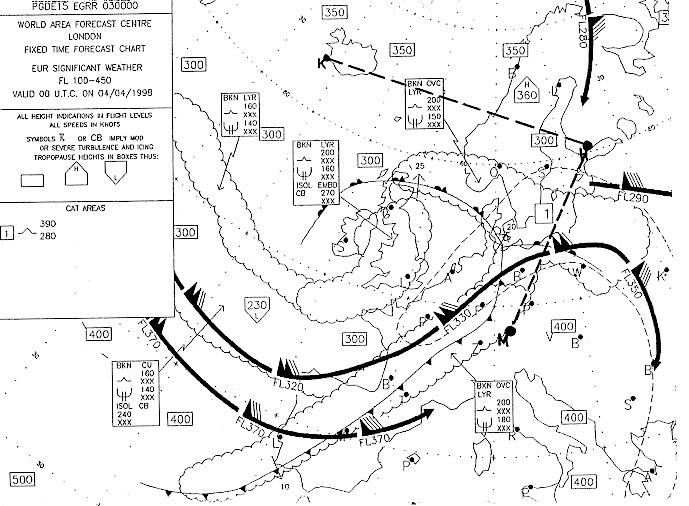
Severe.
Img629 com encom033 481jpgeven if symbol indicates moderate icing is always to be considered as severe next to cbModerate. light. nil.
Question 123-16 : During an ifr flight tas and time appear to deviate from the data in the atc flight plan the minimum deviations that should be reported to atc in order to conform to pans rac are ?
Tas 5% and time 3 minutes.
Tas 3% and time 3 minutes. tas 5 kt and time 5 minutes. tas 10 kt and time 2 minutes.
Question 123-17 : In the atc flight plan item 15 cruising speed when not expressed as a mach number cruising speed is expressed as ?
Tas.
Icao doc4444 pans atm com encom033 490pngIas. cas. groundspeed.
Question 123-18 : In an atc flight plan item 15 route a cruising pressure altitude of 32000 feet would be entered as ?
F320.
Icao doc4444 pans atm com encom033 498pngFl320 s3200 32000f
Question 123-19 : On an atc flight plan to indicate that you will overfly the waypoint tango at 350 kt at flight level 280 you write ?
Tangon0350f280.
Tango/k0350fl280 tango/fl280n0350 tango/ t350f280
Question 123-20 : In the atc flight plan item 15 it is necessary to enter any point at which a change of cruising speed takes place for this purpose a 'change of speed' is defined as ?
5% tas or 001 mach or more.
Icao doc4444 pans atm com encom033 522png10 % tas or 0.05 mach or more. 20 km per hour or 0.1 mach or more. 20 knots or 0.05 mach or more.
Question 123-21 : Which of the following statements regarding filing a atc flight plan is correct ?
In case of atfm air traffic flow management the flight plan should be filed at least three hours in advance of the eobt.
Atfm air traffic flow management is defined as a function established with the objective of contributing to a safe orderly and expeditious flow of air traffic by ensuring that atc capacity is utilised to the maximum extent possible and that the traffic volume is compatible with the capacities declared by the appropriate air traffic service providers in case of atfm air traffic flow management the flight plan should be filed at least three hours in advance of the eobtAny flight plan should be filed at least 10 minutes before departure. a flight plan should be filed when a national fir boundary will be crossed. a flying college can file repetitive flight plan for vfr flights.
Question 123-22 : For the purposes of item 9 wake turbulence category of the atc flight plan an aircraft with a maximum certificated take off mass of 62000 kg is ?
Question 123-23 : The navigation plan reads trip fuel 100 kgflight time 1h35mintaxi fuel 3 kgblock fuel 181 kgthe endurance on the icao flight plan should read ?
2h 49min.
Fuel on board at take off is 181 kg 3 kg = 178 kgfuel flow = trip fuel flight time = 100 kg 1h35min = 10095 = 1052 kgminendurance = 178 1052 = 169 minutes 2h 49min 1h 35min. 2h 04min. 2h 52min.
Question 123-24 : You have a flight plan ifr from amsterdam to london in the flight plan it is noted that you will deviate from the ats route passing the fir boundary amsterdamlondon the airway clearance reads cleared to london via flight planned route which of the following statements is correct ?
The route according to the flight plan is accepted.
It is not allowed to file such a flight plan. you will get a separate clearance for the deviation. the filed deviation is not accepted.
Question 123-25 : In the atc flight plan item 13 in a flight plan submitted before departure the departure time entered is the ?
Estimated off block time.
Estimated time over the first point en route estimated take-off time allocated slot time
Question 123-26 : Given planned and actual data as shown in the flight log excerptarriving overhead gamma you are cleared for direct routeing to mike the flight time for direct flight gamma to mike will be 1 h 08 min assuming other flight data remains constant what fuel will be expected on arrival overhead mike err ?
1272 kg.
Beta to gamma 25 minutesfuel used 2760 2360 = 400 kgfuel flow from beta to gamma 400 25 = 16 kgminfuel used from gamma to mike 68 mins x 16 kg = 1088 kgon arrival overhead mike fuel on board will be 2360 1088 = 1272 kg 2338 kg. 1250 kg. 582 kg.
Question 123-27 : A turbojet aeroplane flies using the following data flight level fl 330flight regime 'long range' lr mass 156 500 kgtailwind component at this level 40 ktwith a remaining flight time of 1 h 10 min the ground distance that can be covered by the aeroplane at cruising speed is err a 033 2 ?
539 nm.
For a mass of 156500 kg the table shows a tas of 427 kt right column we have 40 kt tailwind component our groundspeed is 467 ktthe ground distance that can be covered by the aeroplane at cruising speed is 467 x 7060 = 545 nm close to 539 nm 518 nm. 471 nm. 493 nm.
Question 123-28 : Given true course tc 017°wv 340°30 kttrue air speed tas 420 ktfind wind correction angle wca and ground speed gs ?
Wca 2° gs 396 kt.
Wind correction angle wca is another term for drift except drift is expressed as left or right the wind correction angle uses '+' or ' 'under index set true track 017° centre dot on tas 420 kt with the rotative scale set wind 340°30 kt com encom033 38ajpgdrift is always measured from heading to track so turn to set true heading 0155° 017° 25° right drift under index com encom033 38bjpgyou now read a ground speed of 396 kt a drift of 2º right wca is 2º Wca +2°, gs 396 kt. wca -2°, gs 426 kt. wca +2°, gs 416 kt.
Question 123-29 : The true course is 042°the variation in the area is 6° w and the wind is calmthe deviation card is reproduced in the annexin order to follow this course the pilot must fly a compass heading of err a 033 41 ?
052°.
Use this very useful table for those questions com encom033 41jpgthe nearest compass deviation reading is taken from 045° indicating 4° less than actual magnetic heading add 4° onto the 048° magnetic heading giving the answer of 052° compass heading 044°. 040°. 058°.
Question 123-30 : At reference or see flight planning manual mrjt 1 figure 435given a trip time of about 9 hours within the limits of the data given a temperature decrease of 30°c will affect the trip time by approximately err a 033 67 ?
By 7%.
com encom033 67jpga 9h trip becomes 86 for isa +20°ca 9h trip becomes 92 for isa 10°cdifference for 30°c will affect the trip time by approximately 0686 x 100 = 7%By 3%. by -4%. by -10%.
Question 123-31 : At reference or see flight planning manual mrjt 1 figure 454planning an ifr flight from paris to london for the twin jet aeroplanegiven estimated landing mass 49700 kgfl 280wv 280°40 ktaverage true course 320°procedure for descent 74 m250 kiasdetermine the distance from the top of descent to london ?
76 nm.
From the table com encom033 75jpgtime 19 minutesdistance nam 86 nmtas = distancetime = 8619 x 60 = 272 kton nav computer true course 320°wv 280°40 ktground speed is 240 ktdistance nm from the top of descent to london = 240 x 1960 = 76 nm97 nm. 65 nm. 87 nm.
Question 123-32 : At reference or see flight planning manual mrjt 1 figure 473given diversion distance 720 nmtail wind component 25ktmass at point of diversion 55000kgtemperature isadiversion fuel available 4250 kgwhat is the minimum pressure altitude at which the above conditions may be met err a 033 76 ?
25000 ft.
com encom033 76jpg20000 ft. 16000 ft. 14500 ft.
Question 123-33 : Flight planning chart for an aircraft states that the time to reach the cruising level at a given gross mass is 36 minutes and the distance travelled is 157 nm zero wind what will be the distance travelled with an average tailwind component of 60 kt ?
193 nm.
We know that a headwind or a tailwind component does not modify the time to climb to a specific level thus we only have to calculate our speed 157 x 60 36 = 262 ktadding tail wind component 262 + 60 = 322 ktthe distance travelled in 36 minutes will be 322 x 36 60 = 193 nm128 nm. 157 nm. 228 nm.
Question 123-34 : At reference or see flight planning manual mrjt 1 figure 436given distance to alternate 400 nmlanding mass at alternate 50 000kgheadwind component 25 ktthe alternate fuel required is err a 033 79 ?
2800 kg.
Answer com encom033 1012jpg2550 kg. 2900 kg. 2650 kg.
Question 123-35 : At reference or see flight planning manual mrjt 1 figure 436given twin jet aeroplanedry operating mass 35500 kgtraffic load 14500 kgfinal reserve fuel 1200 kgdistance to alternate 95 nmtailwind component 10 ktfind fuel required and trip time to alternate with simplified flight planning alternate ?
1000 kg 24 min.
Img com encom033 1015jpg800 kg, 0.4 hr. 800 kg, 24 min. 1000 kg, 40 min.
Question 123-36 : Given planning data as shown in the flight log excerpt fuel planning section after a balked landing at the destination airport you have to divert to the alternate airport with the gear extendedthe re calculated flight time to the alternate due to the reduced speed is 1 h 10 min and the fuel flow ?
5987 kg.
900 x 7060 = 1050 kg to reach the alternate airportsubtract 1050 kg from our estimated landing mass at destination 7037 1050 = 5987 kg 5510 kg. 6470 kg. 7427 kg.
Question 123-37 : Flight planning chart for an aeroplane states that the time to reach fl 190 at a given gross mass is 22 minutes and the distance travelled is 66 nm no wind what will be the distance travelled with an average head wind component of 35 kt ?
53 nm.
The time to reach fl 190 is 22 minutes and the distance travelled is 66 nm no wind with a head wind component of 35 kt our ground distance travelled will be less but the time to reach fl 190 remains unchangedwe need first to know our ground speed without wind 6622 x 60 = 180 ktwith 35 kt head wind our ground speed becomes 180 35 = 145 ktin 22 minutes the distance travelled will be 14560 x 22 = 5317 nm61 nm. 79 nm. 85 nm.
Question 123-38 : At reference or see flight planning manual mrjt 1 figure 4531given twin jet aeroplanefl 330long range cruiseoutside air temperature 63°cgross mass 50500 kgtrue air speed tas is err a 033 126 ?
420 kt.
com encom033 126jpgisa temperature at fl330 is 15°c 2°c x 33 = 51°cadjustements for operation at non standard temperatures decrease tas by 1 knot per degree c below isa difference between 63°c and 51°c is 12°c433 12 = 421 kt ninorr this make no difference to the answer but on the picture you have marked wrong mass should be 50500 not 55000 as you marked 433 kt. 431 kt. 418 kt.
Question 123-39 : At reference or see flight planning manual mrjt 1 figure 4531 given long range cruiseoat 45°c at fl 350gross mass at the beginning of the leg 40000 kggross mass at the end of the leg 39000 kg find true air speed tas and cruise distance nam for a twin jet aeroplane err a 033 147 ?
Tas 432 kt 227 nam.
Isa at fl350 is 35 x 2° + 15° = 55°cgross mass at the end of the leg 39000 kg from the table we can read a tas of 422 kt as we are at isa+9 we must increase tas by 1 kt per degree c above isa as indicated on the bottom of the table 422 + 10 = 432 ktfuel consumption on the leg was 1000 kg 40000 39000 table values are 40000 >1163 nam39000 > 936 nam1163 936 = 227 namTas 422 kt, 936 nam. tas 422 kt, 227 nam. tas 432 kt, 1163 nam.
Question 123-40 : During an ifr flight in a beech bonanza the fuel indicators show that the remaining amount of fuel is 100 lbs after 38 minutes fuel at take off is 160lbsfor the alternate fuel 30 lbs is necessarythe planned fuel for taxi is 13 lbsfinal reserve fuel is estimated at 50 lbsif the fuel flow remains the ?
12 minutes.
Minimum take off fuel = trip fuel + contingency + alternate + final reserveafter 38 min 60 lbs of fuel has been used fuel flow = 6038 = 1579 lbminat landing at destination alternate fuel and final reserve must be in your tank 100 lbs 30 + 50 = 20 lbswe can fly 201579 = 1266 min4 minutes. 44 minutes. 63 minutes.
Exclusive rights reserved. Reproduction prohibited under penalty of prosecution.