A free Premium account on the FCL.055 website! Read here
Sign up to unlock all our services and 15164 corrected and explained questions.
Question 124-1 : Given planning data as shown in the flight log excerpt fuel planning section after a balked landing at the destination airport you have to divert to the alternate airport with the gear extendedthe re calculated flight time to the alternate due to the reduced speed is 2h 20 min and the fuel flow will ? [ Preparation civilian ]
5440 kg
Question 124-2 : At reference or see flight planning manual mrjt 1 figure 431cfor a flight of 2400 ground nautical miles the following apply temperature isa 10°ccruise altitude 29000 ftlanding mass 45000 kgtrip fuel available 16000 kgwhat is the maximum headwind component which may be accepted err a 033 164 ?
35 kt.
com encom033 164jpg15 kt. 70 kt. 0 kt.
Question 124-3 : At reference or see flight planning manual mrjt 1 figure 4532 find the fuel flow for the twin jet aeroplane with regard to the following datagiven mach 74 cruiseflight level 310gross mass 50000 kgisa conditions err a 033 171 ?
2300 kgh.
50000 > 2994 nam maximum cruise distance tas is 434 ktin one hour we travel 2294 434 = 2560in the table the weight associated with a distance of 2560 nam is 47700 kg50000 kg 47700 kg = 2300 kghsee section 542 method on caa cap697 flight planning manual for that kind of questions1150 kg/h 2994 kg/h 1497 kg/h
Question 124-4 : At reference or see flight planning manual mrjt 1 figure 431c within the limits of the data given a mean temperature increase of 30°c will affect the trip time by approximately err a 033 172 ?
By 5%.
Draw a line for a ficticious flight duration of 5h for example com encom033 172jpgat isa 10°c trip time is 5h07 min 512h at isa +20°c trip time is 4h50 min 483h a 30°c mean temperature increase decrease trip time by approximately 17 minutes 028h 028512 x 100 = 546%By 5% by 8% by -7%
Question 124-5 : At reference or see flight planning manual mrjt 1 figure 436 in order to find alternate fuel and time to alternate the aeroplane operating manual shall be entered with err a 033 173 ?
Distance in nautical miles nm wind component landing mass at alternate.
Distance in nautical air miles (nam), wind component, landing mass at alternate distance in nautical miles (nm), wind component, zero fuel mass distance in nautical miles (nm), wind component, dry operating mass plus holding fuel
Question 124-6 : During a vfr flight at a navigational checkpoint the remaining usable fuel in tanks is 60 us gallons the reserve fuel is 12 us gallonsaccording to the flight plan the remaining flight time is 1h35min calculate the highest acceptable rate of consumption possible for the rest of the trip ?
303 us gallonshour.
60 12 = 48 us gallons available1 h 35 min = 95 min 48 95 x 60 = 3031 us gallonshourthis is the highest acceptable rate of consumption possible for the rest of the trip33.0 us gallons/hour 37.9 us gallons/hour 21.3 us gallons/hour
Question 124-7 : At reference or see flight planning manual mrjt 1 figure 431cfor a flight of 2000 ground nautical miles cruising at 30000 ft within the limits of the data given a headwind component of 25 kt will affect the trip time by approximately err a 033 190 ?
By 76%.
com encom033 190jpgwith a headwind component of 25 kt we find a trip time of 307 minutes 5h07 without headwind a trip time of 285 minutes 4h45 307 285 285 x 100 = 772%By 2.3%. by -3.6%. by 5.3%.
Question 124-8 : At reference or see flight planning manual mrjt 1 figure 436given distance to alternate 450 nmlanding mass at alternate 45 000 kgtailwind component 50 ktthe alternate fuel required is err a 033 191 ?
2500 kg.
com encom033 191jpgstart at 450 nm go to the reference line enter condition 50 kt tailwindgo to the next condition landing mass 45 000 kg you get your answer 2500 kg2750 kg. 3050 kg. 2900 kg.
Question 124-9 : An aeroplane is on an ifr flight the flight is to be changed from ifr to vfr is it possible ?
Yes the pilot in command must inform atc using the phrase 'cancelling my ifr flight'.
No, you have to remain ifr in accordance to the filed flight plan. no, only atc can order you to do this. yes, but only with permission from atc.
Question 124-10 : See flight planning manual mrjt 1 figure 452 and 4531 given distance c d 680 nmlong range cruise at fl340temperature deviation from isa 0° cheadwind component 60 ktgross mass at c 44700 kgthe fuel required from c d is err a 033 218 ?
3700 kg.
For 44700 kg we have a tas of 431 kt no temperature correction since it is isa conditionnam = ground distance x tasgs nam = 680 x 431371 = 790 namat line 44700 the cruise distance nautical air miles is 2150 nautique air miles substract 790 you find 1360 namwhat is the mass for 1360 nm com encom033 218jpgwe find 41000 kg this is our end mass 44700 41000 = 3700 kgsee section 542 method on caa cap697 flight planning manual for that kind of questions3400 kg. 3100 kg. 4000 kg.
Question 124-11 : Flight planning manual mrjt 1 figure 454a descent is planned at 74250kias from 35000ft to 5000fthow much fuel will be consumed during this descent err a 033 220 ?
150 kg.
com encom033 220jpgfrom 35000 ft to 0 ft 290 kgfrom 5000 ft to 0 ft 140 kgfrom 35000 ft to 5000 ft 290 140 = 150 kg290 kg. 278 kg. 140 kg.
Question 124-12 : At reference or see flight planning manual mrjt 1 figure 473given diversion fuel available 8500kgdiversion cruise altitude 10000ftmass at point of diversion 62500kghead wind component 50kttemperature isa 5°cthe a maximum diversion distance and b elapsed time alternate are approximately err a 033 ?
A 860 nm b 3h 20 min.
com encom033 253jpgthe reference quality is not fantastic sorry for thatfor information 'dash lines' over 'weigth at point of diversion' serve as adjustment variables we have to follow a 'continous line' slope because it is more representative of our pressure altitude continous lines are for low pressure altitudes (a) 1000 nm (b) 3h 40 min. (a) 760 nm (b) 4h 30 min. (a) 1130 nm (b) 3h 30 min.
Question 124-13 : For a planned flight the calculated fuel is as follows flight time 2h42min the reserve fuel at any time should not be less than 30% of the remaining trip fueltaxi fuel 9 kgblock fuel 136 kghow much fuel should remain after 2 hours flight ?
25 kg trip fuel and 8 kg reserve fuel.
127 kg at take off = 130100 x trip fueltrip fuel = 127 x 100130 trip fuel is 98 kgafter after 2 hours flight it remains 42 minutes 07 h the fraction of trip fuel remaining is 0727 x 98 = 25 kg the reserve fuel at any time should not be less than 30% of the remaining trip fuel 30100 x 25 = 8 kg 33 kg trip fuel and 10 kg reserve fuel. 23 kg trip fuel and 10 kg reserve fuel. 33 kg trip fuel and no reserve fuel.
Question 124-14 : An aircraft is flying at mach 084 at fl 330the static air temperature is 48°c and the headwind component 52 ktat 1338 utc the controller requests the pilot to cross the meridian of 030w at 1500 utcgiven the distance to go is 570 nm the reduced mach required is ?
08 m.
13h38 to 15h00 = 1h22 137h first step ground speed = distancetime = 570137 = 416 ktsecond step true air speed = gs + headwind = 416 kt + 52 kt = 468 ktlast step now on the computer in airspeed window 48°c under mach indexin front of 468 kt on the outer scale you read the reduced mach number 08 m0.78 m 0.76 m 0.72 m
Question 124-15 : You must fly ifr on an airway orientated 135° magnetic with a msa at 7800 ft knowing the qnh is 1025 hpa and the temperature is isa +10°c the minimum flight level you must fly at is ?
Fl90.
1025 1013 = 12 hpa12 hpa x 27fthpa = 324 fttemperature correction 75 x 4 x 10 = +300 ft7800 324 300 = 7176 ftit is 'minus' 324 ft because we decrease our pressure setting from 1025 to 1013 indicated altitude will also decrease it is 'minus' 300 ft because air mass is warmer than isaon a 135° heading we need an odd level the first available is fl90Fl80. fl75. fl70.
Question 124-16 : An aircraft following a 215° true track must fly over a 10 600 ft obstacle with a minimum obstacle clearance of 1 500 ft knowing the qnh received from an airport close by which is almost at sea level is 1035 and the temperature is isa 15°cwhat is the minimum fl the aircraft should fly at allowing ?
Fl 140.
Local qnh is 1035 and we gonna fly with a 1013 hpa setting1035 1013 = 22 hpa22 hpa x 27 fthpa = 594 ft new learning objectives state 27ft per 1 hpa we need 10600 + 1500 594 = 11506 ftwe must correct for temperature to determine the true altitudeheight the following rule of thumb called the 4% rule shall be used the altitudeheight changes by 4% for each 10°c temperature deviation from isa4%15 degrees = 6%6% x 11506 = 690 ftair mass is colder we need to flight higher 11506 + 690 = 12196 fton a 215° true track we need an even flight level the first one available is fl 140Fl 130. fl 150. fl 120.
Question 124-17 : Given dry operating mass 33000 kg traffic load 8110 kg final reserve fuel 983 kg alternate fuel 1100 kg contingency fuel not used 102 kg the estimated landing mass at alternate should be ?
42195 kg.
At alternate you must land with the final reserve in your tanks and contingency fuel if not used 33000 kg dom + 8110 kg traffic load + 983 kg final reserve + 102 kg contingency fuel = 42195 kg41110 kg. 42210 kg. 42312 kg.
Question 124-18 : At reference or see flight planning manual mrjt 1 figure 454planning an ifr flight from paris to london for the twin jet aeroplanegiven estimated landing mass 49700 kgfl 280wind 280°40 ktaverage true course 320°procedure for descent 74 m250 kiasdetermine the time from the top of descent to london ?
19 min.
com encom033 303jpgno need for calculations cmarzocchini whats the reason you dont make any correction about the wind coz the descend is at constant mach number if yes can you explain to me please the wind will affect the distance but not the time17 min. 8 min. 10 min.
Question 124-19 : At reference or see flight planning manual mrjt 1 figure 44given twin jet aeroplaneestimated mass on arrival at the alternate 50000 kgelevation at destination aerodrome 3500 ftelevation at alternate aerodrome 30 ftfind final reserve fuel err a 033 304 ?
1180 kg.
com encom033 304jpg30 minutes at 1500 ft above alternate 22602 = 1180 kg ninorr why we do not take into account 3500ft of the airfield elevation we have to fly 1500ft above airfiled what makes 5000ft am i wrong with that calculations the question states find final reserve fuel and you do not have the mass on arrival at destination aerodrome furthermore you have to land with this final reserve in your wing at alternate2360 kg. 1150 kg. 2300 kg.
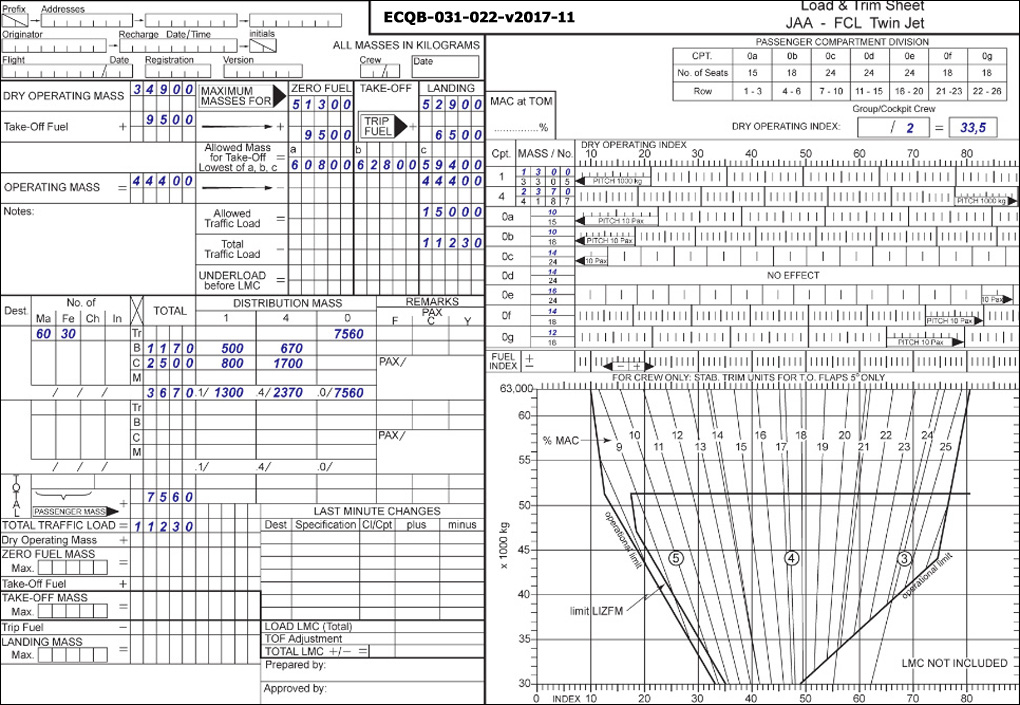
Question 124-20 : Given planned and actual data as shown in the flight log excerptarriving overhead gamma you are cleared for direct routing to mikethe flight time for direct flight gamma to mike will be 1h10 min assuming other flight data remains constant what fuel will be expected on arrival overhead mike err a ?
1300 kg.
From gamma you are cleared direct to mike gamma to mike 1h10 minfrom beta to gamma fuel consumption was 3200 2700 = 500 kgflight time from beta to gamma 1h42 1h17 = 25 minfuel flow between beta to gamma 500 kg 25 min = 20 kgmingamma to mike 1h10 x 20 kgmin = 1400 kgremaining fuel at gamma 2700 kgremaining fuel at mike = 2700 1400 kg = 1300 kg2910 kg. 1510 kg. 380 kg.
Question 124-21 : Given planned and actual data as shown in the flight log excerptarriving overhead gamma you are cleared for direct routeing to mikethe flight time for direct flight gamma to mike will be 57 minutes assuming other flight data remains constant what fuel will be expected on arrival overhead mike err a ?
1720 kg.
Beta to gamma 25 minutes 1h37 to 2h02 fuel used 2950 2575 = 375 kgfuel flow from beta to gamma 375 25 = 15 kgminfuel used from gamma to mike 57 min x 15 kg = 855 kgon arrival overhead mike fuel on board will be 2575 855 = 1720 kg2305 kg. 1450 kg. 790 kg.
Question 124-22 : Given fl 370mach 074oat 47°cthe tas is ?
434 kt.
com encom033 333jpgby calculation mach number = tas lsslss= 39 square root t° kelvinlss= 39 square root 273 47 °klss= 39 square root 226°k = 58630mach number = tas 58630 = 074tas = 074 x 58630 = 43386 kt424 kt. 415 kt. 428 kt.
Question 124-23 : The still air distance in the climb is 189 nautical air miles nam and time 30 minutes what ground distance would be covered in a 30 kt head wind ?
174 nm.
Ground distance nm = air distance + time x effective wind60 ground distance nm = 189 nam 30 minutes x 30kt60 ground distance nm = 189 15 = 174 nm stanley is it correct counting 18930 x 60 = 378 tas378 30 kt = 3483482 = 174 nmyes it works203 nm. 188 nm. 193 nm.
Question 124-24 : At reference or see flight planning manual mrjt 1 figure 4531given long range cruise outside air temperature oat 45°c in fl350mass at the beginning of the leg 40000 kgmass at the end of the leg 39000 kgfind the true airspeed tas at the end of the leg and the distance nam err a 033 345 ?
Tas 431 kt 227 nam.
Mass at the end of the leg 39000 kg we read 422 kt tas on the tabletemperature is isa+9 we must increase tas by 1 kt per degree c above isa 422 + 9 = 431 kt we have burnt 1000 kg on the leg 40000 39000 on the table we read the following values 40000 >1163 nam39000 > 936 nam1163 936 = 227 nam Tas 423 ktxsx 936 nam tas 423 ktxsx 227 nam tas 431 ktxsx 1163 nam
Question 124-25 : At reference or see flight planning manual mrjt 1 figure 436given estimated dry operation mass 35 500 kgestimated load 14 500 kgfinal reserve fuel 1200 kgdistance to alternate 95 nmaverage true track 219°head wind component 10 ktfind fuel and time to alternate err a 033 353 ?
1 100 kg25 min.
com encom033 353jpgthe time to alternate is given as decimal 042 h ==> 25 minutes800 kgxsx40 min 1 100 kgxsx44 min 800 kgxsx24 min
Question 124-26 : At reference or see flight planning manual mrjt 1 figure 451 find time fuel still air distance and tas for an enroute climb 28074 to fl 350 given brake release mass 64000 kgisa +10°cairport elevation 3000 ft err a 033 361 ?
26 min 1975 kg 157 nautical air miles nam 399 kt.
On the table you can read 26 min 2050 kg 157 nam 399 ktbut we can also read 'fuel adjustment for high elevation airport'at 3000 ft we must interpolate between 2000 and 4000 ft and remove 75 kg26 min, 2050 kg, 157 nautical air miles (nam), 399 kt 20 min, 1750 kg, 117 nautical air miles (nam), 288 kt 25 min, 1875 kg, 148 nautical air miles (nam), 391 kt
Question 124-27 : Given planned and actual data as shown in the flight log excerpt arriving overhead gamma you are cleared for direct routing to mike the flight time for direct flight gamma to mike will be 42 minutes assuming other flight data remains constant what fuel will be expected on arrival overhead mike err ?
1475 kg.
Beta to gamma 20 minutesfuel used 3025 2525 = 500 kgfuel flow from beta to gamma 500 20 = 25 kgminfuel used from gamma to mike 42 mins x 25 kg = 1050 kgon arrival overhead mike fuel on board will be 2525 1050 = 1475 kg 2245 kg 1195 kg 670 kg
Question 124-28 : At reference or see flight planning manual mrjt 1 figure 473given distance to alternate 950 nmhead wind component 20 ktmass at point of diversion 50000 kgdiversion fuel available 5800 kgthe minimum pressure altitude at which the above conditions may be met is err a 033 377 ?
22000 ft.
com encom033 377jpg20000 ft. 18000 ft. 28000 ft.
Question 124-29 : Planned and actual data as shown in the flight log excerptactual ground speed gs on the leg beta to gamma will be 105 ktif all other flight parameters remain unchanged what fuel remaining should be expected at waypoint gamma err a 033 379 ?
3260 kg.
Fuel used between alpha to beta 3670 3560 = 110 kgfuel flow was 110 kg 12 min = 917 kgminground speed beta to gamma is 105 ktflight time between beta to gamma 58 105 x 60 = 331 minfuel used between beta to gamma 917 x 331 = 304 kgfuel on arrival at gamma 3560 304 = 3256 kg3318 kg. 3480 kg. 3430 kg.
Question 124-30 : How many feet you have to climb to reach fl 75 given fl 75departure aerodrome elevation 1500 ft qnh = 1023 hpatemperature = isa1 hpa = 30 ft ?
6300 ft.
Distance height between sea level and 1013 = 1023 1013 x 30ft = 300 ftpressure at sea level = 1023 > 1013 so 1013 hpa is above seal levelthus qnh altitude = 7500 + 300 = 7800 ftand height = 7800 1500 = 6300 ft6000 ft. 6600 ft. 7800 ft.
Question 124-31 : Given planned and actual data as shown in the flight log excerpt arriving overhead gamma you are cleared for direct routeing to mike the flight time for direct flight gamma to mike will be 40 minutes assuming other flight data remains constant what fuel will be expected on arrival overhead mike err ?
1900 kg.
From alpha to gamma flight time is 35 minutes 1h07 to 1h42 fuel used 3400 2700 = 700 kg700 kg 35 minutes = 20 kgminutefrom gamma you are cleared for direct routeing to mike flight time will be 40 minutes 40 minutes x 20 kgminute = 800 kg2700 kg 800 kg = 1900 kg2652 kg 1852 kg 1268 kg
Question 124-32 : At reference or see flight planning manual mrjt 1 figure 473given diversion distance 650 nmdiversion pressure altitude 16 000 ftmass at point of diversion 57 000 kghead wind component 20 kttemperature isa + 15°cthe diversion a fuel required and b time are approximately err a 033 418 ?
A 4800kg b 2h 03min.
First set the red lines on the graph com encom033 418jpgreach the ref lines first and after join the red linesabove 'weight at point of diversion' on the right part of the graph you have to interpolate the dashed line and the full line dashed line for high pressure alitude flights full line for low altitude pressure flights (a) 3900kg (b) 1h 45min. (a) 6200kg (b) 2h 10min. (a) 4400kg (b) 1h 35min.
Question 124-33 : The fuel plan gives a trip fuel of 65 us gallons the alternate fuel final reserve included is 17 us gallons contingency fuel is 5% of the trip fuel the usable fuel at departure is 93 us gallons at a certain moment the fuel consumed according to the fuel gauges is 40 us gallons and the distance flown ?
The remaining fuel is not sufficient to reach the destination with reserves intact.
Usable fuel at departure 93 usgminus reserves 7275 usg 93 17 325 72752 distance flown is half of the total distance = 36 usgit misses 4 usgthe remaining fuel is not sufficient to reach the destination without using a part of our fuel reservesAt the destination there will still be 30 us gallons in the tanks. at departure the reserve fuel was 28 us gallons. at destination the required reserves remain intact.
Question 124-34 : At reference or see flight planning manual mrjt 1 figure 41find the optimum altitude for the twin jet aeroplane given cruise mass 50000 kgmach 078 err a 033 436 ?
35500 ft.
com encom033 436jpg36200 ft. 36700 ft. maximum operating altitude.
Question 124-35 : You are flying a constant compass heading of 252°variation is 22°edeviation is 3°w and your ins is showing a drift of 9° righttrue track is ?
280°.
com encom033 469jpguse this very useful table for those questions224°. 242°. 262°.
Question 124-36 : A descent is planned from 7500 ft amsl so as to arrive at 1000 ft amsl 6 nm from a vortacwith a ground speed of 156 kt and a rate of descent of 800 ftminthe distance from the vortac when descent is started is ?
Question 124-37 : Given planned and actual data as shown in the flight log excerptactual ground speed gs on the leg beta to gamma will be 100 kt if all other flight parameters remain unchanged what fuel remaining should be expected at waypoint gamma err a 033 474 ?
2600 kg.
Actual consumption between alpha and beta was 3000 2900 = 100 kgflight time between alpha and beta was 12 minutesour fuel flow is 100 kg12 minutes = 833 kgminute between beta and gamma ground speed will be 100 kt instead of 130 kt we have to actualize the flight log the leg duration will be 36 minutes distancespeed 60100 with a fuel flow of 833 kgminute 36 minutes x 833 = 300 kgfuel remaining at waypoint gamma should be 2900 300 = 2600 kg2820 kg. 2684 kg. 2770 kg.
Question 124-38 : Given planned and actual data as shown in the flight log excerptarriving overhead gamma you are cleared for direct routing to mike the flight time for direct flight gamma to mike will be 45 minutes assuming other flight data remains constant what fuel will be expected on arrival overhead mike err a ?
1384 kg.
From alpha to gamma flight time was 39 minutes 1h07 to 1h46 fuel flown was 3400 2464 39 = 24 kgmingamma to mike = 45 minutes45 min x 24 kgmin = 1080 kgon arrival overhead mike fuel on board will be 2464 1080 = 1384 kg 2082 kg. 1002 kg. 252 kg.
Question 124-39 : Minimum planned take off fuel is 160 kg 30% total reserve fuel is included assume the groundspeed on this trip is constantwhen the aircraft has done half the distance the remaining fuel is 70 kgis diversion to a nearby alternate necessary ?
Diversion to a nearby alternate is necessary because the remaining fuel is not sufficient.
Fuel on board at take off = 160 kgat half the distance it remains 70 kg we have burned 90 kgthe remaining quantity of 70 kg is not enough for travelling the next part of the flightDiversion to a nearby alternate is not necessary, because the reserve fuel has not been used completely. diversion to a nearby alternate is not necessary, because it is allowed to calculate without reserve fuel. diversion to a nearby alternate is necessary, unless the captain decides to continue on his own responsibility.
Question 124-40 : Which of the following statements is relevant for forming route portions in integrated range flight planning ?
The distance from take off up to the top of climb has to be known.
No segment shall be more than 30 minutes of flight time. each reporting point requires a new segment. a small change of temperature (2°c) can divide a segment.
Exclusive rights reserved. Reproduction prohibited under penalty of prosecution.