A free Premium account on the FCL.055 website! Read here
Sign up to unlock all our services and 15164 corrected and explained questions.
Question 152-1 : An aircraft is flying over the sea at fl 90 the true altitude is 9100 feet local qnh is unknownwhat assumption if any can be made about the air mass in which the aircraft is flying ? [ Learning aircraft ]
There is insufficient information to make any assumption
Question 152-2 : An aircraft is flying over the sea at fl 120 with a true altitude of 12000 feet local qnh is 1013 hpa what assumption if any can be made about the air mass in which the aircraft is flying ?
Its average temperature is the same as isa.
It is colder than isa. it is warmer than isa. there is insufficient information to come to any conclusion.
Question 152-3 : An aircraft is flying over the sea at fl 100 with a true altitude of 10000 feet local qnh is 1003 hpa what assumption if any can be made about the air mass in which the aircraft is flying ?
It is warmer than isa.
If air temperature is isa at fl 100 with a subscale setting of 1013 hpa when turning the subscale knob to the left to set 1003 in the window our indicated altitude will be 1013 1003 = 10 hpa10 x 27 = 270 ft10000 270 = 9730 ftthe question states that our true altitude is 10000 ft so to remain at 10000 ft when passing from fl100 1013 hpa to 10000 ft 1003 hpa the air must be warmer than isait means that we were at fl100 1013 hpa or 10270 ft 1003 hpa Its average temperature is about isa. it is colder than isa. there is insufficient information to come to any conclusion.
Question 152-4 : Which layer of the atmosphere contains more than 90 per cent of all water vapour ?
Question 152-5 : The temperature at fl 80 is +6°c what will the temperature be at fl 130 if the icao standard lapse rate is applied ?
4°c.
The temperature lapse rates of the troposphere is mean value 065°c100 m or 2°c1000 ftin isa temperature at fl80 should be 15° 2x8 = 1°c as the current temperature at that level is +6°c you can say that at fl130 it is currently isa+7therefore at fl130 15° 2x13 = 11°c +7 from isa+7 = 4°c-6°c. 0°c. +2°c.
Question 152-6 : The temperature at fl 110 is 5°c what will the temperature be at fl 50 if the icao standard lapse rate is applied ?
+7°c.
In isa temperature at fl110 should be 15° 2x11 = 7°c as the current temperature at that fl is 5°c you can say that at fl110 it is currently isa+2therefore at fl50 15° 2x5 = 5°c +2 from isa+2 = 7°c+3°c. -3°c. 0°c.
Question 152-7 : The temperature at fl 160 is 22°c what will the temperature be at fl 90 if the icao standard lapse rate is applied ?
8°c.
The temperature lapse rates of the troposphere is mean value 065°c100 m or 2°c1000 ftin isa temperature at fl160 should be 15° 2x16 = 17°c as the current temperature at that level is 22°c you can say that at fl160 it is currently isa 5therefore at fl90 15° 2x9 = 3°c + 5 from isa 5 = 8°c-4°c. 0°c. +4°c.
Question 152-8 : A temperature of +15°c is recorded at an altitude of 500 metres above sea level if the vertical temperature gradient is that of a standard atmosphere what will the temperature be at the summit of a mountain 2500 metres above sea level ?
+2°c.
2°c1000 ft = 65°c1000 mfrom 500 m to 2500 m temperature would drop by 65°c x 2 = 13°cthe temperature at the summit of the mountain will be 15°c 13°c = +2°c+4°c. 0°c. -2°c.
Question 152-9 : How would you characterise an air temperature of 15°c at the 700 hpa level over western europe ?
Low.
There is a few questions in the exam that take information directly from that table below write these down on a sticky and have them on the wall beside you 1013 hpa = msl850 hpa = fl50 700 hpa = fl100 500 hpa = fl180300 hpa = fl300200 hpa = fl390isa temperature at fl100 is normally 15°c 2° x 10 = 5°cwe are 10° below isa the air temperature at this level is lower than standardHigh. within +/-5°c of isa. 20°c below standard.
Question 152-10 : An air temperature of 30°c at the 300 hpa level over central europe in summer is ?
High.
300 hpa corresponds at flight level 300isa temperature at fl300 is 15º 2º x 30 = 45ºcoutside air temperature is 30°c instead of 45° air temperature is higher than standard temperatureLow. very low. within +/-5°c of isa.
Question 152-11 : How would you characterise an air temperature of 55°c at the 200 hpa level over western europe ?
Within + 5°c of isa.
There is a few questions in the exam that take information directly from that table below write these down on a sticky and have them on the wall beside you 1013 hpa = msl850 hpa = fl50700 hpa = fl100500 hpa = fl180300 hpa = fl300200 hpa = fl390at fl390 200 hpa isa temperature is 15°c 2°c x 39 = 63°c but the lowest temperature in the icao standard atmosphere isa is 565°cthus with an air temperature of 55°c we are within + 5°c of isaHigh. low. very high.
Question 152-12 : What is the technical term for an increase in temperature with altitude ?
Inversion.
Subsidence. adiabatic. advection.
Question 152-13 : The station pressure used in surface weather charts is ?
Qff.
Qff is obtained by taking the airfield pressure qfe and reducing it to sea level assuming the actual temperature at the airfield is constant isothermal down to that level this value is used by meteorologists on surface weather charts because it is more likely to accurately reflect actual conditionsQfe. qnh. qne.
Question 152-14 : Which fl corresponds with the 300 hpa pressure level ?
Fl 300.
There is a few questions in the exam that take information directly from that table below write these down on a sticky and have them on the wall beside you 1013 hpa = msl850 hpa = fl50700 hpa = fl100500 hpa = fl180300 hpa = fl300200 hpa = fl390any others you can interpolate between these and figure it outthe decrease of 1hpa27ft is only applicable at the lower levels of the troposphere as you go up and air pressure decreases the change of height per 1 hpa increases at msl 1hpa27ft at fl180 it's 50fthpa and at fl390 it's 105fthpa Fl 50 fl 100 fl 390
Question 152-15 : Which fl corresponds with the 500 hpa pressure level ?
Fl 180.
There is a few questions in the exam that take information directly from that table below write these down on a sticky and have them on the wall beside you 1013 hpa = msl850 hpa = fl50700 hpa = fl100500 hpa = fl180300 hpa = fl300200 hpa = fl390any others you can interpolate between these and figure it outthe decrease of 1hpa27ft is only applicable at the lower levels of the troposphere as you go up and air pressure decreases the change of height per 1 hpa increases at msl 1hpa27ft at fl180 it's 50fthpa and at fl390 it's 105fthpa Fl 390. fl 100. fl 160.
Question 152-16 : Which fl corresponds with the 700 hpa pressure level ?
Fl 100.
There is a few questions in the exam that take information directly from that table below write these down on a sticky and have them on the wall beside you 1013 hpa = msl850 hpa = fl50700 hpa = fl100500 hpa = fl180300 hpa = fl300200 hpa = fl390any others you can interpolate between these and figure it outthe decrease of 1hpa27ft is only applicable at the lower levels of the troposphere as you go up and air pressure decreases the change of height per 1 hpa increases at msl 1hpa27ft at fl180 it's 50fthpa and at fl390 it's 105fthpa Fl 180. fl 300. fl 390.
Question 152-17 : Which fl corresponds with the 850 hpa pressure level ?
Fl 50.
There is a few questions in the exam that take information directly from that table below write these down on a sticky and have them on the wall beside you 1013 hpa = msl850 hpa = fl50700 hpa = fl100500 hpa = fl180300 hpa = fl300200 hpa = fl390any others you can interpolate between these and figure it outthe decrease of 1hpa27ft is only applicable at the lower levels of the troposphere as you go up and air pressure decreases the change of height per 1 hpa increases at msl 1hpa27ft at fl180 it's 50fthpa and at fl390 it's 105fthpa Fl100. fl 300. fl 390.
Question 152-18 : The qff at an airfield located 400 metres above sea level is 1016 hpa the air temperature is 10°c higher than a standard atmosphere what is the qnh ?
More than 1016 hpa.
Qff is atmospheric pressure at sea levelqnh is the setting which will give airfield elevation when parked on the airfieldin cold conditions a column of air will shrink so the 'cold' qnh will be less than qff and the 'warm' qnh will be more than qffthis table will help for the exam 5391016 hpa. less than 1016 hpa. it is not possible to give a definitive answer.
Question 152-19 : An aircraft is descending to land under ifr if the local qnh is 1009 hpa what will happen to the altitude reading when the altimeter is reset at the transition level ?
It will decrease.
At transition level you will reset your altimeter from 1013 hpa standard to qnh 1009 hpa 541you have to turn altimeter setting adjustement knob in a counter clockwise direction to decrease the indicated pressurethis will decrease the indicated altitude the needle moves in the same direction of the subscale knob It will increase. it will remain the same. it will not be affected.
Question 152-20 : During the climb after take off the altimeter setting is adjusted at the transition altitude if the local qnh is 1023 hpa what will happen to the altimeter reading during the resetting procedure ?
It will decrease.
At transition altitude you will reset your altimeter from qnh to 1013 hpa standard 541you have to turn altimeter setting adjustement knob in a counter clockwise direction to decrease the indicated pressure 1023 hpa to 1013 hpa this will decrease the indicated altitude the needle moves in the same direction of the subscale knob It will increase. it will remain the same. it is not possible to give a definitive answer.
Question 152-21 : During the climb after take off the altimeter setting is adjusted at the transition altitude if the local qnh is 966 hpa what will happen to the altimeter reading during the resetting procedure ?
It will increase.
At transition altitude you will reset your altimeter to standard 1013 hpa 514you have to turn altimeter setting adjustement knob in a clockwise direction to increase the indicated pressurethis will increase the indicated altitudeIt will decrease. it will remain the same. it is not possible to give a definitive answer.
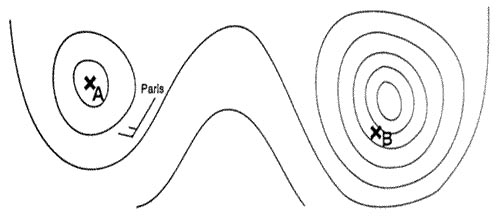
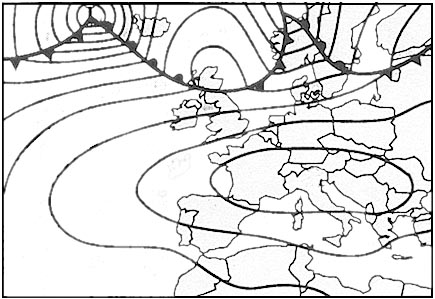
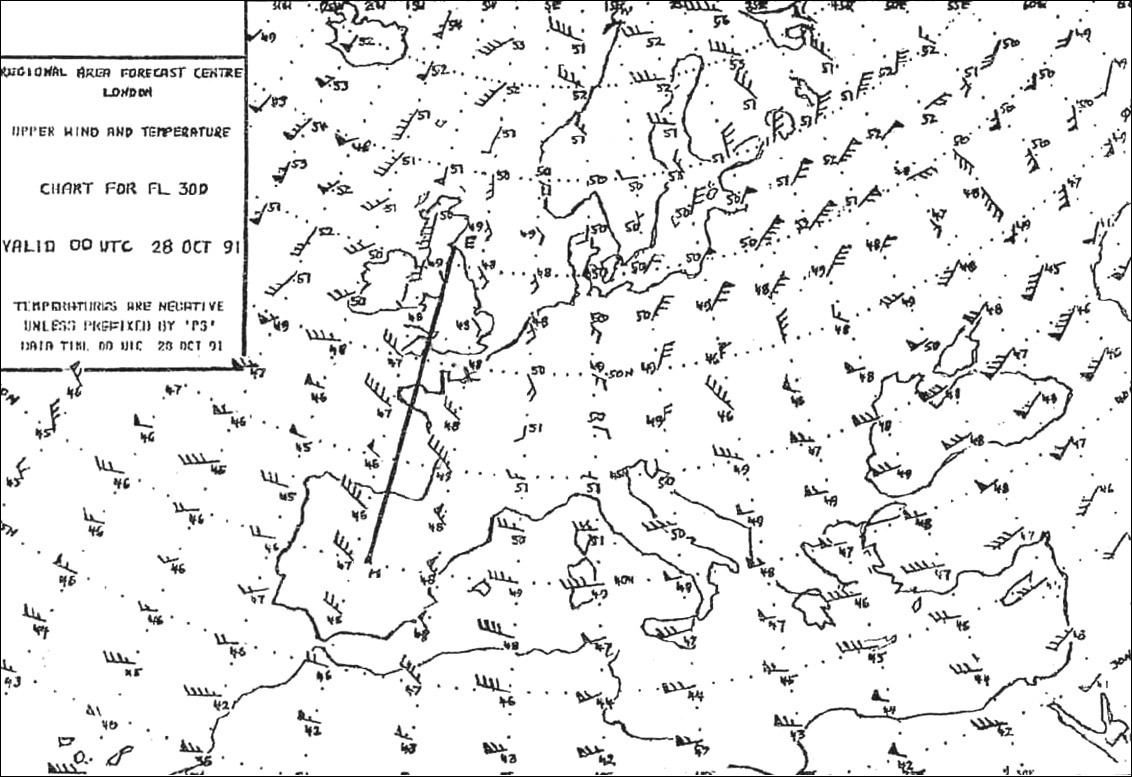
Question 152-22 : An aircraft is flying from point a to point b on the upper level contour chart the altimeter setting is 10132 hpa which of these statements is correct 292 ?
The true altitude will be higher at a than at b.
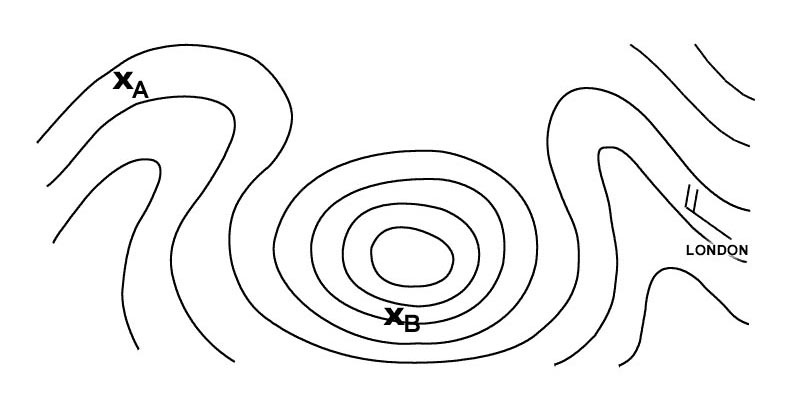
Point a is close to paris and the wind feather shows the wind is anti clockwise so it must be a low pressure if you follow the isobar around then b must be a low pressure as well but there are more isobars so it must be a 'lower' pressuretherefore you are flying from a low to lower pressure or practically from a high to a low true altitude must be higher at aThe true altitude will be higher at b than at a wind speed at a is higher than at b wind speed at paris is higher than at b
Question 152-23 : An aircraft is flying from point a to point b on the upper level contour chartthe altimeter setting is 10132 hpa which of these statements is correct 293 ?
The true altitude will be higher at a than at b.
If you stand with your back to the wind in the northern hemisphere low pressure is on your left buys ballot's law with a wind coming from the west direction and you stand with your back to it low pressure is on your left 542on the annex a is on a higher contour line than b true altitude will be higher at a than at bThe true altitude will be higher at b than at a. wind speed at a is higher than at b. wind speed at a and at b is the same.
Question 152-24 : An aircraft is flying from point a to point b on the upper level contour chart the altimeter setting is 10132 hpa which of these statements is correct 294 ?
The true altitude will be higher at b than at a.
In southern hemisphere wind flows clockwise around a low 543close to point b we can suppose a low pressure area as stated on our drawing but it could be a high pressure areaa is at a lower pressure than in b the true altitude will be higher at b than at aThe true altitude will be higher at a than at b. wind speed at a and at b is the same. wind speed at b is higher than at a.
Question 152-25 : You are planning to fly across a mountain range the chart recommends a minimum altitude of 12000 feet above mean sea levelthe air mass you will be flying through is an average 10°c warmer than isa your altimeter is set to 1023 hpa qnh of a nearby airport at nearly sea level what altitude will the ?
11520 feet.
The air mass is warmer than isa thus your true altitude will be greater than your indicated altitudeyou only have to correct the air above the airport for the temperature deviation qnh is set correctly so to determine the true altitudeheight the following rule of thumb called the '4% rule' shall be used the altitudeheight changes by 4% for each 10°c temperature deviation from isa 4 x 1 x 12000 100 = 480 ftas sait before your true altitude will be greater than your indicated altitude the recommended minimum true altitude is 12000 ft indicated altitude is lower 12000 480 = 11520 ft12210 feet. 11250 feet. 11790 feet.
Question 152-26 : An aircraft lands at an airport airport elevation 540 ft qnh 993 hpa with the altimeter set to 1013 hpa what will it indicate ?
1080 ft.
The qnh is less than isa so the true altitude will be less than the indicatedthe true altitude is 540 ft and the pressure error is 1013 993 = 20 hpa x 27 fthpa = 540 ftindicated altitude will be higher 540 + 540 = 1080 ft700 ft. 380 ft. 0 ft.
Question 152-27 : After landing at an aerodrome qnh 993 hpa it is noticed that the altimeter is still set to 10132 hpa and that it reads 1200 feet what is the elevation of the aerodrome above mean sea level ?
660 feet.
You simply have to turn the altimeter subscale setting knob counterclockwise from 10132 to 993it's a decrease of indicated altitude by 20 hpa x 27 ft = 540 ft1200 ft 540 ft = 660 ft1200 feet. 1740 feet. 2280 feet.
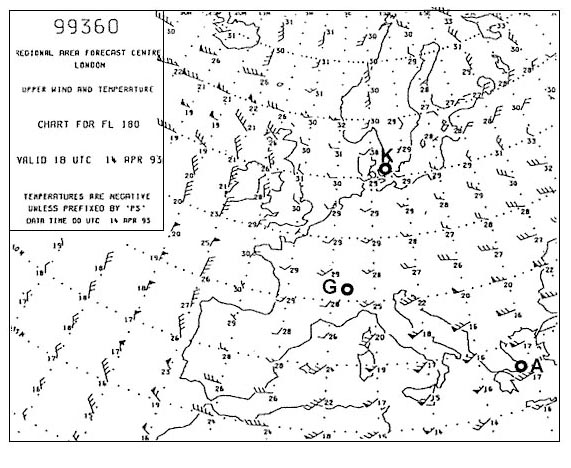
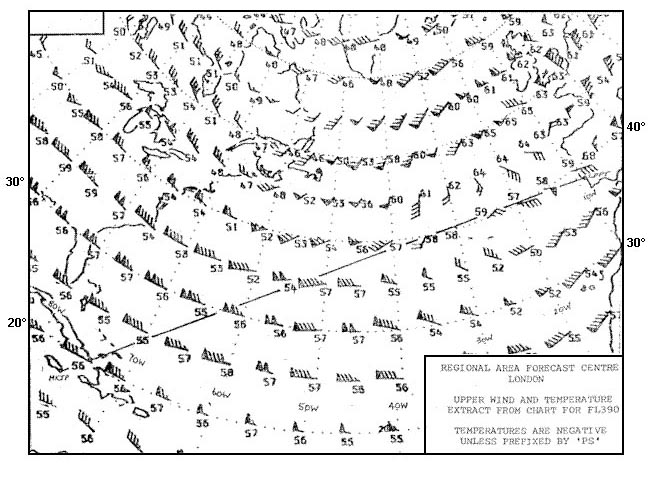
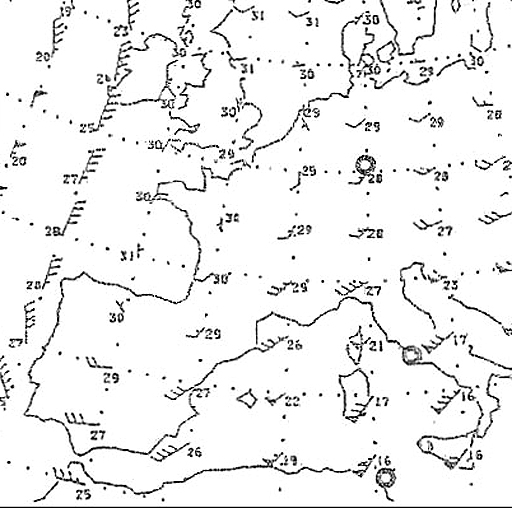
Question 152-28 : Select from the map the average temperature for the route zurich rome at fl 110 303 ?
9°c.
549if you take in account the ' 8' located below the red ' 9' why you don't take in account the ' 3' located just below rome 9 + 7 + 7 3 = 766 766°c at fl100 + 2°c for fl110 = 966°c-13°c. -6°c. +5°c.
Question 152-29 : Select from the map the average temperature for the route athens geneva at fl 150 304 ?
14°c.
Average temperature for the route athens to geneva is around 20°c 16+18+25 3 at fl 180assuming a typical lapse rate of 2°c1000ft at fl 150 it will be 6°c warmer 20°c + 6°c = 14°c-21°c. -11°c. -27°c.
Question 152-30 : What is the deviation of the temperature at fl 140 above copenhagen compared to isa 304 ?
8°c colder than isa.
At fl180 above copenhagen temperature is 29°cat fl180 in a standard atmosphere temperature is 15° 2° x 18 = 21°cas the current temperature at that level is 29°c you can say that at fl180 it is currently isa 8°cwithout other informations for fl140 we can only assume that the same temperature deviation occurs at fl1404°c warmer than isa. 8°c warmer than isa. 12°c colder than isa.
Question 152-31 : Select from the map the average temperature for the route zurich lisboa at fl 200 305 ?
33°c.
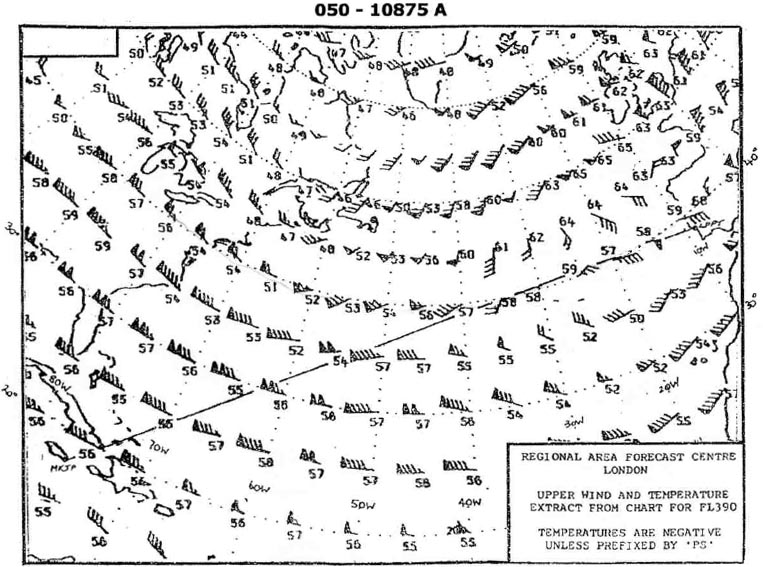
The chart is for fl240 55036 + 38 + 42 + 43 + 42 + 43 + 43 = 2872877 = 41°c+2°1000 ft in standard atmopshere when descendingfl240 ==> fl200 4000 ft ==> +8°c 41 + 8° = 33°c-30°c. -41°c. -49°c.
Question 152-32 : Select from the map the average temperature for the route geneva stockholm at fl260 306 ?
47°c.
This chart is given for fl300at fl260 between geneva and stockholm average temperature is 52 + 54 + 57 + 57 + 56 + 56 6 = around 55°caverage temperature at fl260 is 8° warmer 2° per 1000 ft = 55°c + 8°c = 47°c-55°c. -63°c. -51°c.
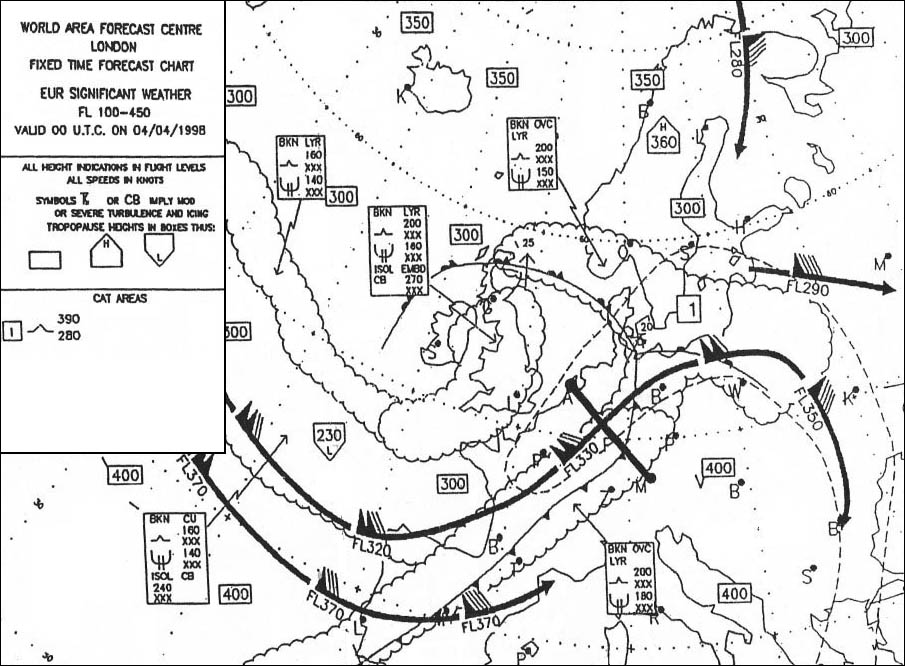
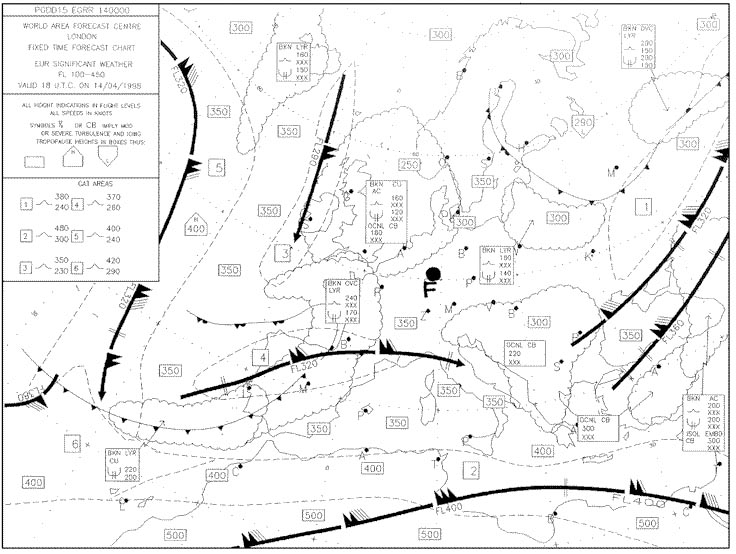
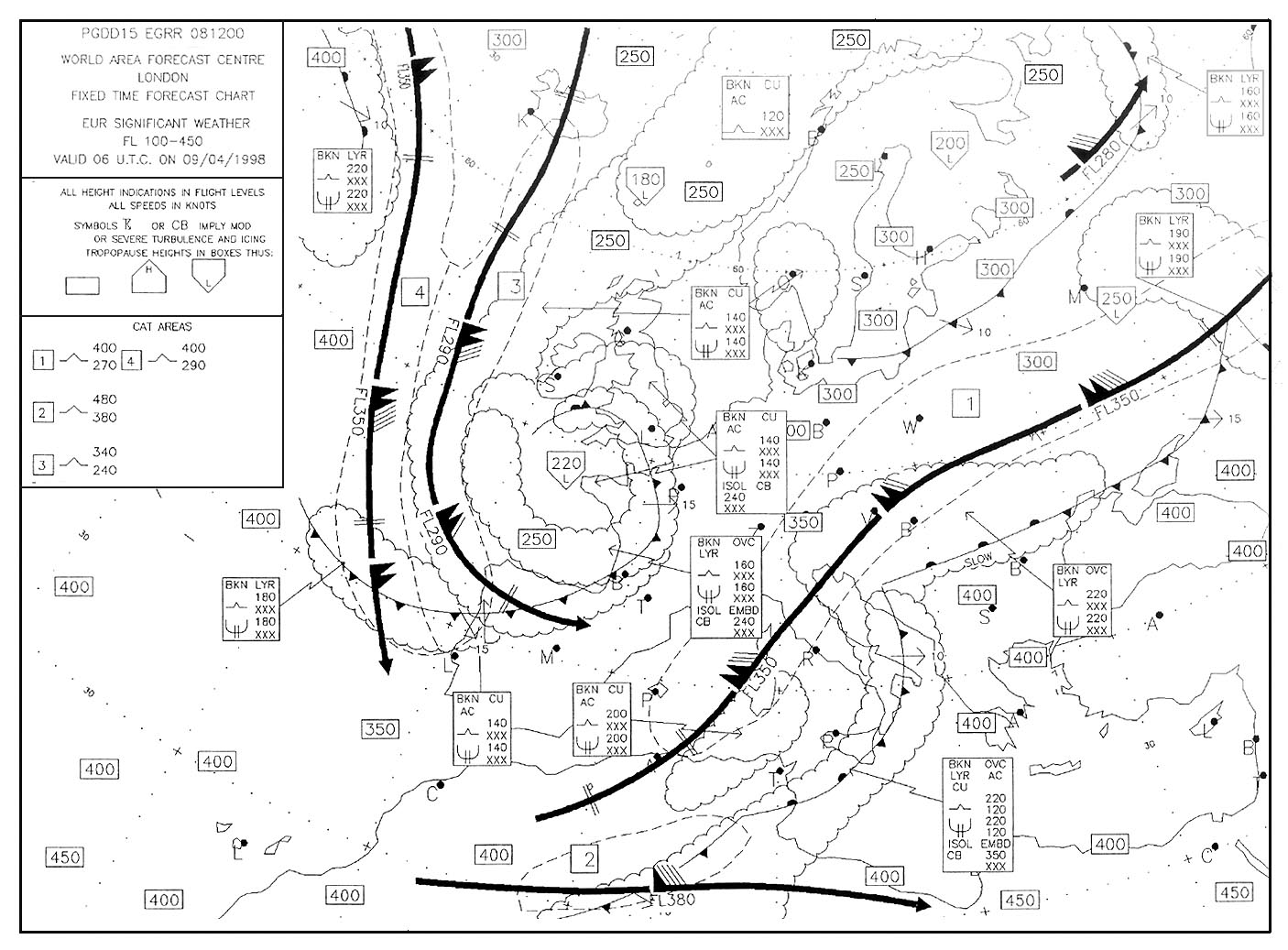
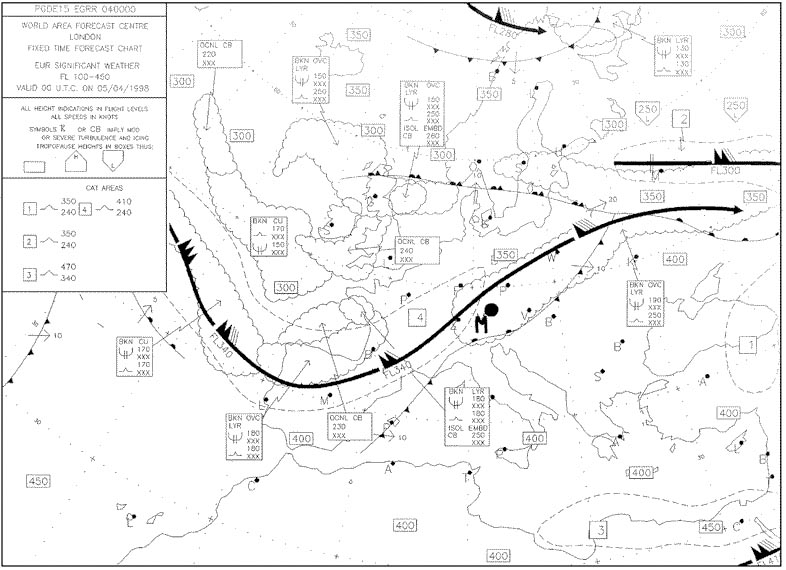
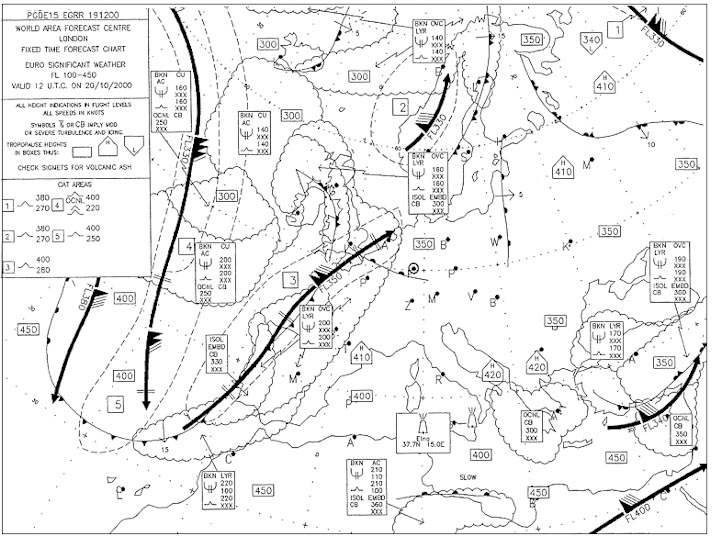
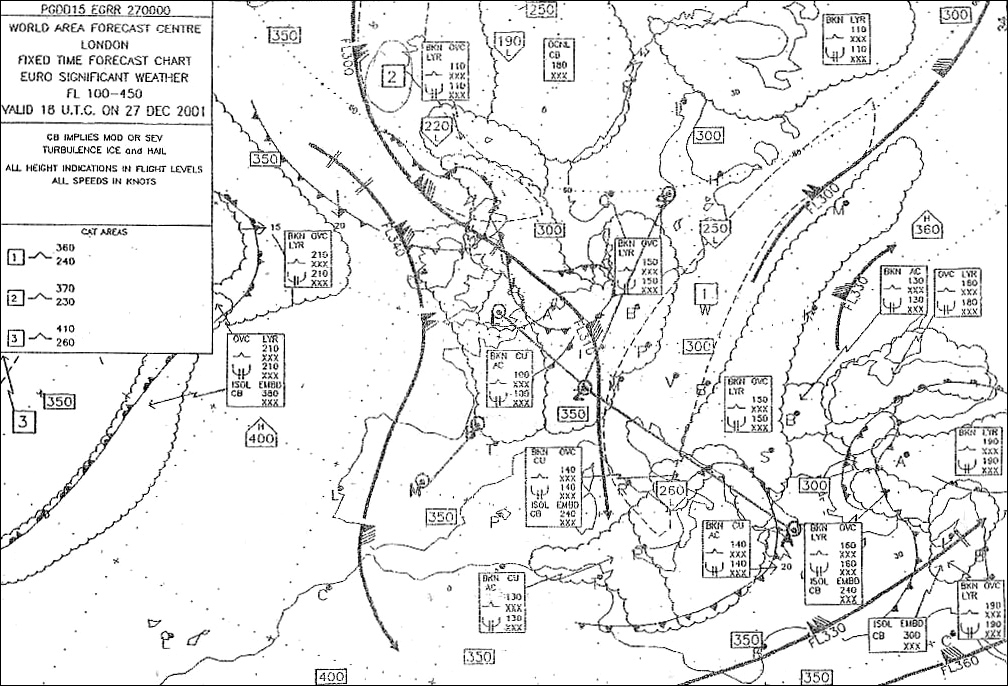
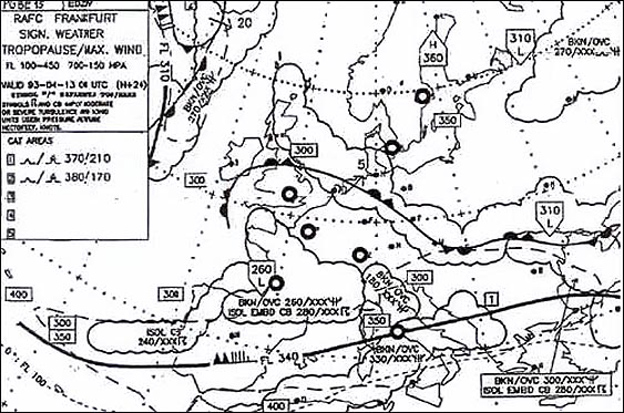
Question 152-33 : Looking at the chart at what altitude above frankfurt would you expect the tropopause to be located 308 ?
Fl 360.
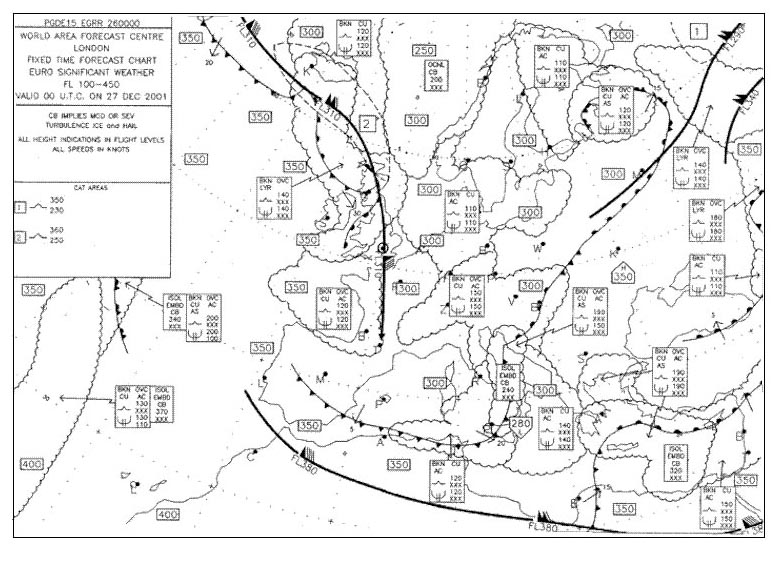
553frankfurt is close to the 350 boxe answer fl360 is the bestFl 410. fl 330. fl 390.
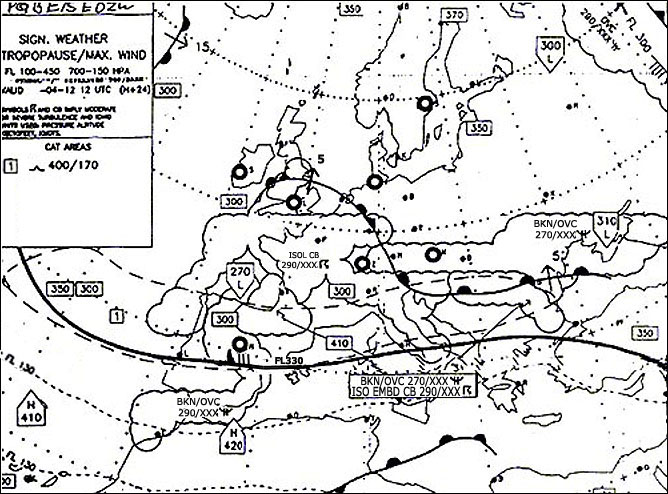
Question 152-34 : If you are flying from zurich to shannon at fl 340 where will your cruising altitude be 311 ?
Constantly in the stratosphere.
555all boxes on the chart indicate a level below fl340 on the zurich to shannon routeConstantly in the troposphere. first in the troposphere and later in the stratosphere. in the stratosphere for part of time.
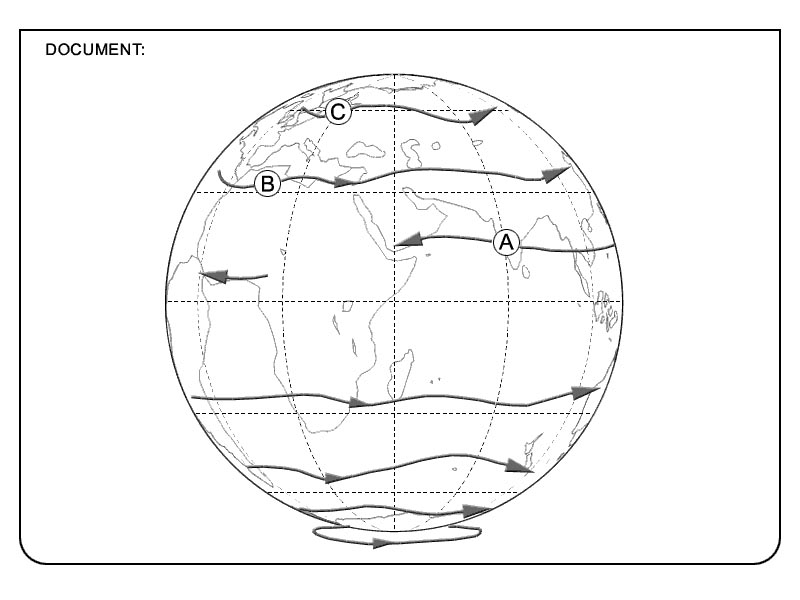
Question 152-35 : The troposphere is the ?
Part of the atmosphere below the tropopause.
633Part of the atmosphere above the stratosphere boundary between the mesosphere and thermosphere boundary between the stratosphere and the mesosphere
Question 152-36 : The tropopause is a level at which ?
Temperature ceases to fall with increasing height.
633the layer from 12 km to 25 km above the tropopause is absolutely stable the temperature does not vary with height it is an isothermal layer where we have absolute stabilityWater vapour content is greatest. pressure remains constant. vertical currents are strongest.
Question 152-37 : The tropopause is lower ?
Over the north pole than over the equator.
558In summer than winter in moderate latitudes south of the equator than north of it over the equator than over the south pole
Question 152-38 : The temperature at 10000 ft in the icao standard atmosphere is ?
5°c.
In standard atmosphere the decrease in temperature per 1000 feet is 2°cthe icao standard atmosphere isa states 'at msl temperature is 15°c and pressure is 101325 hpa'at 10000 ft temperature is 15°c 2°c x 10 = 5°c0°c. -20°c. -35°c.
Question 152-39 : What of the following is the most important constituent in the atmosphere from a weather stand point ?
Water vapour.
Nitrogen. hydrogen. oxygen.
Question 152-40 : The average height of the tropopause at 50°n is about ?
11 km.
5588 km. 14 km. 16 km.
Exclusive rights reserved. Reproduction prohibited under penalty of prosecution.