A free Premium account on the FCL.055 website! Read here
Sign up to unlock all our services and 15164 corrected and explained questions.
Question 153-1 : The height and the temperature of the tropopause are respectively in the order of ? [ Learning aircraft ]
16 km and 75°c over the equator
Question 153-2 : In the icao standard atmosphere the decrease in temperature with height below 11 km is ?
065°c per 100m.
2°c1000 ft1°c per 100m 0.5°c per 100m 0.6°c per 100m
Question 153-3 : Which statement is correct regarding the icao standard atmosphere ?
At msl temperature is 15°c and pressure is 101325hpa.
At msl temperature is 15°c and the decrease in temperature with height is 1°c per 100m at msl temperature is 10°c and the decrease in temperature with height is 1°c per 100m at msl pressure is 1013.25 hpa and the decrease of temperature with height is 1°c per 100m
Question 153-4 : Qnh is defined as ?
Qfe reduced to msl using the values of the standard atmosphere.
Qnh doesn't give you msl mean sea level zero height just the pressure reading at which your altimeter will read zeroin cold air this will be above msl in warm air below mslat isa temperatures the qnh pressure level will be at msl but will not necessarily be 1013 hpaPressure at msl in the standard atmosphere. pressure at msl in the actual atmosphere. qfe reduced to msl using the values of the actual atmosphere.
Question 153-5 : Which of the following statements is true ?
Qnh can be equal to qfe.
Qnh is always lower than qfe. qnh is always higher than qfe. qnh is always equal to qfe.
Question 153-6 : Which statement is true ?
Qnh can be lower as well as higher than 101325 hpa.
Qnh can not be 1013.25 hpa. qnh is lower than 1013.25 hpa at any time. qnh can be 1013.25 hpa only for a station at msl.
Question 153-7 : When the subscale is set to the qnh of an airfield the pressure altimeter indicates ?
Elevation while landing.
Regardless of atmospheric conditions the altimeter will indicate field elevation at touchdown with qnh set because the qnh is the qfe reduced to sea level using isa conditions and the altimeter is calibrated to isa conditionsZero while landing. elevation while landing only if conditions are as in the icao standard atmosphere. zero while landing only if conditions are as in the icao standard atmosphere.
Question 153-8 : The radiation of the sun heats ?
The surface of the earth which heats the air in the troposphere.
The air in the troposphere mainly by absorbtion. the water vapour in the air of the troposphere. the air in the troposphere only directly if no clouds are present.
Question 153-9 : The vertical extent of the friction layer depends primarily on ?
Stability wind speed roughness of surface.
The height of the friction layer can vary depending on the type of terrain and wind speed it depends also on the vertical temperature profile if the air is stable environmental lapse rate less than 18°c1000 ft any air moved up by turbulence will want to sink back to its original level in the atmosphere and there will be a relatively shallow friction layerif the air is unstable elr more than 3°c1000 ft then any movement up will continue up increasing the depth of the friction layerWind speed, roughness of surface, temperature. roughness of surface, temperature, local time. temperature, local time, environmental lapse rate.
Question 153-10 : The following temperatures have been observed over a station at 1200 utc station is at mean sea level 20000 ft 12°c18000 ft 11°c16000 ft 10°c14000 ft 10°c12000 ft 6°c10000 ft 2°c8000 ft +2°c6000 ft +6°c4000 ft +12°c2000 ft +15°csurface +15°cwhich of the following statements is correct ?
Assuming that the msl pressure is 101325 hpa the true altitude of an aircraft would actually be higher than the indicated altitude.
The isa temperature lapse rates is 2°c1000 ft at 2000 ft temperature is +11°cat 4000 ft temperature is +7°cat 6000 ft temperature is +3°cat 8000 ft temperature is 1°cat 10000 ft temperature is 5°cat 12000 ft temperature is 9°cat 14000 ft temperature is 13°cat 16000 ft temperature is 17°cat 18000 ft temperature is 21°cat 20000 ft temperature is 25°capart from sea level we can see from the observed temperatures that the air is warmer than isa throughoutan aircraft at fl180 for example will be at a higher true altitude than 18000 ft indicated altitude The temperature at 10000 ft is in agreement with the temperature in the international standard atmosphere. the layer between 16000 ft and 18000 ft is absolutely unstable. the height of the freezing level over the station is approximately 12000 ft.
Question 153-11 : A significant inversion at low height is a characteristic of ?
Nocturnal radiation.
Air close to the surface is cooled significantly but the air above it isn't and the surface temperature falls below the temperature of the air aboveThe passage of cold front. advection fog. cumulus clouds.
Question 153-12 : In order to reduce qfe to qnh which of the following item s must be known ?
Elevation of the airfield.
Temperature at the airfield. elevation of the airfield and the temperature at msl. elevation of the airfield and the temperature at the airfield.
Question 153-13 : The qnh is equal to the qfe if ?
The elevation = 0.
T actual = t standard t actual < t standard t actual > t standard
Question 153-14 : Which of the following conditions gives the highest value of the qnh ?
Question 153-15 : The pressure altitude is equal to the true altitude if ?
Standard atmospheric conditions occur.
Pressure altitude is the altitude you read on an altimeter it's indicated altitude true altitude depends on temperature pressure altitude is only the same as true altitude in isa conditionsThe outside air temperature is standard for that height. the air pressure is 1013.25 hpa at the surface. the indicated altitude is equal to the pressure altitude.
Question 153-16 : You must make an emergency landing at sea the qnh of a field on a nearby island with an elevation of 4000 ft is 1025 hpa and the temperature is 20°cwhat is your pressure altimeter reading when landing if 1025 hpa is set in the subscale ?
Less than 0 ft.
With temperature below isa we are actually below the indicated altitude but with a subscale of 1025 hpa while landing on the airport 4000 ft would have been correct actual and indicated if you fly lower than the indicated aiport altitude for which qnh has been calculated correction will be reverse in that case in colder air our true actual altitude will be higher than altitude indicated on our altimeterif you perform an emergency landing at sea your altimeter will indicate 0 ft whereas you still are few meters above the sea0 ft. more than 0 ft, but less than 4000 ft. 4000 ft.
Question 153-17 : The troposphere ?
Has a greater vertical extent above the equator than above the poles.
Contains all oxygen of the stratosphere. is the separation layer between the stratosphere and atmosphere. reaches the same height at all latitudes.
Question 153-18 : For a given airfield the qfe is 980 hpa and the qnh is 1000 hpa the approximate elevation of the airfield is ?
160 metres.
The qfe indicates in standard atmosphere the height of the aircraft above the official airport elevation an altimeter set to qfe will therefore read zero when on the ground and you want to know the approximate elevation of the airfield qfe 980 hpa = read zero on the altimeter|| m 8m per hpa = 20 hpa 1000 980 || qnh 1000 hpa8m x 20 hpa = 160 metres600 metres. 540 metres. 120 metres.
Question 153-19 : Which is true of the temperature at the tropopause ?
It is higher in polar regions than in equatorial regions.
Polar tropopause 8km 45°ctropicale tropopause 15 km 75°cequatorial tropopause 16 km 80°c 491It is higher in equatorial regions than in polar regions it is highest in mid-latitudes there is no significant difference with change of latitude
Question 153-20 : Around paris on january 3rd at 1800 utc the surface temperature under shelter is 3°cthe sky is covered by 8 oktas of stratus qnh is 1033 hpaif the sky is covered all night the minimum temperature of the night of january 3rd to january 4th should be ?
Slightly below +3°c.
the sky is covered by 8 oktas of stratus it's overcast the stratus cloud cover will act as a lid close to the surface the heat is kept close from the groundthere will still be a small temperature drop on a winter night thus the minimum temperature should be slightly below +3°cSlightly above +3°c. significantly above +3°c. significantly below 0°c.
Question 153-21 : On a clear sky continental ground surface wind calm the minimum temperature is reached approximately ?
Half an hour after sunrise.
The temperature falls continuously until a little after sunrise the lowest temperature occurs at about sunrise plus 30 minutesHalf an hour before sunrise. at the moment the sun rises. one hour before sunrise.
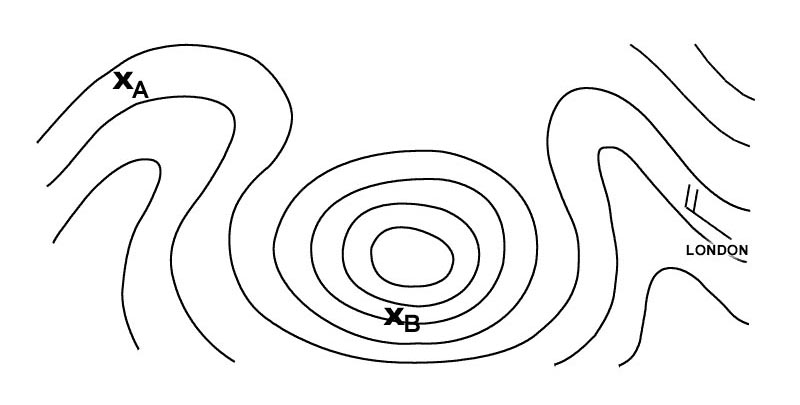
Question 153-22 : An isohypse contour ?
Indicates the true altitude of a pressure level.
Isohypses contour lines are drawn on a constant pressure chart therefore they indicate the true altitude of a pressure levelIs the longest slope line of a frontal surface. is the limit between two air masses of different temperature. indicates the altitude of the zero degree isotherm.
Question 153-23 : Before landing an altimeter set to qfe indicates ?
In standard atmosphere the height of the aircraft above the official airport elevation.
Qfe is a 'q code' used by pilots and air traffic control to refer to the barometric altimeter setting which will cause an altimeter to read height above a particular runway thresholdan altimeter set to qfe will therefore read zero when on the ground at the beginning of the runwaythis setting may be used during take off and landing and when flying in the circuit a mnemonic for the code is 'q field elevation'The flight level. the aircraft's altitude above the mean sea level. the height of the aircraft's wheels above the runway.
Question 153-24 : In the mid latitudes the stratosphere extends on an average from ?
11 to 50 km.
0 to 11 km. 50 to 85 km. 85 to more than 200 km.
Question 153-25 : An aircraft maintains a constant indicated altitude of 4500 ft from a 360 ftamsl qnh 986 hpa to b 690 ftamsl qnh 1011 hpa assuming that the altimeter subscale setting remains unchanged at 986 hpa the actual height of the aircraft above the surface at b will be ?
4485 ft.
The altimeter subscale setting remains unchanged at 986 hpadifference at b 1011 986 = 25 hpa x 27 ft = 675 ft4500 ft 690 ft = 3810 ftactual height of the aircraft above the surface at b will be 3810 ft + 675 ft = 4485 ft gargameleatpl alt elevation = height so correct answer is 3810 675= 3135you should take a break3135 ft is your corret answer but if we provide an other answer and an explanation it might be for a reason when you will be over b with a subscale setting of 986 hpa you gonna turn the selection knob in a counterclockwise direction to set 1011 hpa the indicated altitude will then increased by 25 hpa x 27 ft = 675 ft4500 ft over b + 675 ft = 5175 ftb elevation is 690 ft thus actual height of the aircraft above the surface at b will be 5175 690 = 4485 ft3135 ft. 4815 ft. 5175 ft.
Question 153-26 : An aircraft maintains a constant indicated altitude of 5500 ft from a 1050 ftamsl qnh 968 hpa to b 650 ftamsl qnh 1016 hpa assuming that the altimeter subscale setting remains unchanged at 968 hpa the actual height of the aircraft above the surface at b will be ?
6146 ft.
The altimeter subscale setting remains unchanged at 968 hpadifference at b 1016 968 = 48 hpa x 27 ft = 1296 ft5500 ft 650 ft = 4850 ftactual height of the aircraft above the surface at b will be 4850 ft + 1296 ft = 6146 ft6796 ft. 4854 ft. 7446 ft.
Question 153-27 : An aircraft maintains a constant indicated altitude of 6500 ft from a 600 ftamsl qnh 1012 hpa to b 930 ftamsl qnh 977 hpa assuming that the altimeter subscale setting remains unchanged at 1012 hpa the actual height of the aircraft above the surface at b will be ?
4625 ft.
The altimeter subscale setting remains unchanged at 1012 hpadifference at b 977 1012 = 35 hpa x 27 ft = 945 ft6500 ft 945 ft = 5570 ftactual height of the aircraft above the surface at b will be 5570 ft 945 ft = 4625 ft6515 ft. 5555 ft. 5225 ft.
Question 153-28 : An aircraft maintains a constant indicated altitude of 7500 ft from a 270 ftamsl qnh 1021 hpa to b 1650 ftamsl qnh 983 hpa the altimeter sub scale setting remains unchanged at 1021 hpa the actual height of the aircraft above the surface at b will be ?
4824 ft.
The altimeter subscale setting remains unchanged at 1021 hpadifference at b 983 1021 = 38 hpa x 27 ft = 1026 ft7500 ft 1650 ft = 5850 ftactual height of the aircraft above the surface at b will be 5850 ft 1026 ft = 4824 ft dadoki for better and logical understanding you've got 1021hpa set on the altimeter when you arrive at position b you realize to change your altimeter height and set it to 983 hpato do it of course you turn anticlockwise the knob and height is decreasing on your altimeter altimeter went down about 1026 ft because you've just turned the knob anticlockwise downwards so you get 6474 ft 7500 1026 and to adjust it to the elevation of the point b you subtract the elevation so 6474 1650 = 4824ft if you have a situation where point a has a lower qnh like 970 hpa and you will get at the point with higher qnh like 1020 hpa so you are about to turn the knob clockwise or upwards to get the height in this case the difference is 50 hpa and therefore 50 x 27 = 1350 ft and then you just add this difference and again subtract the elevation of the point b or present point 6204 ft. 6876 ft. 6474 ft.
Question 153-29 : Between mean sea level and a height of 20 km the lowest temperature in the icao standard atmosphere isa is ?
565°c.
-273°c. -44.7°c. -100°c.
Question 153-30 : Considering the north atlantic area north of 60°n during winter the mean height of the tropopause is approximately ?
29 000 ft.
The tropopause is at the top of the troposphere it marks the boundary between the troposphere and the next atmospheric layer the stratosphere the tropopause is defined as being that part of the atmosphere where temperature no longer decreases with height 49129000 ft is approximately 9 kmthe average height of the tropopause over the equator is 16 km and 8 km over the poles at 60°n the mean height of the tropopause is approximately 29 000 ft56 000 ft. 37 000 ft. 20 000 ft.
Question 153-31 : Considering the north atlantic at latitude 50°n during winter the mean height of the tropopause is approximately ?
31 000 ft.
The tropopause is at the top of the troposphere it marks the boundary between the troposphere and the next atmospheric layer the stratosphere the tropopause is defined as being that part of the atmosphere where temperature no longer decreases with height 49131 000 ft is approximately 95 kmthe average height of the tropopause over the equator is 16 km and 8 km over the poles at 50°n the mean height of the tropopause is approximately 31 000 ft23 000 ft. 43 000 ft. 54 000 ft.
Question 153-32 : If the qfe qnh and qff of an airport have the same value ?
The airport must be at msl.
Qfe qnh and qff will all be at the same pressure for having the same value and it can occur only if the airport is at msltemperature or pressure can differ from isa at msl there is no incidenceThe conditions must be as in the isa. the airport must be at msl and the conditions must be as in the isa. the 1013.25 hpa level must be at msl.
Question 153-33 : In relation to the total weight of the atmosphere the weight of the atmosphere between mean sea level and a height of 5500 m is ?
50%.
50% of the atmosphere by mass is below an altitude of 5500 m90% of the atmosphere by mass is below an altitude of 16 km9999997% of the atmosphere by mass is below 100 km1%. 25%. 99%.
Question 153-34 : The icao standard atmosphere isa assumes that temperature will reduce at the rate of ?
198°c per 1000 ft up to 36090 ft after which it remains constant to 65617 ft.
1,98°c per 1000 ft up to 36090 ft and will then rise at 0,3°c per 1000 ft up to 65617 ft when it will remain constant. 2°c per 1000 ft up to 65617 ft after which it will remain constant to 104987 ft. 2°c per 1000 ft up to 36090 ft and will then increase at 0,3°c per 1000 ft up to 65617 ft.
Question 153-35 : With all other quantities being constant the density of the atmosphere increases with increasing ?
Air pressure.
Density depends on pressure and temperaturedensity is proportional to air pressure and inversely proportional to temperatureRelative humidity. stability. temperature.
Question 153-36 : You are flying over the sea at fl 250 and measure an outside temperature of 50°c the pressure at sea level is 1023 hpawhat is your approximate true altitude calculated using normal vertical change in temperature with increase in height ?
23770 ftamsl.
The following rules shall be considered for altimetry calculations the value for the barometric lapse rate near mean sea level is 27 ft 8 m per 1 hpa to determine the true altitudeheight the following rule of thumb called the '4% rule' shall be used the altitudeheight changes by 4% for each 10°c temperature deviation from isa 1023 1013 = 10 hpa10 x 27 = 270 ft25000 ft + 270 ft = 25270 ftaltitudeheight changes by 4% for each 10°c temperature deviation from isatemperature correction = 4 x 2527 x 15temperature correction is minus 15162 ft since air is colder than isa and we are looking for our true altitude our altimeter remains at fl250 setting 1013 our approximate true altitude 25270 1516 = 23754 ftclose enough to the result desired26230 ft/amsl. 26770 ft/amsl. 23230 ft/amsl.
Question 153-37 : You are flying at fl 200outside air temperature is 40°c and the pressure at sea level is 1033 hpawhat is the true altitude ?
19310 ft.
1033 1013 = 20 hpa x 27 ft = 540 ftin isa conditions altitude is 20540 ft and oat will be 15°c 2°c x 20 = 25°coat is 40°c to determine the true altitudeheight the following rule of thumb called the '4% rule' shall be used the altitudeheight changes by 4% for each 10°c temperature deviation from isa 4% x 2054 x 15 = 1232 ft20540 1232 = 19308 ft minus 1232 ft because the air mass is colder than isa 20630 ft. 21770 ft. 18290 ft.
Question 153-38 : You are flying at fl 160outside air temperature is 27°c and the pressure at sea level is 1003 hpawhat is the true altitude ?
15100 ft.
1013 1003 = 10 hpa x 27 ft = 270 ftin isa conditions altitude is 15730 ft and oat will be 15°c 2°c x 16 = 17°coat is 27°c to determine the true altitudeheight the following rule of thumb called the 4% rule shall be used the altitudeheight changes by 4% for each 10°c temperature deviation from isa 4% x 1573 x 10 = 629 ft15730 629 = 15101 ft minus 629 ft because the air mass is colder than isa 15620 ft. 16360 ft. 16920 ft.
Question 153-39 : Which statement concerning the tropopause is correct ?
The layer just above the tropopause is absolutely stable.
633the layer just above the tropopause is absolutely stable from 12 km to 25 km the temperature does not vary with height it is an isothermal layer where we have absolute stability note the icao standard atmosphere does not state that the tropopause has different heights around the earth tropopause is constant at 11 km for icao Above the tropopause no clear air turbulence occurs. in the icao standard atmosphere the tropopause lies lower over the poles than over the equator. the temperature at the tropopause is approximately -80°c over the poles and -40°c over the equator.
Question 153-40 : Pressure altitude is obtained by ?
Setting the altimeter to standard sea level pressure.
101325 hpa is the isa mean sea level pressure also known as 'standard pressure setting'in non isa conditions the 101325 hpa pressure level will be above or below mean sea level the standard pressure setting is used as an altimeter setting above the transition altitudeCorrecting the altimeter for temperature deviation from isa. setting the altimeter to a station pressure which has been corrected to sea level. setting the altimeter to qff pressure.
Exclusive rights reserved. Reproduction prohibited under penalty of prosecution.