A free Premium account on the FCL.055 website! Read here
Sign up to unlock all our services and 15164 corrected and explained questions.
Question 160-1 : Rising air cools because ? [ Formation assignment ]
It expands
Question 160-2 : A layer can be ?
Stable for unsaturated air and unstable for saturated air.
If the environmental lapse rate elr is more than 3°c1000 ft dry adiabatic lapse rate the environment is unstableif the environmental lapse rate elr is less than 18°c1000 ft saturated adiabatic lapse rate the environment is stablebut if the environmental lapse rate elr is more than 18°c1000 ft but less than 3°c1000 ft we have conditional stability stable if air is dry unsaturated or unstable if air is saturated Stable for saturated air and unstable for unsaturated air. unstable for unsaturated air and neutral for saturated air. unstable for unsaturated air and conditionally unstable.
Question 160-3 : In a layer of air the decrease in temperature per 100 metres increase in height is more than 1°c this layer can be described as being ?
Absolutely unstable.
More than 1°c100 m = more than 3°c1000 ftif the environmental lapse rate elr is more than 3°c1000 ft dry adiabatic lapse rate the environment is unstableif the environmental lapse rate elr is less than 18°c1000 ft saturated adiabatic lapse rate the environment is stableif the environmental lapse rate elr is more than 18°c1000 ft but less than 3°c1000 ft we have conditional stability stable if air is dry unsaturated or unstable if air is saturatedAbsolutely stable. conditionally unstable. conditionally stable.
Question 160-4 : Which statement is true for a conditionally unstable layer ?
The environmental lapse rate is less than 1°c100 m.
More than 1°c100 m = more than 3°c1000 ftif the environmental lapse rate elr is more than 3°c1000 ft dry adiabatic lapse rate the environment is unstableif the environmental lapse rate elr is less than 18°c1000 ft saturated adiabatic lapse rate the environment is stableif the environmental lapse rate elr is more than 18°c1000 ft but less than 3°c1000 ft we have conditional stability stable if air is dry unsaturated or unstable if air is saturatedThe environmental lapse rate is less than 0.65°c/100 m. the layer is unstable for unsaturated air. the wet adiabatic lapse rate is 0.65°c/100 m.
Question 160-5 : The stability in a layer is increasing if ?
Warm air is advected in the upper part and cold air in the lower part.
It is similar to an inversionif a parcel of air is forced to rise it will be colder than the air it is rising into so the moment the trigger stops lifting it it will sink back to the level it started from because it is more dense the layer is stableWarm air is advected in the lower part and cold air in the upper part. warm and moist air is advected in the lower part. cold and dry air is advected in the upper part.
Question 160-6 : Which of the following statements concerning the lifting of a parcel of air is correct ?
Unsaturated parcels cool more rapidly than saturated parcels.
There is less moisture in an unsaturated parcels to retain heatUnsaturated parcels cool less rapidly than saturated parcels. unsaturated parcels cool at a rate of 0.65°c per 100 m. saturated parcels always cool at a rate of 0.65°c per 100 m.
Question 160-7 : When in the upper part of a layer warm air is advected the ?
Stability increases in the layer.
It is similar to an inversionif a parcel of air is forced to rise it will be colder than the air it is rising into so the moment the trigger stops lifting it it will sink back to the level it started from because it is more dense the stability increases in the layerStability decreases in the layer. wind will back with increasing height in the northern hemisphere. wind speed will always decrease with increasing height in the northern hemisphere.
Question 160-8 : The dew point temperature ?
Can be equal to the air temperature.
Is always lower than the air temperature. is always higher than the air temperature. can not be equal to the air temperature.
Question 160-9 : Relative humidity depends on ?
Moisture content and temperature of the air.
Moisture content and pressure of the air moisture content of the air only temperature of the air only
Question 160-10 : When water evaporates into unsaturated air ?
Heat is absorbed.
A known phenomena when water evaporates into unsaturated air is that the air is cooled the water transitioning from a liquid state to a gaseous state is transitioning from a lower energy state to a higher energy state the energy required for this transition to take place is provided to the water in the form of heat that is taken out of the surrounding air this latent heat of vaporization leaving the air causes a temperature of the air to be reducedHeat is released. relative humidity is not changed. relative humidity is decreased.
Question 160-11 : A moist but unsaturated parcel of air becomes saturated by ?
Lifting the parcel to a higher level.
Air can hold a certain amount of water depending on it's temperature warmer air can hold more water vapour than colder airthus by cooling the air it can hold less water vapour and the relative humidity increases how does air cool usually by increasing in heightso to get an unsaturated parcel of air with say 40% of relative humidity to 100% of relative humidity fully saturated a cloud then you must cool the parcel by lifting it to a higher levelLowering the parcel to a lower level. moving the parcel to an area with lower pressure and equal temperature. moving the parcel to an area with higher pressure and equal temperature.
Question 160-12 : A sample of moist but unsaturated air may become saturated by ?
Expanding it adiabatically.
Fabricet don't get why an unsaturated air mass could become saturated by expanding it adiabatically by compressing it the relative humidity will increase until reaching the 100% of humidity making the air mass saturated if you compress it it will heat up and if you expand it will coolduring an adiabatic process heat is neither added nor lost air can hold a certain amount of water depending on it's temperature warmer air can hold more water vapour than colder airthus by cooling the air it can hold less water vapour and the relative humidity increases how does air cool usually by increasing in heightso to get an unsaturated parcel of air with say 40% of relative humidity to 100% of relative humidity fully saturated a cloud then you must cool the parcel by lifting it to a higher level when it expands adiabatically it cools so relative humidity must increaseRaising the temperature. lowering the pressure, keeping temperature constant. compressing it adiabatically.
Question 160-13 : The maximum amount of water vapour that the air can contain depends on the ?
Air temperature.
The most commonly used measure of humidity is relative humidity relative humidity can be simply defined as the amount of water in the air relative to the saturation amount the air can hold at a given temperature multiplied by 100 air with a relative humidity of 50% contains a half of the water vapor it could hold at a particular temperature 501 concept of relative humidity we can say that the amount of water vapour which air can hold largely depends on air temperature Relative humidity. stability of the air. dewpoint.
Question 160-14 : Convective clouds are formed ?
In unstable atmosphere.
In stable atmosphere. in summer during the day only. in mid-latitudes only.
Question 160-15 : The most effective way to dissipate cloud is by ?
Subsidence.
Convection. a decrease in temperature. a decrease in pressure.
Question 160-16 : Areas of sinking air are generally cloudless because as air sinks it ?
Is heated by compression.
As the air sinks to lower levels the pressure increases which compresses the air increasing density and temperatureas the air temperature increases its capacity to hold water vapour increases and relative humidity decreasesReaches warmer layers. is heated by expansion. loses water vapour.
Question 160-17 : The main factor which contributes to the formation of very low clouds ahead of a warm front is the ?
Saturation of the cold air by rain falling into it and evaporating.
Clouds form in the front rain falls from them out of the warm sector into the cold sector 559latent heat is absorbed when going from liquid to gas vapour at low levels you will have stratus and nimbostratus cloudsSaturation of the warm air by rain falling into it and evaporating. reduction of outgoing radiation due to clouds. warm air moving over a cold surface.
Question 160-18 : In an unstable layer there are cumuliform clouds the vertical extent of these clouds depends on the ?
Thickness of the unstable layer.
Wind direction air pressure at the surface pressure at different levels
Question 160-19 : Which of the following phenomena are formed when a moist stable layer of air is forced to rise against a mountain range ?
Stratified clouds.
Lifting moist stable layer of air produces stratusInversions. showers and thunderstorms. areas of severe turbulence.
Question 160-20 : The height of the lifting condensation level is determined by ?
Temperature and dewpoint at the surface.
560the height of a cloud base that results from lifting of near surface air can be estimated based on the surface values of temperature and dew point since the height at which a cloud will form is roughly the height at which the temperature and dew point would become equal due to expansion of the air as it rises to regions of lower pressureTemperature at surface and air pressure. wind and dewpoint at the surface. wet adiabatic lapse rate and dewpoint at the surface.
Question 160-21 : During an adiabatic process heat is ?
Neither added nor lost.
Added. lost. added but the result is an overall loss.
Question 160-22 : The decrease in temperature per 100 metres in an unsaturated rising parcel of air is ?
1°c.
1°c100 m or 3°c1000 ft this is the dry adiabatic lapse rate 2°c. 0.65°c. 0.5°c.
Question 160-23 : The decrease in temperature per 100 metres in a saturated rising parcel of air at lower level of the atmosphere is approximately ?
06°c.
Dry lapse rate = 3ºc1000 ft or 1ºc100 msaturated lapse rate = 1ºc1000 ft or 06ºc100 m1°c. 1.5°c. 0.35°c.
Question 160-24 : In unstable air ground visibility is most likely to be restricted by ?
Showers of rain or snow.
Haze. drizzle. low stratus.
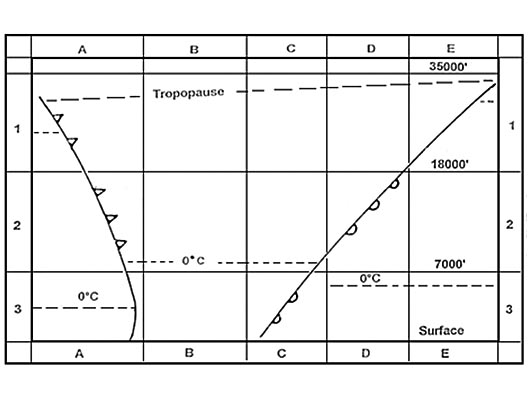
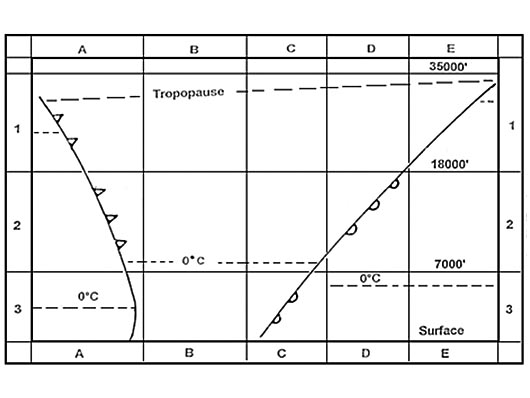
Question 160-25 : A vertical temperature profile indicates the possibility of severe icing when the temperature profile ?
Intersects the 0°c isotherm twice.
To intersect the 0ºc isotherm twice there must be warm air above cold air this occurs at a warm front and is where rain ice will be encounteredCoincides with a dry adiabatic lapse rate. indicates temperatures below -40°c. indicates temperatures above 3°c.
Question 160-26 : The rate of cooling of ascending saturated air is less than the rate of cooling of ascending unsaturated air because ?
Heat is released during the condensation process.
Moist air is heavier than dry air. water vapour doesn't cool as rapidly as dry air. water vapour absorbs the incoming heat from the sun.
Question 160-27 : If the surface temperature is 15°c then the temperature at 10000 ft in a current of ascending unsaturated air is ?
15°c.
ascending unsaturated air means dry adiabatic lapse rate and we know that the environmental lapse rate elr is more than 3°c1000ft for dry adiabatic lapse rate 15°c 3° x 10 = 15°c0°c. 5°c. -5°c.
Question 160-28 : An inversion is ?
An increase of temperature with height.
An increase of pressure with height a decrease of pressure with height a decrease of temperature with height
Question 160-29 : In still air the temperature decreases at an average of 12°c per 100 m increase in altitude this temperature change is called ?
Dry adiabatic lapse rate.
If the environmental lapse rate elr is more than 3°c1000 ft dry adiabatic lapse rate the environment is unstableif the environmental lapse rate elr is less than 18°c1000 ft saturated adiabatic lapse rate the environment is stableif the environmental lapse rate elr is more than 18°c1000 ft but less than 3°c1000 ft we have conditional stability stable if air is dryor unstable if air is saturated12°c per 100m is 36°c per 1000 ftthe environmental lapse rate elr is more than 3°c1000 ft this temperature change is called 'dry adiabatic lapse rate'Saturated adiabatic lapse rate. environmental lapse rate. normal lapse rate.
Question 160-30 : From which of the following pieces of information can the stability of the atmosphere be derived ?
Environmental lapse rate.
If the environmental lapse rate elr is more than 3°c1000ft dry adiabatic lapse rate the environment is unstableif the environmental lapse rate elr is less than 18°c1000ft saturated adiabatic lapse rate the environment is stableif the environmental lapse rate elr is more than 18°c1000ft but less than 3°c1000ft we have conditional stability stable if air is dryor unstable if air is saturatedDry adiabatic lapse rate. surface temperature. pressure at the surface.
Question 160-31 : A layer is absolutely unstable if the temperature decrease with height is ?
More than 1°c per 100m.
If the environmental lapse rate elr is more than 3°c1000 ft dry adiabatic lapse rate the environment is unstableif the environmental lapse rate elr is less than 18°c1000 ft saturated adiabatic lapse rate the environment is stableif the environmental lapse rate elr is more than 18°c1000 ft but less than 3°c1000 ft we have conditional stability if air is dryor unstability if air is saturatedthe question states absolutely unstable it is more than 3°c1000 ft3°c1000 ft = 1°c per 328 ft = 1°c for 100 mBetween 1°c per 100m and 0.65°c per 100m. 0.65°c per 100m. less than 0.65°c per 100m.
Question 160-32 : A layer in which the temperature remains constant with height is ?
Absolutely stable.
A layer in which the temperature remains constant or increases with height is absolutely stablefor example the layer just above the tropopause is absolutely stable from 12 km to 25 km the temperature does not vary with height it is an isothermal layer where we have absolute stability Unstable. neutral. conditionally unstable.
Question 160-33 : A layer in which the temperature increases with height is ?
Absolutely stable.
A layer in which the temperature remains constant or increases with height is absolutely stablefor example the layer just above the tropopause is absolutely stable from 12 km to 25 km the temperature does not vary with height it is an isothermal layer where we have absolute stability Absolutely unstable. conditionally unstable. neutral.
Question 160-34 : A layer in which the temperature decreases with 1°c per 100 m increasing altitude is ?
Neutral for dry air.
Lapse rate is 1°c for 100 m 1° per 328 ft so 3°1000 ft we have four possibilities if the environmental lapse rate elr is more than 3°c1000 ft dry adiabatic lapse rate the environment is unstableif the environmental lapse rate elr is less than 18°c1000 ft saturated adiabatic lapse rate the environment is stableif the environmental lapse rate elr is more than 18°c1000 ft but less than 3°c1000 ft we have conditional stability if air is dryor unstability if air is saturatedthe question states 1°c per 100m it is not more or not less than 3°c1000 ft it will be neutral for dry airAbsolutely stable. absolutely unstable. conditionally unstable.
Question 160-35 : If in a 100 m thick layer the temperature at the bottom of the layer is 10°c and at the top of the layer is 8°c then this layer is ?
Absolutely unstable.
If the environmental lapse rate elr is more than 3°c1000 ft dry adiabatic lapse rate the environment is unstableif the environmental lapse rate elr is less than 18°c1000 ft saturated adiabatic lapse rate the environment is stableif the environmental lapse rate elr is more than 18°c1000 ft but less than 3°c1000 ft we have conditional stability stable if air is dryor unstable if air is saturatedin our layer the environmental lapse rate is 2°c300 ft or around 6°c1000 ft which is absolutely unstableAbsolutely stable. conditionally unstable. neutral.
Question 160-36 : A wide body takes off on a clear night in dhahran saudi arabia shortly after take off the aircraft's rate of climb drops to zero this can be due to ?
A very strong temperature inversion.
The question states 'clear night' we can exclude sand or dust in the engines very pronounced downdrafts might be a acceptable answer but it means unstable air and clouds it can't be a clear nighthumidity will not sufficiently affect lift and engine power to visually decrease the rate of climbduring the night radiation will cool the surface which then cools the air close to the surface the air temperature at 3 4000 ft the air is still very warm this is a very strong temperature inversion less density less lift and less power Sand/dust in the engines. very pronounced downdrafts. low relative humidity.
Question 160-37 : The value of the saturated adiabatic lapse rate is closest to that of the dry adiabatic lapse rate in ?
Cirrus.
If the environmental lapse rate elr is more than 3°c1000 ft dry adiabatic lapse rate the environment is unstable if the environmental lapse rate elr is less than 18°c1000 ft saturated adiabatic lapse rate the environment is stable if the environmental lapse rate elr is more than 18°c1000 ft but less than 3°c1000 ft we have conditional stability stable if air is dryor unstable if air is saturatedas we go up in the atmosphere the air gets colder and the dry adiabatic lapse rate and the saturated adiabatic lapse rate become closer because the moisture varies the colder the air mass is the lesser moisture it can contain cirrus clouds are located at high levels near the lowest temperatures of the troposphereFreezing fog. stratus. cumulonimbus.
Question 160-38 : Dew point is defined as ?
The temperature to which moist air must be cooled to become saturated at a given pressure.
The lowest temperature at which evaporation will occur for a given pressure the lowest temperature to which air must be cooled in order to reduce the relative humidity the temperature below which the change of state in a given volume of air will result in the absorption of latent heat
Question 160-39 : The process by which water vapour is transformed directly into ice is known as ?
Sublimation.
The answer should be 'deposition'sublimation ice to water vapour deposition water vapour to icebut the expression 'sublimation' may be be used for both processesSupercooling. supersaturation. radiation cooling.
Question 160-40 : A foehn wind occurs on the ?
Leeward side of a mountain range and is caused by significant moisture loss by precipitation from cloud.
Windward side of a mountain range and is caused by surface heating windward side of a mountain range and is caused by surface cooling and reverse air flow leeward side of a mountain range and is caused by the condensation level being lower on the leeward side than on the windward side
Exclusive rights reserved. Reproduction prohibited under penalty of prosecution.