A free Premium account on the FCL.055 website! Read here
Sign up to unlock all our services and 15164 corrected and explained questions.
Question 196-1 : Given tas = 465 kt track t = 007° wv = 30080ktcalculate the hdg °t and gs ? [ Level reports ]
358° 428 kt
Question 196-2 : Given tas = 200 kt track t = 110° wv = 01540 ktcalculate the hdg °t and gs ?
099° 199 kt.
Under index set true track 110° centre dot on tas 200 kt with the rotative scale set wind 1775now drift is always measured from heading to track turn to set true heading 099° 110° 11° right drift under index you now read a ground speed of 198 kt cmarzocchini the answer is wrong you have tail wind correct answer using sin and cos and cr3 098205 don't be so confident and read carefully the explanation drift is always measured from heading to track when you will be on your track with the correct heading to counteract drift the wind becomes a headwind121° - 207 kt. 121° - 199 kt. 097° - 201 kt.
Question 196-3 : Given true hdg = 307° tas = 230 kt track t = 313° gs = 210 ktcalculate the wv ?
26030kt.
True heading is 307° true track is 313° our drift is 6° right 2492wind 261°30kt257/35kt. 255/25kt. 265/30kt.
Question 196-4 : Given true hdg = 133° tas = 225 kt track t = 144° gs = 206 ktcalculate the wv ?
07545kt.
True heading is 133° true track is 144° our drift is 11° right 2493065/45kt. 060/50kt. 075/70kt.
Question 196-5 : Given true heading = 206° tas = 140 kt true track = 207° gs = 135 ktcalculate the wind ?
180°05 kt.
True heading is 206° true track is 207° our drift is 1° right com encom061 192jpgwind 180°05 kt000°/05 kt. 000°/10 kt. 180°/10 kt.
Question 196-6 : Given true heading = 145° tas = 240 kt true track = 150° gs = 210 ktcalculate the wind ?
115°35 kt.
True heading is 145° true track is 150° our drift is 5° right com encom061 194jpgwind 115°35 kt360°/35 kt. 180°/35 kt. 295°/35 kt.
Question 196-7 : Given true hdg = 035° tas = 245 kt track t = 046° gs = 220 ktcalculate the wv ?
34050kt.
True heading is 035° true track is 046° our drift is 11° right 2520335/45kt 335/55kt 340/45kt
Question 196-8 : Given course required = 085° t forecast wv 030100kt tas = 470 kt distance = 265 nm calculate the true hdg and flight time ?
075° 39 min.
Tas = 470 kttrue course = 085°vw = 030°100ktdrift = gs = a set true track to true index b turn the indicator to the wind direction in this case using the black azimuth graduation the angle being upwind counting anti clockwise c shift the speed arc corresponding to the true air speed so as to coincide with the wind speed on the indicator d read the wind correction at the same place read the ground speed under the center bore from the scal on the axis of the slide setting set 85° to true index set the indicator to 030° on the black azimuth circle being upwind adjust the speed arc labelled 470 of the diagram slide to the wind speed 10 100 kt of the indicator scale reading under the plotted point read the wind correction angle 10° under the center bore read the ground speed 405 kt 1770then true heading = true course drift = 085° 10° = 075°40560 = 675 nmminutes265675 = 39 minutes095°, 31 min. 096°, 29 min. 076°, 34 min.
Question 196-9 : For a landing on runway 23 227° magnetic surfacewind reported by the atis is 18030 ktvariation is 13°ecalculate the cross wind component ?
22 kt.
Wind from tower is already corrected for variation the wind from tower refers to magnetic northwind angle = 227° 180° = 47°crosswind = windspeed x sin wind anglecrosswind = 30 kt x sin 47° = 22 kt26 kt. 15 kt. 20 kt.
Question 196-10 : Given maximum allowable tailwind component for landing 10 kt planned runway 05 047° magnetic the direction of the surface wind reported by atis 210° variation is 17°e calculate the maximum allowable windspeed that can be accepted without exceeding the tailwind limit ?
10 kt.
Wind from tower atis is recorded by the tower is already corrected for variation the wind from tower refers to magnetic norththis is a tailwind our wind angle is = 047°+180° 210° = 17°tailwind = windspeed x cos 17° = 10 ktmaximum allowable windspeed = 10 kt cos 17° = 1046 kt8 kt. 15 kt. 18 kt.
Question 196-11 : Given maximum allowable crosswind component is 20 ktrunway 06 rwy qdm 063° m wind direction 100° m calculate the maximum allowable windspeed ?
33 kt.
Wind angle = 100° 063° = 37°crosswind = windspeed x sin 37° = 20 ktmaximum allowable windspeed = 20 kt sin 37° = 33 kt27 kt. 25 kt. 16 kt.
Question 196-12 : Given true course a to b = 250°distance a to b = 315 nmtas = 450 ktwv = 200°60ktetd a = 0650 utc what is the eta at b ?
0736 utc.
Set 250° under index center dot on tas 450 kt and wind 200º60kt 2522drift is 6° rightnow set heading 244° under index read ground speed 410 kt315 nm 410 kt = 0768 hour = 46 minutes 0768 x 60 etd at a is 0650 utc + 46 minutes = 0736 utc 0730 utc. 0810 utc. 0716 utc.
Question 196-13 : Given gs = 510 kt distance a to b = 43 nmwhat is the time from a to b ?
Question 196-14 : Given gs = 122 ktdistance from a to b = 985 nmwhat is the time from a to b ?
8 hr 04 min.
985 nm 122 kt60 min = 484 minutes 8h04 7 hr 48 min. 7 hr 49 min. 8 hr 10 min.
Question 196-15 : Given gs = 435 kt distance from a to b = 1920 nmwhat is the time from a to b ?
4 hr 25 min.
1920 nm 435 kt60 min = 265 minutes 4h25 3 hr 25 min. 3 hr 26 min. 4 hr 10 min.
Question 196-16 : Given gs = 480 kt distance from a to b = 5360 nmwhat is the time from a to b ?
11 hr 10 min.
5360 nm 480 kt60 min = 670 minutes 11h10 11 hr 06 min. 11 hr 07 min. 11 hr 15 min.
Question 196-17 : Given gs = 105 kt distance from a to b = 103 nmwhat is the time from a to b ?
00 hr 59 min.
103 nm 105 kt60 min = 59 minutes00 hr 57 min. 00 hr 58 min. 01 hr 01 min.
Question 196-18 : Given gs = 135 kt distance from a to b = 433 nmwhat is the time from a to b ?
3 hr 12 min.
433 nm 135 kt60 min = 192 minutes 3h12 3 hr 25 min. 3 hr 19 min. 3 hr 20 min.
Question 196-19 : Given runway direction 083° m surface wwind 03535 ktcalculate the effective headwind component ?
24 kt.
Angle between the wind and the direction of the runway 083° 035° = 48°effective headwind = cos of the angle between the wind and the direction of the runway x windspeedeffective headwind = cos 48° x 35 kt = 2342 kt27 kt. 31 kt. 34 kt.
Question 196-20 : Given for take off an aircraft requires a headwind component of at least 10 kt and has a cross wind limitation of 35 kt the angle between the wind direction and the runway is 60° calculate the minimum and maximum allowable wind speeds ?
20 kt and 40 kt.
Crosswind = 35 kt maximum35 = x sin 60x = 35 sin 60 = 40 ktheadwind = 10 kt minimum10 = x cos 60x = 10 cos 60 = 20 kt18 kt and 50 kt. 15 kt and 43 kt. 12 kt and 38 kt.
Question 196-21 : Given runway direction 230° t surface wind 280° t 40 ktcalculate the effective cross wind component ?
31 kt.
Angle between the wind and the direction of the runway 280° 230° = 50°crosswind = sine of the angle between the wind and the direction of the runway x windspeedcrosswind = sin50° x 40 kt = 3064 kt36 kt. 21 kt. 26 kt.
Question 196-22 : Given runway direction 210° m surface wv 230° m 30 ktcalculate the cross wind component ?
10 kt.
Angle between the wind and the direction of the runway 230° 210° = 20°crosswind = sine of the angle between the wind and the direction of the runway x windspeedcrosswind = sin20° x 30 kt = 1026 kt19 kt. 16 kt. 13 kt.
Question 196-23 : An aircraft obtains a relative bearing of 315° from an ndb at 08h30 at 08h40 the relative bearing from the same position is 270°assuming no drift and a gs of 240 kt what is the approximate range from the ndb at 08h40 ?
40 nm.
2521you have an isoceles triangle and the angles are 45° 45° and 90°the hypotonuse is the distance from the 0830 position to the ndb the two equal sides are the distance travelled between 0830 and 0840and the distance from the 0840 position to the ndbin 10 minutes at 240 kt the aircraft will travel 40 nm so this is also the distance from the 0830 position and the ndbyou can also use the 1 in 60 rule 315° 270° = 45°240 kt 60 min = 4° per minute10 min x 4° = 40 nm50 nm. 60 nm. 30 nm.
Question 196-24 : The equivalent of 70 msec is approximately ?
136 kt.
1 nm = 05 ms70 05 = 140 kt closest to 136 kt than 145 kt if you want to find the exact answer 70 ms x 3600 secondes = 252000 mh252000 mh = 252 kmh252 1852 = 136 kt145 kt. 210 kt. 35 kt.
Question 196-25 : Given runway direction 305° m surface wv 260° m 30 ktcalculate the cross wind component ?
21 kt.
Angle between the wind and the direction of the runway 305° 260° = 45°crosswind = sine of the angle between the wind and the direction of the runway x windspeedcrosswind = sin45° x 30 kt = 212 kt24 kt. 27 kt. 18 kt.
Question 196-26 : The distance between positions a and b is 180 nm an aircraft departs position a and after having travelled 60 nm its position is pinpointed 4 nm left of the intended track assuming no change in wind velocity what alteration of heading must be made in order to arrive at position b ?
6° right.
8° right. 2° left. 4° right.
Question 196-27 : A flight is to be made from 'a' 49°s 180°ew to 'b' 58°s 180°ew the distance in kilometres from 'a' to 'b' is approximately ?
1000 km.
You are travelling south along the greenwich anti meridian from 49°s to 58°s which is a 9° change of latitude9° x 60 nm = 540 nm540 nm x 1852 = 1000 km1222 km. 804 km. 540 km.
Question 196-28 : Given distance a to b = 120 nm after 30 nm aircraft is 3 nm to the left of coursewhat heading alteration should be made in order to arrive at point 'b' ?
8° right.
6° right. 8° left. 4° right.
Question 196-29 : An aircraft was over 'a' at 1435 hours flying direct to 'b' given distance 'a' to 'b' 2900 nmtrue airspeed 470 ktmean wind component 'out' +55 ktmean wind component 'back' 75 ktthe eta for reaching the point of equal time pet between 'a' and 'b' is ?
1657.
Ground speed out 470 + 55 = 525 ktground speed home 470 75 = 395 ktpet = d x gsh gso + gsh pet = 2900 x 395 525 + 395 = 1245 nm1245 nm 525 kt = 237h237 x 60 minutes = 142 minutes 2h22minutes 14h35 + 2h22 = 16h571744. 1846. 1721.
Question 196-30 : Given distance 'a' to 'b' 2484 nmgroundspeed 'out' 420 ktgroundspeed 'back' 500 ktthe time from 'a' to the point of equal time pet between 'a' and 'b' is ?
193 minutes.
Ground speed out 420 ktground speed home 500 ktpet = distance x gsh gso + gsh pet = 2484 x 500 420 + 500 = 1350 nm1350 nm 420 kt = 321 h321 h x 60 minutes = 193 minutes163 minutes. 173 minutes. 183 minutes.
Question 196-31 : Given distance 'a' to 'b' 2484 nmground speed out 420 ktground speed home 500 ktsafe endurance 08 h 30 minutesthe distance from 'a' to the point of safe return psr is ?
1940 nm.
Point of safe return psr = endurance x homeward gs outbound gs + homeward gs ground speed out = 420 ktground speed home = 500 ktpoint of safe return psr = 85 x 500 420 + 500 point of safe return psr = 4250 920point of safe return psr = 462 hdistance of the psr from the departure point at a speed of 420 kt 462 h x 420 = 1940 nm1908 nm. 1736 nm. 1630 nm.
Question 196-32 : An aircraft was over 'q' at 1320 hours flying direct to 'r' given distance 'q' to 'r' 3016 nmtrue airspeed 480 ktmean wind component 'out' 90 ktmean wind component 'back' +75 ktendurance 10 hwhat is the eta at the point of equal time pet ?
1752.
Ground speed out 480 90 = 390 ktground speed home 480 + 75 = 555 ktpet = d x gsh gso + gsh pet = 3016 x 555 390 + 555 = 1771 nm1771 nm 390 kt = 454 h454 x 60 minutes = 272 minutes 4h32minutes 13h20 + 4h32 = 17h521756. 1820. 1742.
Question 196-33 : Given distance 'a' to 'b' 1973 nmgroundspeed 'out' 430 ktgroundspeed 'back' 385 ktthe time from 'a' to the point of equal time pet between 'a' and 'b' is ?
130 minutes.
Ground speed out 430 ktground speed home 385 ktpet = distance x gsh gso + gsh pet = 1973 x 385 430 + 385 = 932 nm932 nm 430 kt = 216 h216 h x 60 minutes = 1296 minutes145 minutes. 162 minutes. 181 minutes.
Question 196-34 : Given distance 'a' to 'b' 2346 nmground speed out 365 ktground speed back 480 ktsafe endurance 8 h 30 minutesthe time from 'a' to the point of safe return is ?
290 minutes.
Point of safe return psr = endurance x homeward gs outbound gs + homeward gs ground speed out = 365 ktground speed home = 480 ktpoint of safe return psr = 85 x 480 365 + 480 point of safe return psr = 4080 845point of safe return psr = 483 hthe time from 'a' to the point of safe return is 483 x 60 minutes = 290 minutes219 minutes. 197 minutes. 209 minutes.
Question 196-35 : Given distance 'a' to 'b' 3623 nmgroundspeed 'out' 370 ktgroundspeed 'back' 300 ktthe time from 'a' to the point of equal time pet between 'a' and 'b' is ?
263 minutes.
Ground speed out 370 ktground speed home 300 ktpet = distance x gsh gso + gsh pet = 3623 x 300 370 + 300 = 1622 nm1622 nm 370 kt = 438h438 h x 60 minutes = 2628 minutes288 minutes. 323 minutes. 238 minutes.
Question 196-36 : Given magnetic track = 075°magnetic heading = 066°variation = 11°etas = 275 kt aircraft flies 48 nm in 10 min calculate the true wind ?
335°45 kt.
48 nm in 10 minutes > gs = 288 kton the computer under index set true heading 077° and in center dot tas 275 ktour true track is 086° so drift is 9° rightmark the point where the 9° right drift crosses the ground speed 288 kton the rotating scale you can read a wind of 335°45kt 1742320°/50 kt. 210°/15 kt. 180°/45 kt.
Question 196-37 : Given magnetic track = 210°magnetic heading = 215°variation = 15°etas = 360 ktaircraft flies 64 nm in 12 minutes calculate the true wv ?
265°50 kt.
64 nm in 12 minutes > gs = 320 kton the computer under index set true heading 230° and over center dot tas 360 ktour true track is 225° so drift is 5° leftmark the point where the 5° left drift crosses the ground speed 320 kton the rotating scale you can read a wind of 265°50 kt 2531195°/50 kt. 235°/50 kt. 300°/30 kt.
Question 196-38 : Given aircraft at fl150 overhead an airportelevation of airport 720 ft qnh is 1003 hpaoat at fl150 5°cwhat is the true altitude of the aircraft assume 1 hpa = 27 ft ?
15 300 ft.
At fl150 isa = 15°c 2°c x 15 = 15°coat is 5°c we are in air mass 10°c warmer than isachanging subscale from 1013 hpa to 1003 hpa means that indicated altitude on the altimeter will decrease by 270 ft 10 hpa 15000 270 = 14730 fttemperature correction 4 x 15 x 10 = 600 ft14730 + 600 = 15330 ft 'plus' 600 ft because air mass is warmer than isa maxscail how do you find 4x15x10=600ft is it a formula yes this is the rule of thumb formula called the '4% rule' the altitudeheight changes by 4% for each 10°c temperature deviation from isathis is an official formula given by easa for altitudeheight calculations at the exam15 840 ft. 14 160 ft. 14 720 ft.
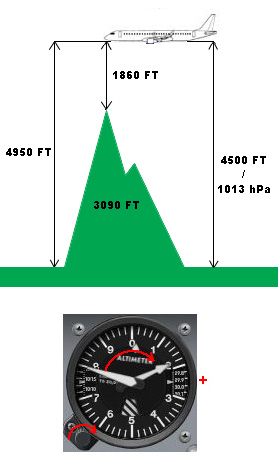
Question 196-39 : An aircraft takes off from the aerodrome of brioude altitude 1483 ft qfe = 963 hpa temperature = 32°c five minutes later passing 5000 ft on qfe the second altimeter set on 1013 hpa will indicate approximately ?
6 500 ft.
Difference between 963 hpa and 1013 hpa is 50 hpa 50 hpa x 30 fthpa = 1500 ft5000 + 1500 = 6500 ftyour altimeter indicates your pressure altitude not your true altitude this is the reason why we do not correct the temperature we only want to know the reading of the altimeter note 061 general navigation learning objectives states for questions involving height calculation 30 fthpa is to be used unless another figure is specified in the question 6 800 ft. 3 500 ft. 4 000 ft.
Question 196-40 : Given distance a to b is 360 nmwind component a b is 15 kt wind component b a is +15 kt tas is 180 ktwhat is the distance from the equal time point to b ?
165 nm.
Babar350 e*o*h o+h e enduranceo gs outnboundh gs inbounde = distance * oeoh o+h = 218*165*195 360 is giving distance from etp from a 195 nmthe question is etp from b so 360 195 = 165 nm195 nm. 180 nm. 170 nm.
Exclusive rights reserved. Reproduction prohibited under penalty of prosecution.