A free Premium account on the FCL.055 website! Read here
Sign up to unlock all our services and 15164 corrected and explained questions.
Question 205-1 : Single sideband two way communication is used in what frequency band and how can such radio waves propagate ? [ Exam pilot ]
Hf 3 30 mhz as ground waves and sky waves
Question 205-2 : The pilot of an aircraft changes its heading to the right from 214º to 334º and makes a rate 1 turn the duration of this manoeuvre is ?
40 seconds.
Refer to figurenote this is certainly not a suitable question for rnav so should be appealed if seen in the examif the turn is unbalanced an aircraft either slips into or skids out of the turn thereby reducing the aerodynamic efficiency of the aircraft to help correct for these unwanted conditions the aircraft is flown using the balance part of the turn and balance indicatorduring a balanced turn the ball remains in the centre of the balance indicator and the pilot remains upright in the seat relative to the aircraft with no tendency to leanrate of turn is the measurement of how long it takes for an aircraft to turn measured in degrees per second this is particularly important during instrument flying where rate 1 turns are usually carried out at a rate of 3° per second this means that the aircraft turns through 180° in 1 minute or 360° in 2 minutes a steeper angle of bank is required to carry out a rate 1 turn at higher airspeedsto solve this exercise first we need to calculate how many degrees was the turn performed and then apply the rate of turn 334º 214º = 120º at 3ºsecond rate 1 turn 1203º = 40 secondsImpossible to calculate, because we need the aircraft's tas. 30 seconds. impossible to calculate, because we need the aircraft's angle of bank.
Question 205-3 : You are trying to get a bearing on an ndb in the hf frequency range in theory how can you best receive a strong enough signal ?
Climb to increase your chance of capturing the sky wave.
Refer to figures note this is a ridiculous question and when paired to these options is very misleading and nearly unanswerable appeal this question in the exam please send us any further feedback if you do see this question as we would certainly like to see if they change the options or if they accept the appeal we believe this question has already been appealed at least once so hopefully it will soon be gone completelyndbs non directional beacons emit their signals in the mf and lf frequency bands which allows them to propagate as sky waves bouncing off the ionosphere and surface waves sticking to the ground surface waves stick to the surface of the earth in a strange fight between reflection diffraction and refraction with the charged surface of the earth they can propagate very far in the right conditions and mostly maintain their direction over the earth other than when going from land to sea where they shift direction as part of the 'coastal effect'we can go through each option now to try and work out which could be most correct 'climb to increase your chance of capturing the sky wave'this would give us a better chance of receiving a sky wave as the angles would be shallower so more chance of the waves 'bouncing' off the ionosphere due to total internal refraction however the bouncing off the ionosphere introduces large changes of lateral direction and we would not receive an accurate bearing but we would receive a stronger bearing we would argue that this is useless as we use ndbs for navigation so wildly inaccurate bearings are just as bad as no bearing at all'climb to increase your chance of capturing the ground wave'ground waves run along the surface of the earth and hold their direction much better than sky waves so this is how we usually pick up long range ndb bearings however we do not believe that climbing higher will aid us to do this'increase your distance from the ndb to better capture the ground wave'ground waves have limited distance the closer you are to the source the better the reception therefore this is wrong'fly towards the ndb to better capture the sky wave'before the 'first skip' distance of the sky wave no sky wave will be present and remember we do not want to get a sky wave anyway as it often has fading or is in the wrong direction giving us a bad bearingas you can see there is no good answer here and we believe that the assumption that you have to make to answer it is misleadingClimb to increase your chance of capturing the ground wave. increase your distance from the ndb to better capture the ground wave. fly towards the ndb to better capture the sky wave.
Question 205-4 : A pilot departs an aerodrome on the west coast of spain at dawn for a flight to new york half an hour after departure the vhf station for communication can no longer be received what are two of the main reasons that vhf radio range is limited to line of sight ?
Space waves have no reflection by the ionosphere no surface waves.
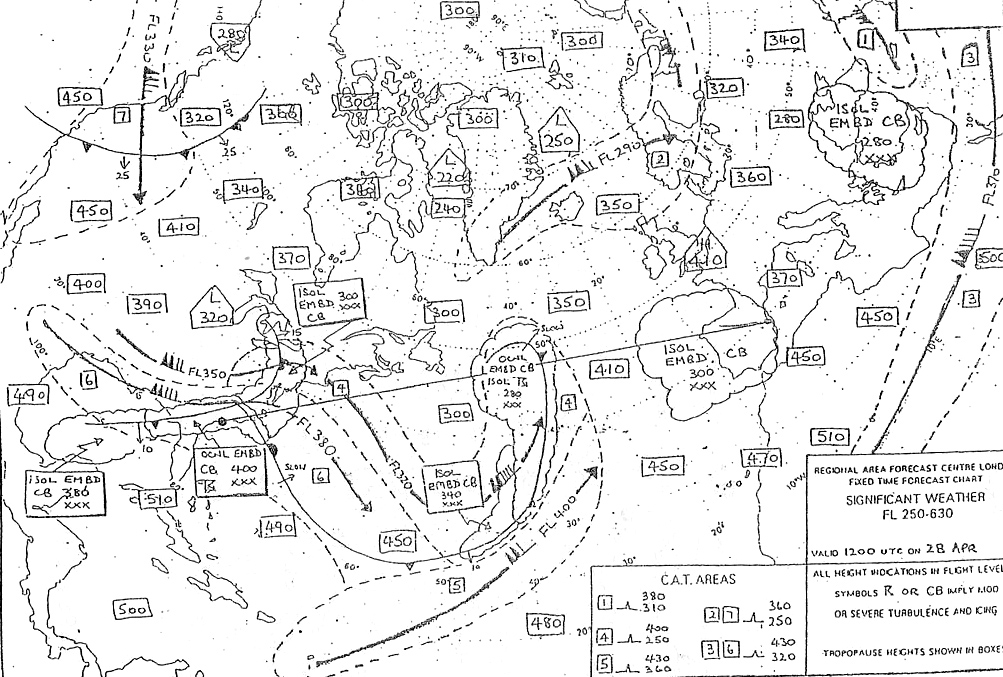
Refer to figure learning objective 06201030401 state that radio waves in vhf uhf shf and ehf propagate as space waves learning objective 06201030301 define 'space waves' the electromagnetic waves travelling through the air directly from the transmitter to the receiveras the aircraft in this scenario is communicating with the ground station via vhf radio the radio signals will only propagate as space waves space waves are line of sight waves that go in straight lines only and therefore cannot go around obstacles including around the earth's horizonthis means that there is a very well defined limit of how far vhf communications can be received from it is calculated with the formula range nm = 123 x height of transmitter ft + 123 x height of receiver ft as soon as the aircraft is outside of this range vhf communication will not be possible relays with other aircraft closer to land could be used but the aircraft will usually change to hf radio and datalink communications instead hf radio can travel as a sky wave which requires ionospheric refraction to bounce the signal off the upper atmosphere and as a short surfaceground wave although this is not really used so can allow transmissions that can go further than the line of sight limitations of vhfvhf has a frequency too high to be affected much by ionospheric attenuation and refraction and therefore will not be able to form a sky wave its frequency is also too high to propagate for any reasonable distances as a ground wave as the attenuation due to obstacles etc is huge even hf radio struggles to propagate as ground waves for our uses so vhf is ever worse there is some diffraction of vhf radio waves around the earth's surface which extends range slightly but it is not a huge effectnote the mention of dawn in the question is not necessary vhf radio is not affected by ionospheric refraction which could create a sky wave so dawndusknight does not make a differenceFading by reflected signals, and limited transmission power. absorption by the ionosphere, and no direct waves. inversion of polarisation by the ionosphere, and attenuation.
Question 205-5 : An aircraft is flying in the skip zone dead space the pilot wishes to establish communication with atc on an hf frequency theoretically the pilot can fly 1 in order to receive the 2 wave ?
1 higher 2 sky.
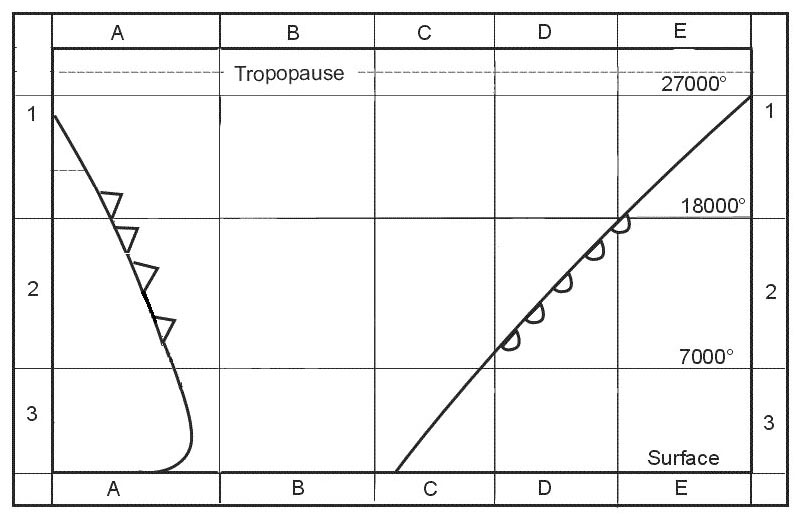
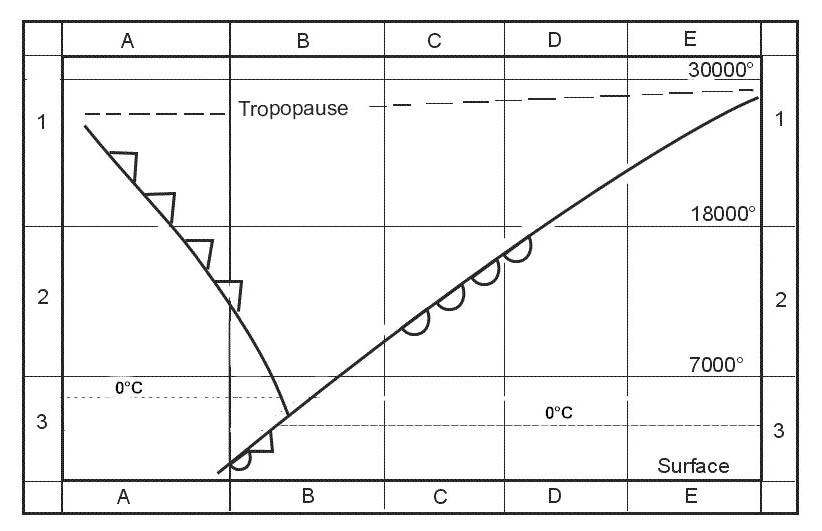
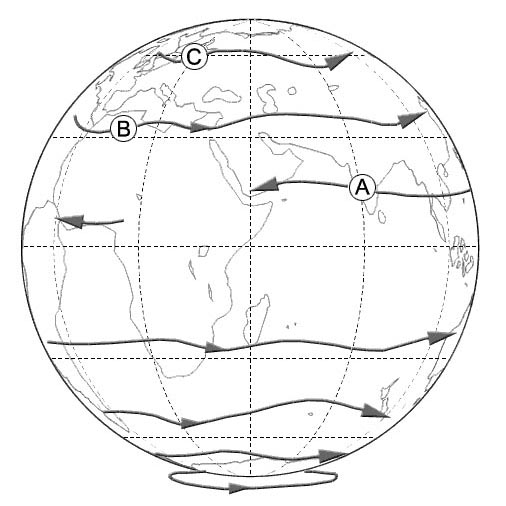
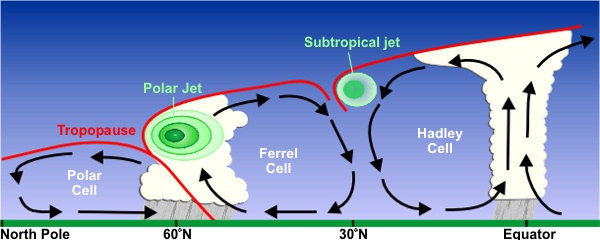
Refer to figures hf radio waves are transmitted as surface waves figure part c or sky waves figure part b surface wave propagation exists at frequencies from about 20 khz to about 50 mhz from the upper end of vlf to the lower end of vhf surface waves are created due to diffraction the portion of the wave in contact with the surface of the earth is retarded which results in bending of the wave around the surface of the earth the range of the surface waves is limited due to surface attenuation the wave induces a voltage in the earth which takes energy away from it sky wave propagation exists at frequencies between 2 mhz to 30 mhz from the upper end of mf to the whole hf range sky waves are radio waves that reach the ionosphere an electrically charged layer of the upper atmosphere and are reflected back toward the earth since sky waves are not limited by the curvature of the earth sky wave propagation can be used to communicate beyond the horizon at intercontinental distancesfor every frequency capable to create sky waves there is an angle between the vertical and the radio wave known as critical angle refer to figure above which total internal refraction occurs and the wave returns to the surface first returning sky wave at angles below critical radio waves pass straight through ionosphere and outer space they do not return on the surface of the earth the distance from the transmitter to the point where the first returning sky wave appears at the surface is known as the skip distance from the point where the surface wave is totally attenuated to the point where the first returning sky wave appears there will be no detectable signal this area is known as dead space(1) lower; (2) surface (1) towards the station; (2) sky (1) away from the station; (2) surface
Question 205-6 : Imagine an aircraft not equipped with automatic temperature correction what happens with the glide path ?
Colder temperature reduces your glide path angle.
Temperature correction even with no other errors at all the pressure altimeter will not indicate true altitude height amsl unless the surface temperature and lapse rate of the column of air are those assumed in the calibrationin flight from high to low temperature the altimeter would read highthis means that the approach path flown by an aircraft would be shallower than expected with a lower glide path angleWarmer temperature reduces your glide path angle. temperature has no effect on your glide path angle. colder temperature highers your glide path angle.
Question 205-7 : What is the maximum theoretical range at which an aircraft flying at 3500 ft amsl can receive a vhf radio transmission from a station at 126 ft amsl ?
87 nm.
The space wave is the direct line of sight transmission of a radio wave through space because the earth is round vhf communications via space waves are limited by the curvature of the earth as such aircraft at higher altitude and transmission stations at higher altitude have a higher maximum theoretical communication rangethe equation to calculate maximum theoretical range is maximum theoretical range in nm = 123 x sqrooth1 + sqrooth2 where h1 is the receiver height in feeth2 is the transmitter height in feetcalculating the range for the problem in the question range = 123 x sqroot3500 + sqroot126 = 866 nm87 km 74 nm 74 km
Question 205-8 : The frequency of the amplitude modulation and the colour of an outer marker om light is ?
400 hz blue.
677400 hz, amber. 1300 hz, blue. 3000 hz, blue.
Question 205-9 : An rmi indicates aircraft heading and bearing to convert the rmi bearings of ndbs and vors to true bearings the correct combination for the application of magnetic variation is ?
Ndb aircraft position vor beacon position.
Application of magnetic variation is at beacon position for a vor application of magnetic variation is at aircraft position for a ndb Ndb: beacon position xsxvor: beacon position. ndb: beacon position xsxvor: aircraft position. ndb: aircraft position xsxvor: aircraft position.
Question 205-10 : An aircraft is flying on the true track 090° towards a vor station located near the equator where the magnetic variation is 15°e the variation at the aircraft position is 8°e the aircraft is on vor radial ?
255°.
Application of magnetic variation is at beacon position for a vor so flying 90° true tracks towards a vor means that we are on the 270° inbound radial270° minus 15° east = 255° m278°. 262°. 285°.
Question 205-11 : Given magnetic heading 280°vor radial 090°what bearing should be selected on the omni bearing selector in order to centralise the vor deviation needle with a 'to' indication ?
270°.
For training purpose please use one of the following websites luizmonteiro learning vor280°. 100°. 090°.
Question 205-12 : A vor is sited at position 58°00'n 073°00'w where the magnetic variation equals 32°w an aircraft is located at position 56°00'n 073°00'w where the magnetic variation equals 28°w the aircraft is on vor radial ?
212°.
The aircraft is south of the vor and we apply the variation at the beacon it is a vor the aircraft is on vor radial of 180 + 32 = 212°declination west > compass bestdeclination east > compass least208°. 360°. 180°.
Question 205-13 : In order to plot a bearing from a vor station a pilot needs to know the magnetic variation ?
At the vor.
The application of magnetic variation is ndb aircraft positionvor beacon positionAt the aircraft location. at the half-way point between the aircraft and the station. at both the vor and aircraft.
Question 205-14 : An aircraft dme receiver does not lock on to its own transmissions reflected from the ground because ?
They are not on the receiver frequency.
The interrogation and reply frequencies always differ by 63 mhzDme transmits twin pulses. the pulse recurrence rates are varied. dme uses the uhf band.
Question 205-15 : A dme is located at msl an aircraft passing vertically above the station at flight level fl 360 will obtain a dme range of approximately ?
6 nm.
The aircraft is directly overhead the beacon so interrogation pulses will therefore go vertically down to the beacon and the response pulses will go vertically upwards to the aircraftdme range = 36000ft1 nm = 6000ftdme range = 360006000 = 6 nm7 nm. 11 nm. 8 nm.
Question 205-16 : During a flight at fl 210 a pilot does not receive any dme distance indication from a dme station located approximately 220 nm away the reason for this is that the ?
Aircraft is below the line of sight altitude.
Dme distance measuring equipment ground stations transmit within a uhf frequency band of 962 to 1213 mhz because the equipment is uhf the signals transmitted are subject to line of sight restrictions therefore its range varies in direct proportion to the altitude of receiving equipmentgenerally the reception range of the signals at an altitude of 1000 feet above ground level agl is about 40 to 45 miles this distance increases with altitudevhf transmissions follow a line of sight course 2562Aircraft is circling around the station. altitude is too high. range of a dme system is always less than 200 nm.
Question 205-17 : Which of the following will give the most accurate calculation of aircraft ground speed ?
A dme station sited on the flight route.
dme distance measuring equipment the dme receiver can express groundspeed in knots this value is accurate only if the aircraft is flying directly to or from the station because the dme measures groundspeed by comparing the time lapse between a series of pulses when accurate the groundspeed information allows the pilot to make accurate estimates of time of arrival and accurate checks of aircraft progressAn adf sited on the flight route. a vor station sited on the flight route. a dme station sited across the flight route.
Question 205-18 : What is the approximate angular coverage of reliable navigation information for a 3° ils glide path out to a minimum distance of 10 nm ?
135° above the horizontal to 525° above the horizontal and 8° each side of the localiser centreline.
1680glide slope coverage goes from 045 to 175 times the glide path angle3° x 045 = 135°3° x 175 = 525°0.45° above the horizontal to 1.75° above the glide path and 8° each side of the localiser centreline. 0.7° above and below the glide path and 2.5° each side of the localiser centreline. 3° above and below the glide path and 10° each side of the localiser centreline.
Question 205-19 : A vor is sited at position a 45°00'n 010°00'e an aircraft is located at position b 44°00'n 010°00'e assuming that the magnetic variation at a is 10°w and at b is 15°w the aircraft is on vor radial ?
190°.
The application of magnetic variation is for a ndb aircraft positionfor a vor beacon position 2563aircraft is south 180°t of the vor and we have to apply variation at the vor position variation west magnetic best 180° + 10° = 190°195°. 185°. 180°.
Question 205-20 : A dme station is located 1000 feet above mslan aircraft flying at fl 370 in isa conditions which is 15 nm away from the dme station will have a dme reading of ?
Question 205-21 : What is the approximate maximum theoretical range at which an aircraft at fl130 could receive information from a vdf facility which is sited 1024 ft above msl ?
Question 205-22 : In isa conditions what is the maximum theoretical range at which an aircraft at fl80 can expect to obtain bearings from a ground vdf facility sited 325 ft above msl ?
134 nm.
Calculate the range using the formula 123 x sqrttransmitter height in feet + 123 x sqrtreceiver height in feet123* sqrt325 + sqrt8000 = 1322 nm sqrt square root 158 nm. 107 nm. 114 nm.
Question 205-23 : The principle used in vor bearing measurement is ?
Phase comparison.
The vor encodes azimuth direction from the station as the phase relationship of a reference and a variable signalthe omni directional signal contains a modulated continuous wave mcw and morse code station identifier and usually contains an amplitude modulated am voice channelthe conventional 30 hz reference signal is on a 9960 hz frequency modulated fm subcarrier the variable amplitude modulated am signal is conventionally derived from the lighthouse like rotation of a directional antenna array 30 times per second although older antennas were mechanically rotated current installations scan electronically to achieve an equivalent result with no moving parts when the signal is received in the aircraft the two 30 hz signals are detected and then compared to determine the phase angle between them the phase angle by which the am signal lags the fm subcarrier signal is equal to the direction from the station to the aircraft in degrees from local magnetic north and is called the 'radial'Envelope matching. beat frequency discrimination. difference in depth of modulation.
Question 205-24 : You are flying along an airway which is 10 nm wide 5 nm either side of the centreline the distance to the vordme you are using is 100 nm if you are on the airway boundary how many dots deviation will the vor needle show if one dot represents 2 degrees ?
15.
Apply the 1 in 60 rule= max distance off route x 60 range= 5 x 60 100= 300100= 3°2° = 1 dot3° = 15 dots3.0 4.5 6.0
Question 205-25 : An airway 10 nm wide is to be defined by two vors each having a resultant bearing accuracy of plus or minus 55° in order to ensure accurate track guidance within the airway limits the maximum distance apart for the transmitter is approximately ?
105 nm.
Tan 55 x x = 10 nmx = 10 00962 = 1039 nm miloszhomik 10 nm wide but 5 to each side so it will be approx 50 nm approximately 50 nm if you consider only the beacon behind you but when you switch to the beacon in front of you the maximum distance apart for the transmitter will be approximately 525 + 525 = 105 nm50 nm. 165 nm. 210 nm.
Question 205-26 : An aircraft is required to approach a vor via the 104° radial which of the following settings should be made on the vorils deviation indicator ?
284° with the to flag showing.
For training purpose please use luizmonteiro learning vor284° with the from flag showing. 104° with the to flag showing. 104° with the from flag showing.
Question 205-27 : An aircraft is required to approach a vor station via the 244° radial in order to obtain correct sense indications the deviation indicator should be set to ?
064° with the to flag showing.
1710for training purpose luizmonteiro learning vor064° with the from flag showing. 244° with the from flag showing. 244° with the to flag showing.
Question 205-28 : What is the maximum theoretical range that an aircraft at fl150 can receive signals from a vor situated 609 feet above msl ?
Question 205-29 : For a conventional dme facility beacon saturation will occur whenever the number of aircraft interrogations exceeds ?
100.
A typical dme transponder can provide distance information to 100 aircraft at a time above this limit the transponder avoids overload by limiting the gain of the receiver replies to weaker more distant interrogations are ignored to lower the transponder loaddme can be used by 300 users at one time the technical term of the dme station when its overloaded and cannot accept more than 100 aircraft is called station or beacon saturation 200. 60. 80.
Question 205-30 : The aircraft dme receiver is able to accept replies to its own transmissions and reject replies to other aircraft interrogations because ?
The time interval between pulse pairs is unique to that particular aircraft.
The interrogation and reply frequencies always differ by 63 mhzthe time interval between pulse pairs is unique because the pulse recurrence frequency is randomisedTransmission frequencies are 63 mhz different for each aircraft. pulse pairs are amplitude modulated with the aircraft registration. aircraft interrogation signals and transponder responses are 63 mhz removed from each other.
Question 205-31 : The aircraft dme receiver cannot lock on to interrogation signals reflected from the ground because ?
Aircraft transmitter and dme ground station are transmitting on different frequencies.
The interrogation pulses are at one frequency 1030 mhz and the reply pulses are at a different frequency 1090 mhz Reflections are subject to doppler frequency shift. dme transmits twin pulses. dme pulse recurrence rates are varied.
Question 205-32 : The design requirements for dme n stipulate that at a range of 100 nm the maximum systematic error should not exceed ?
+ or 15 nm.
The error of the dme 'n' according to annex 10 should not exceed + 025 nm + 125% of the distance measured 025 + 00125 x 100 = 15 nm for installations installed after 1 jan 1989 the total system error should not exceed 02 nm for dme 'p' precise + or - 3 nm. + or - 0.25 nm. + or - 1.25 nm.
Question 205-33 : In which situation will speed indications on an airborne distance measuring equipment dme most closely represent the groundspeed of an aircraft flying at fl400 ?
When tracking directly towards the station at a range of 100 nm or more.
The dme instrument in the cockpit will not only show your distance to a station but will calculate the rate of movement and display groundspeedif you are to close you will have a 'slant range' the distance mesured is the from the station to the aircraft and not from your equivalent position on the groundat long distances this will be minimised when passing abeam the station and within 5 nm and at a range of 10 nm will not give you the most accurate groundspeed indication overhead the station will give you a grounspeed indication of zeroWhen passing abeam the station and within 5 nm of it. when overhead the station, with no change of heading at transit. when tracking directly away from the station at a range of 10 nm.
Question 205-34 : The time taken for the transmission of an interrogation pulse by a distance measuring equipment dme to travel to the ground transponder and return to the airborne receiver was 2000 micro secondthe slant range from the ground transponder was ?
158 nm.
2564slant range= time 50 micro second 2 x c velocity of light in kms slant range= 2000 50 2 x cslant range= 975 x 300000slant range= 292500000292500 km > 158 nm50 micro second is the time taken by the airborne receiver to reply to the ground transponder and you must divide 2000 by 2 because 2000 micro second is the total time taken for a signal to travel and come back296 nm. 316 nm. 186 nm.
Question 205-35 : The reason why pre take off holding areas are sometimes further from the active runway when ils category 2 and 3 landing procedures are in progress than during good weather operations is ?
Aircraft manoeuvring near the runway may disturb guidance signals.
Question 205-36 : An aircraft tracking to intercept the instrument landing system ils localiser inbound on the approach side outside the published ils coverage angle ?
May receive false course indications.
False glideslope signals may exist outside the published ils coverage angle and in the area of the localizer back course approach which can cause the glideslope flag alarm to disappear and present unreliable glideslope informationOnly glide path information is available. will receive signals without identification coding. can expect signals to give correct indications.
Question 205-37 : The middle marker of an instrument landing system ils facility is identified audibly and visually by a series of ?
Alternate dots and dashes and an amber light flashing.
Two dashes per second and a blue light flashing. dots and a white light flashing. dashes and an amber light flashing.
Question 205-38 : The outer marker of an instrument landing system ils facility transmits on a frequency of ?
75 mhz and is modulated by morse at two dashes per second.
677200 mhz and is modulated by alternate dot/dash in morse. 75 mhz and is modulated by alternate dot/dash in morse. 300 mhz and is modulated by morse at two dashes per second.
Question 205-39 : What approximate rate of descent is required in order to maintain a 3° glide path at a groundspeed of 120 kt ?
600 ftmin.
3° glide > 5% rate of descentdivide speed by 2 add a zero550 ft/min. 800 ft/min. 950 ft/min.
Question 205-40 : An rmi slaved to a remote indicating compass has gone unserviceable and is locked on to a reading of 090° the tail of the vor pointer shows 135° the available information from the vor is ?
Radial 135° relative bearing unknown.
Our heading information is false but the needle will give the correct magnetic bearings of the beaconexample you perform a 360° turn the heading remains locked on 090° on the rmi and the tail of the needle will remain against 135°now you fly on a northerly heading the tail of the needle progressively shows 134° 133° 132° etcRadial unknown, relative bearing 225°. radial unknown, relative bearing 045°. radial 315°, relative bearing unknown.
Exclusive rights reserved. Reproduction prohibited under penalty of prosecution.