A free Premium account on the FCL.055 website! Read here
Sign up to unlock all our services and 15164 corrected and explained questions.
Question 214-1 : Middle marker beacons of an ils transmit at ? [ Preparation civilian ]
75 mhz
Question 214-2 : The ils marker identified audibly by a series of dots 6second is the… ?
Inner marker.
The outer marker middle marker and inner marker all emit an amplitude modulated horizontally polarised signal the beacons operate at a 75 mhz carrier frequencyouter marker om to provide height distance and equipment function checks for aircraft on final approachaural identification a 400 hz low pitch tone keyed in a form of 2 dashes per second visual representation lights bluemiddle marker mm indicated the imminence of transition to visual guidance often defines the decision pointaural identification a 1300 hz medium pitch tone keyed in a form of alternating dots and dashes with 3 dashes per second visual representation lights amberinner marker im indicates the imminence of arrival above the thresholdaural identification a 3000 hz tone keyed continuous dots at a rate of 6 dots per second visual representation lights whiteOuter marker. locator. middle marker.
Question 214-3 : The ils marker identified audibly by a series of alternate dots and dashes is the… ?
Middle marker.
The outer marker middle marker and inner marker all emit an amplitude modulated horizontally polarised signal the beacons operate at a 75 mhz carrier frequencyouter marker om to provide height distance and equipment function checks for aircraft on final approachaural identification a 400 hz low pitch tone keyed in a form of 2 dashes per second visual representation lights bluemiddle marker mm indicated the imminence of transition to visual guidance often defines the decision pointaural identification a 1300 hz medium pitch tone keyed in a form of alternating dots and dashes with 3 dashes per second visual representation lights amberinner marker im indicates the imminence of arrival above the thresholdaural identification a 3000 hz tone keyed continuous dots at a rate of 6 dots per second visual representation lights whiteOuter marker. locator. inner marker.
Question 214-4 : The audio frequency modulation of the middle marker shall be keyed as follows… ?
A continuous series of alternate dots and dashes.
The outer marker middle marker and inner marker all emit an amplitude modulated horizontally polarised signal the beacons operate at a 75 mhz carrier frequencyouter marker om to provide height distance and equipment function checks for aircraft on final approachaural identification a 400 hz low pitch tone keyed in a form of 2 dashes per second visual representation lights bluemiddle marker mm indicated the imminence of transition to visual guidance often defines the decision pointaural identification a 1300 hz medium pitch tone keyed in a form of alternating dots and dashes with 3 dashes per second visual representation lights amberinner marker im indicates the imminence of arrival above the thresholdaural identification a 3000 hz tone keyed continuous dots at a rate of 6 dots per second visual representation lights white6 dots per second continuously. 2 dashes per second continuously. 3 dashes, 3 dots and 3 dashes per second continuously.
Question 214-5 : The ils outer marker modulation frequency is ?
400 hz.
All ils marker beacons operate on 75 mhz vhf thus no frequency selections are necessary for the pilot and radiate a fan shaped field pattern giving to the pilot an indication of range from the thresholdthe purpose of the markers is to provide range information while on the approachthey transmit an almost vertical beamalmost all installations are equipped with an outer marker and a middle markercategory 2 or 3 ils may be equipped with an inner marker as wellaudio and visual signals in the cockpit will indicate when the aircraft is passing overhead in many installations marker beacons are being replaced or supplemented by the use of a dme associated with the ilsthe outer marker is located approximately 39 nautical miles from the runway threshold and is aligned across the front beam of the localiserits purpose is to provide height distance and equipment functioning checks to aircraft on final approachit is modulated at 400 hertz and keyed to transmit dashes continuously at a rate of 2 per second the middle marker is aligned across the front beam of the localiser and is situated approximately 1050 metres from the runway thresholdits purpose is to indicate the imminence in low visibility conditions of visual approach guidancethis marker is modulated at 1300 hertz and keyed to transmit alternate dots and dashes · · · the rate is 2 dashes and 6 dots per secondan aircraft on the glide slope over the middle marker should be roughly 200 feet above the touchdown zone elevationthe inner marker is modulated at 3000 hertz identified by a keyed continuous signal of 6 dots per second · · · · · and is located 75–450 metres from the runway threshold summary outer marker identifies glideslope intercept or the final approach fix light flashes blue middle marker identifies decision height light flashes amber inner marker identifies decision height for a cat ii ils light flashes white3000 hz. 1300 hz. 1500 hz.
Question 214-6 : According to the principle of operation in an ils the difference in depth of modulation will ?
Increase with displacement from the centreline.
Refer to figurethe difference in depth modulation ddm is a principle used by the ils to define a position in an airspace the deviation detection of the aircraft from the desired track is based on two different overlapping lobes these lobes are radiated by both the localiser and the glide path antennas these consist of a 90 hz lobe and a 150 hz lobefor the glide path when the airborne receiver receives a stronger signal from the 90 hz lobe than the 150 hz lobe it means that the aircraft is above the 'ideal' glideslope when the airborne receiver receives a stronger signal from the 150 hz lobe than the 90 hz lobe the aircraft will be below the 'ideal' glideslope when both the signals received are at the same strength it means the aircraft will be on the 'ideal' glideslope and the glideslope needle will indicate zero for the localiser the same method is used stronger signals from the 90 hz lobe means a displacement to the left whereas stronger signals from the 150 hz lobe means a right displacement in relation to the centreline when both the signals received are at the same strength it means the aircraft will be on the centreline and the localiser needle will indicate zeroassume that you are on the centreline if you move away from the centrelline however still in the range of the localizer the ddm will increaseddm = am 90 hz am 150 hz 100therefore once you go off centreline either the 90 or 150 increases causing ddm to increase negative is also assumed to be an increase Increase from the centre position to half full scale of the indicator needle and decrease until full scale of the needle. increase with left displacement from the centreline and decrease with right displacement from the centreline. decrease with displacement from the centreline.
Question 214-7 : The type of modulation of the ils frequency carrier is ?
Amplitude modulation.
The modulation type of all ils transmitters is the good old amplitude modulation am the carrier oscillation in the localizer frequency range is 10800 mhz to 111975 mhz modulated with a 90hz and a 150hz tone signalthe ils works by sending 2 beams up from the landing runway one telling the pilots if they or high or low and the other telling them if they are left or right of the runway centreline the ils receiver on the aircraft measures the difference in depth of modulation ddpm between the signals for most ils’s the pilots should be lined up with the runway centreline and on a 3 degree glide path but on some ils’s like london city have a steeper approach of 55 degreesthis two modulated signals are produced from a horizontally polarized antenna complex beyond the far end of the approach runway they create an expanding field that is 21 2° wide about 1500 feet 5 miles from the runway the field tapers to runway width near the landing threshold the left side of the approach area is filled with a vhf carrier wave modulated with a 90 hz signal the right side of the approach contains a 150 mhz modulated signal the aircraft’s vor receiver is tuned to the localizer vhf frequency that can be found on published approach plates and aeronautical charts the circuitry specific to standard vor reception is inactive while the receiver uses localizer circuitry and components common to both the signals received are passed through filters and rectified into dc to drive the course deviation indicator if the aircraft receives a 150 hz signal the cdi of the vorils display deflects to the left this indicates that the runway is to the left the pilot must correct course with a turn to the left this centers course deviation indicator on the display and centers the aircraft with the centerline of the runway if the 90 hz signal is received by the vor receiver the cdi deflects to the right the pilot must turn toward the right to center the cdi and the aircraft with the runway center line annex1 like the localizer the glideslope transmits two signals one modulated at 90 hz and the other modulated at 150 hz the aircraft’s glideslope receiver deciphers the signals similar to the method of the localizer receiver it drives a vertical course deviation indicator known as the glideslope indicator the glideslope indicator operates identically to the localizer cdi only 90° to it the vorils localizer cdi and the glideslope are displayed together on whichever kind of instrumentation is in the aircraft annex2Phase modulation. dual modulation. frequency modulation.
Question 214-8 : One of the possible disturbances of the ils signal is 'scalloping' which statement is correct ?
Scalloping causes rapid indicator changes from side to side of the intended approach path which cannot be followed by the aircraft.
Scalloping is a type of error in radio signal transmission which causes oscillatory propagation distortion due to presence of ground andor atmospheric conditions it results in rapid fluctuations of the needles on the cdihsi which are impossible to followScalloping are minor changes or bends which can be followed by the aircraft. scalloping are rapid changes or bends which can be followed by the aircraft. scalloping are major changes or bends in the approach path which cannot be followed by the aircraft.
Question 214-9 : What is the reason that dme utilises pulse pairs instead of single pulses ?
To distinguish dme transmissions from transmissions of other radar systems utilising single pulses.
Dme uses the uhf frequency band between 962 1213 mhz the aircraft dme equipment radiated coded pulse pairs which is then received at the ground station triggering the transponder to send a suitably formatted reply adjusted by + 63 mhz after a delay of 50 microseconds for each of the interrogation channels two reply frequencies are allocated one is 63 mhz higher than the transmission and the other 63 mhz lower the reason for using pulse pairs is to ensure the receivers do no accept random single pulses or other transmissions that are not addressed for this type of communication each pulse pair is spaced at 12 microseconds x channels or 36 microseconds y channels and the space of each pair of pulse pairs is different between each group and is randomly unique to each transmissionTo increase the number of aircraft that can simultaneously use the dme station to determine the dme range. to be able to use a separate interrogation and reply frequency, and thus to increase the number of dme stations that can transmit in the same part of the dme frequency band. to increase the accuracy and reliability of the range measurement.
Question 214-10 : If two dme ranges are plotted on the chart and used to fix the aircraft position what would be indicated on the chart ?
Two circular position lines intersecting at two points the distance from each transmitter being the slant range.
Refer to figurethe dme displays distance information from a fix this distance being the slant range between the transmitter and the aircraft the position of the aircraft may be anywhere on a circle with the dme in the centre with a radius that is the range from the dme two overlapping circles will intersect at two pointsTwo circular position lines intersecting at two points, the distance from each transmitter being the plan range. two straight lines intersecting at one point, the distance from each transmitter being the slant range. two straight lines intersecting at one point, the distance from each transmitter being the plan range.
Question 214-11 : Which option correctly identifies the approach aid s listed below to which the uhf band is assigned 1 locator 2 localiser 3 outer marker 4 glide path ?
Only 4.
Locators operate on a frequency between 190 and 1750khz mf localiser operates on a frequency between 10810 and 11196 mhz vhf marker beacons operate on a frequency of 75 mhz vhf glide path operates between the frequencies 3286 and 3354 mhz uhf3 and 4. 1 and 3. only 1.
Question 214-12 : What radio navigation aid would be associated with the transmission frequency 11035 mhz ?
Ils localiser.
108 mhz and 112 mhz frequency band is shared between ils and vor frequencies from 112 mhz to 117975 mhz the band belongs to vor alone and spacing is reduced to 50 khzthus 1082 mhz and 11335 mhz would be vor frequencies and 1081 mhz would notwithin the vor ils shared frequency range the allocated frequencies are as follows vor = even 100 khz numerals10800 10805 10820 10825 to 11180 11185ils = odd 100 khz numerals10810 10815 10830 10835 to 11190 11195 so 11035 is between themVor station vdf mls
Question 214-13 : To enter a holding pattern based on a vordme fix which entry sectors are permissible when following a dme arc entry track sectors ?
1 and 3.
Refer to figureicao doc 8168147 dme arc entrydme arc entry at the fix the aircraft shall enter the holding pattern in accordance with either the sector 1 or sector 3 entry proceduresector 1 procedure => parallel entrysector 2 procedure => offset entrysector 3 procedure => direct entry1 and 2. 1, 2, and 3. 2 and 3.
Question 214-14 : On an ils approach when flying overhead the outer marker the colour of the flashing light will be… ?
Blue.
The outer marker middle marker and inner marker all emit an amplitude modulated horizontally polarised signal the beacons operate at a 75 mhz carrier frequencyouter marker om to provide height distance and equipment function checks for aircraft on final approachaural identification a 400 hz low pitch tone keyed in a form of 2 dashes per second visual representation lights bluemiddle marker mm indicated the imminence of transition to visual guidance often defines the decision pointaural identification a 1300 hz medium pitch tone keyed in a form of alternating dots and dashes with 3 dashes per second visual representation lights amberinner marker im indicates the imminence of arrival above the thresholdaural identification a 3000 hz tone keyed continuous dots at a rate of 6 dots per second visual representation lights whiteGreen. amber. white.
Question 214-15 : Mls installations notified for operation unless otherwise stated provide azimuth coverage of ?
±40° about the nominal course line out to a range of 20 nm.
Refer to figure the icao annex 10 declares a requirement for a minimum coverage area within which the mls must provide full serviceability for the approach a wide area is allocated for mls precision navigation that is a circular arc with a 20 nm radius from the threshold with ± 40º from the transmitter in each direction of the runway centreline±20° about the nominal course line out to a range of 20 nm. ±20° about the nominal course line out to a range of 10 nm. ±40° about the nominal course line out to a range of 30 nm.
Question 214-16 : There are two ndbs one 20 nm inland and the other 50 nm inland from the coast assuming that the error caused by coastal refraction is the same for both propagations the extent of the error in a position line plotted by an aircraft that is over water will be ?
Greater from the beacon that is 50 nm inland.
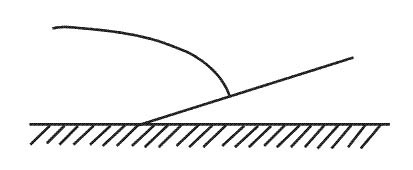
Refer to figurendbs send out low or medium frequency radio waves they actually generate two waves a ground wave that follows the earth and a sky wave that bounces off of the ionosphere in this case were only talking about the ground wavewhen the ground wave crosses a shoreline and moves out to sea it bends towards the coastcoastal refraction changes in conductivity from land to seaelectrical differences between land and sea affect radio wavesas low frequency waves cross the shoreline they move abruptly from an area of low conductivity land to an area of high conductivity water that rapid change in conductivity changes the radio wave's phase velocity what's that imagine the crest of a wave moving across the ocean the speed that the crest moves is the wave's phase velocityradio waves are no differentas the phase velocity changes the wave's frequency what you dialed into the radio receiver stays the sameto decrease this error pilot must use stations closer to the coast stations that produce signal crossing the cost line as close to 90° as possible use higher cruising altitude as the refraction error decreases with altitude note the laws of conservation of energy and momentum come into play and the wave bends this is called refraction for a more in depth look at the physics check out snell's lawGreater from the beacon that is 20 nm inland the same from both beacons when the aircraft is on a relative bearing of 180° and 360° the same from both beacons when the aircraft is on a relative bearing of 090° and 270°
Question 214-17 : When an ndb fails which kind of warning is visible in the cockpit ?
No warning.
Ndb failure warningunline vor or ils systems that have failure warning indications the ndb does not warn the pilot in the case of a failure the ndb is a simple transmitter the adf receives the signal and displays the direction of the radio source since adf receivers do not have a 'flag' to warn the pilot when erroneous bearing information is being displayed the pilot should continuously monitor the ndb's identification when the ndb itself fails the pilot might notice a searching needle on their display much line when it is out of range of the receiverOn a moving card adf: a red button. on a radio magnetic indicator: a flag alarm. on a digital navigation display: the acronym ‘ndb’ in red.
Question 214-18 : The dme line of position is a circle with radius ?
A the ground distance and centre the dme station.
A dme is used for determining the distance from a ground dme transmitter compared to other vhfuhf navaids a dme is very accurate the distance information can be used to determine the aircraft position or flying a track that is a constant distance from the station this is referred to as a dme arc there are several way to plot a route on a chart straight route plotted between radio beacons direct route plotted without reference to any paricular radio beacons and fixes are calculated along the track based on position lines plotted from radio beacons in general a position line is a circle with radius the ground distance between the point and the ground station and centre at the ground stationpay attention there are some quite similar questions regarding dme poistion lines with very different answer the main problem is about the dme distance should a pilot consider dme distace plotted on a chart like a slant or a ground range distance in general we can affirm that there is a difference between ground range and slant range but that difference is negligible and not worth considering until you are very close to the beacon at which point plotting becomes quite immaterial and difficult owing to the relatively rapid changes in distance ie 3 nm change in range is not significant when 150 nm from the beacon but it is significant when you are only 5 nm from the beaconas a rule of thumb discrepancies only start to appear within 1 nm per 1000' of height eg when flying at 10000' the discrepancies only start to appear within 10 nm at 20000 within 20 nm etc even then they are very small and hardly worth worrying about eg at 35000' 35 nm ground distance = 356 nm dme distance and 10 nm gnd dist = 12 nm dme distThe slant range and centre the dme-station. the ground distance and centre the aircraft. the slant range and centre the aircraft.
Question 214-19 : An aircraft has a magnetic heading of 290°and is on vor radial 280° which value has to be selected on the obs to get a to indication and the cdi centred ?
100°.
Refer to figureto start with the heading is given in the question as a 'red herring' it is not a useful piece of information the cdi does not have a heading input so is not affected by any heading changesafter discounting the heading we can now draw out the scenario that we are in our aircraft is on radial 280 from the vor and the question asks us what we need to set the obs omni bearing selector to in order to get a centred indication and a 'to' indicator that means that we want to know what track to fly to go directly towards the beacon in this case being on radial 280 means that we are 280º from the vor so we would have to fly a track of 100º to the vor290° 280° 110°
Question 214-20 : The bfo selector switch on the adf control panel must be in the 'on' position to enable the pilot to ?
Hear the ident of ndbs using n0n a1a transmissions.
Navigational ndbs have an unmodulated carrier wave icao classification n0n station identification is transmitted at roughly ten second intervalsolder systems interrupt the carrier wave keying to send an unmodulated but also inaudible morse code ident classified as a1a user will have also erratic indications while the signal is interrupted in this type of beaconto make the unmodulated parts of the a1a signal audible adf equipment incorporates a beat frequency oscillator bf0 that produces a signal slightly removed from the received frequency that is then mixed with itthe mixing of the two frequencies produces an audible beat frequency tahat is the difference of the twosummary selecting the bfo on makes the n0n carrier wave audible and allows the a1a type of ident to be heardnote bfo is not needed for an a2a signal which is already modulated to an audible frequencyAdjust the loop to the aural null position. stop the loop rotation. hear the ident of ndbs using n0n a2a transmissions.
Question 214-21 : An ndb is on a relative bearing of 316° from an aircraft given compass heading 270° at aircraft deviation 2°w at aircraft variation 30°e at station variation 28°e calculate the true bearing of the ndb from the aircraft ?
254°.
Initially we can use the compass heading and relative bearing to calculate the compass bearing to the ndbto do this we just add the two numbers together 270º + 316º = 586º too large so take 360º away = 226º compass bearingthen to use cdmvt to calculate the true bearing to the ndb off this remember to use the variation at the aircraft as that is where the direction is measured for ndbadf operations compass deviation magnetic variation true 226º 2ºw 224º 30ºe + 254º so the true bearing from the aircraft to the ndb is 254º074° 252° 072°
Question 214-22 : Given the following information what relative bearing will be shown on the rbi in order to maintain an outbound course of 257° m from overhead the ndb wv 230° t 20 kt variation 6°e tas 80 kt ?
188°.
Refer to figurethe aircraft needs to maintain a magnetic course of 257º away from the station a left wind 230ºt20 kt is being experienced therefore a wind correction angle must be applied to the left in order to maintain the desired track to calculate the wca we must either convert the magnetic track into true or the wind into magnetic the question gives a magnetic variation of 6ºe => variation east magnetic leastthe wind direction is therefore 230º 6º = 224ºcalculate the wind correction angle using the flight computer set wind direction under true index 224º set the centre point over tas 80 kt and mark wind velocity up from centre point over 100 kt set the course under true index 257º wind correction angle reads between centre line and wind velocity mark => wca of approx 8ºwe can now calculate the magnetic heading = 257º 8º = 249ºmagnetic bearing = relative bearing + magnetic headingthe magnetic bearing to the station is the reciprocal of the magnetic bearing from the station 257º 180º = 077ºmagnetic bearing = relative bearing + magnetic heading 077º = rb + 249º rb = 077º 249º rb = 172º + 360º = 188º352° 008° 172°
Question 214-23 : On the qdr of 075° in the vicinity of the station with a magnetic heading of 295° the relative bearing on the adf indicator is ?
320°.
Refer to figure qdm = magnetic bearing from the aircraft to the station qdr = magnetic bearing from the station to the aircraft radial if our qdr radial is 075º then our qdm is the reciprocal of that which is 255ºthen you can think of it one of two ways our qdm of 255º is 40º to the left of our current heading 295º and the relative bearing that is 40º left of our nose is 320º you could also use the formula mh + rb = qdm mh = magnetic heading rb = relative bearing qdm as described aboverearranged to make rb = qdm mh = 255º 295º = 40º which is too low so add 360º = 320º relative bearing040° 140° 220°
Question 214-24 : During day time the range of an ndb depends on ?
The power output and the nature of the earth’s surface over which the ground wave travels.
Several factors affect the range of an ndb transmission the most significant effect is the transmission power output depending on the desired range of operation different types of ndbs have different transmission powers the range obtained is proportional to the square of the power transmitted as a result a range twice as far requires four times the power the ndb range is also limited by frequency lower frequencies result in longer ground waves the earth’s surface over which the ground wave travels also has an impact on the range of an ndb multipath propagation phenomenon results in radio signals reaching the receiving antenna by two or more paths this can result in a false indication of the adf needle that points to the source of the reflection and not the ndb in use the altitude at which the aircraft travels can also have an effect on the ndb range for instance in mountainous terrain an ndb may not be received at low level but could be received higher upThe power output, the altitude of the aircraft and the elevation of the ndb. the ionospheric refraction index, the altitude of the pertaining ionospheric layer, the wave length and the power output. the atmospheric refraction index, the wave length, the elevation of the ndb and the power output.
Question 214-25 : Which statement is true about the use of the doppler effect in a doppler vor ?
The doppler effect is used to create a signal which is received by the aircraft’s vor receiver as a frequency modulated signal.
Doppler vor is an evolution of cvor and provides improved signal quality and accuracy by reducing scalloping errors the reference signal of dvor is amplitude modulated and the variable signal is frequency modulated exactly the opposite of cvor the frequency modulated signal is less prone to interference when compared to the amplitude modulated signal which makes the rotating variable signal fm make direction determination more accuratethe doppler effect is generated by electronically rotating the variable signal via this set of circular elements the variable signal is emitted in a rotating sequence at 30 revolutions per second when the signal is heading towards a receiver a positive doppler shift is experienced and the received frequency is slightly higher when it is moving away it is slightly lowerdoppler effect in a vor is not used to detect velocity the vor does not measure rangeBy using the doppler effect it is possible to determine the range of the aircraft from the vor station more accurately. the doppler effect is used to create a signal which is received by the aircraft’s vor-receiver as an amplitude modulated signal. by using the doppler effect it is also possible to determine the aircraft’s approach speed to the vor.
Question 214-26 : An aircraft is flying on a heading of 270° m the vor obs is also set to 270° with the full left deflection and from flag displayed in which sector is the aircraft from the vor ground station ?
Nw.
Refer to figurelet's start by mentioning that the heading is not at all important or useful here it is included to confuse us as the cdi course deviation indicator does not have a heading input so it makes no differencestart by drawing the vor and the known radials from it in this case we can just draw the 270º radial line because the question says that we have 270º set on the obs omni bearing selector course and it is showing a 'from' indication this means that we are nearest to the 270º from not the 270º to course which is the 270 radial this immediately means that we are to the west of the vor we must then interpret the cdi indication which thinks that we are wanting to fly along the 270 radial outbound from the vor if the cdi is giving us a fly left indication then we are to the right of this outbound course so we are north of it that means we are in the nw sector of the vorSe sw ne
Question 214-27 : An aircraft is flying a heading of 245° towards a vor at fl300 the hsi displays a selected course of 255° with a to indication the variation at the vor is 15°e variation at the aircraft position is 16°e and the deviation is +1°when the pilot keeps the cdi on the left inner dot on a display with two ?
The vor will be approached along radial 070.
Refer to figureselected course 255º to meaning that the aircraft is positioned on or close to the reciprocal of 255º over r075 full deflection of a cdi equals 10º there are 2 dots on each side therefore each dot equals 5ºthe cdi is on the left inner dot which means that the selected course is 5º left of the aircraft and consequently the aircraft is 5º to the right of the selected course the selected radial is 075º inbound since the aircraft is 5º to the right of it it is flying on radial 075 – 5 = r070The aircraft will pass north of the vor. the vor will be approached along radial 080. the aircraft will pass south of the vor.
Question 214-28 : Your aircraft is heading 075° m the obs is set to 025° the vor indications are 'to' with the needle showing right deflection relative to the station you are situated in a quadrant defined by the radials ?
205° and 295°.
Refer to figurewe are going to recreate the image on the right of the above annex a 'plan view' of the situation first start by drawing the vor and known radials from it the easiest known radials are often the obs course and the reciprocal of that that is important as in this case the obs course is 025º but we have a 'to' indication showing when we set this so we are closer to the reciprocal course which is the 205º radial or the '025 to' courseas this is a quadrant question we would also recommend adding in the two other dividing lines as shown in the diagram radial 295 and 115 here to correctly define the quadrantsnow we must work out what the cdi course deviation indicator thinks is happening it believes that we want to fly course 025º it knowns our radial is not on the '025' side of the vor so it gives us a 'to' indication instead of a 'from' indication now we can mark the southernmost and westernmost quadrants as 'to' quadrants and that is the area our aircraft could be inthis also means that the cdi thinks we want to fly the 025 to course towards the vor and the 'fly right' indication means we are left of track which means we are to the west of the desired track we are therefore in the quadrant between radials 205º and 295º from the vornote radials are magnetic bearings from the station also called qdr and the heading is not at all important to this question as cdis have no heading input so therefore do not know it295° and 025°. 115° and 205°. 025° and 115°.
Question 214-29 : The obs is set on 048° to appears in the window the needle is close to full right deflection the vor radial is approximately ?
238°.
Refer to figurestart by drawing the vor and the known radials from it in this case we can draw the obs course the 048º radial line also we must add the opposite radial to 048º which is 228º as the question also mentions that the cdi has the 'to' indication showing that means that the course of 228º is going to take us closer to the vor if we fly ittherefore we are closer to the 228º radial as we are only a few degrees deflection from this course now the vor thinks that we want to fly that exact radial but inbound to the beacon we can therefore call it the '048º to' course so it is going to give us fly rightfly left indications from our current position remember it does not know our heading it assumes we are heading in the correct direction therefore a fly right indication means that we are to the left of that inbound track so we are south east of the '048º to' course which is the 228º radialfull scale deflection of a vor cdi course deviation indicator is 10º so we have close to 10º deviation therefore our radial is close to 228º + 10º = 238º038° 058° 218°
Question 214-30 : Given the following information where does the hsi course deviation bar appear heading 160° vor radial 240° selected course 250° ?
Behind the aeroplane symbol with the from flag showing.
Refer to figurethe hsi gives a pictorial representation of the navigational position of the aircraft with reference to a selected coursein this case the selected course is 250º which equates to a 10º displacement from the current radial 240ºnow if the aircraft was flying away from the station along radial 240º the cdi needle would be fully deflected to the right this would indicate that the selected radial was located to the right of the aircraft however the aircraft is actually following a heading of 160º which means that the selected course is behind the aircraft therefore the cdi indicator should be displaced behind the aircraft symbol in the instrumentAhead of the aeroplane symbol with the from flag showing. behind the aeroplane symbol with the to flag showing. ahead of the aeroplane symbol with the to flag showing.
Question 214-31 : An aircraft is situated at 30°n 005°e with a magnetic variation of 10°w a vor is located at 30°n 013°e with a magnetic variation of 15°w the aircraft is situated on the vor radial ?
287°.
3 steps aircraft and vor on the same latitude 30°n true radial is 270° conversion angle 05 x 13 5 x sin 30° = 2°aircraft is located west of the vor in northern hemisphere so true course at vor = 270° + 2° last step we apply magnetic variation of 15°w at beacon position for a vor vor radial = 272° + 15° = 287°282°. 293°. 284°.
Question 214-32 : The captain of an aircraft flying at fl100 wishes to obtain weather information at the destination airfield 0 ft msl from the airfields vor assuming isa conditions what is the approximate maximum theoretical range at which it can be expected to obtain this information ?
125 nm.
Refer to figurevors transmit their signals via vhf very high frequency radio transmissions these travel in straight lines and will not go through solid objects such as buildings mountains the ocean etc this question mentions gaining the aerodrome weather from the vor which is possible as many airfield vors have the atis readout on the vor audio frequencywe call these signals line of sight as if the antennas can see each other they can transmit between each other of course that depends on the power of the transmission as higher power transmitters allow for a greater rangewith the earth being curved this does pose a problem for long range transmissions between aircraft and ground stations as the aircraft may not be within line of sight of the ground station the ways to fix this are to get closer or go higherthe higher the aircraft gets the further it can see so that means it can communicate with radio stations further awaythe formula for the expected range of a transmission earth curvature limited is distance nm = 123 x sqrt height of transmitter ft + 123 x sqrt height of receiver ft if either the transmitter or receiver is at sea level 0 ft then you can cut out one term from the equation making it distance nm = 123 x sqrt height ft in this case we are at fl 100 10 000 ft so our maximum range is 123 x sqrt 10 000 = 123 x 100 = 123 nm closest answer 125 nm125 km 12.5 nm 1 250 km
Question 214-33 : The effect of masking the dme antenna of the aircraft from the ground installation is a potential interruption of the signal which may result in… ?
The airborne installation switching to the memory mode for about 10 to 15 seconds.
Important note the current correct option is technically wrong kindly consult icao annex 10 354725 distance measuring equipment dme is a type of secondary radar system that provides slant range using the pulse technique the aircraft’s interrogator transmits a stream of psuedo random omni directional pulse pairs on the carrier frequency of the ground transponder the ground transponder then receives these waits 50 microseconds and repeats those pulse pairs outwards at a frequency 63 mhz above the interrogation frequencythe airborne system identifies its own unique stream of pulse pairs and measures the time of arrival electronically between the start of the interrogation and the reception of the ground transponder's repliesas there is only one interrogation frequency and one reply frequency for each dme ground station they can only service a certain number of pulses per second and it ends up meaning that the dme becomes saturated with around 100 aircraft using it and it will then prioritise the pulses with the strongest signalaircraft attempting to search for a dme emit 150 pulses per second but after 15000 pulses reduce that to 60 pulses per second and later on to 24 pulses per second when fully 'locked on' as the dme can only handle 2700 pulses per second reliably this ends up being approximately 100 aircraft some searching some locked ononce locked on if the aircraft 'loses' the dme replies at any time then the equipment will go into memory mode which maintains the dme range changing at the same rate for up to 8 10 seconds before dropping out completely into search mode this is useful for when the ident sounds every 40 seconds as no pulses are sent during that time it is also useful for momentary interruptions such as this questionThe airborne equipment switching directly to the search mode. the signal controlled search circuit (scs) blanking the dme display. the ground installation not sending any pulse pairs.
Question 214-34 : What approximate rate of descent is required in order to maintain a 3° glide path at a groundspeed of 120 kts ?
600 ftmin.
Now all of this could be calculated from first principles going down into the trigonometry thankfully easa do not expect us to be able to do trigonometry on the approach so we have useful shortcuts and 'rules of thumb' to useone such rule is that rate of climbdescent ftmin = groundspeed nm x gradient % this is an approximation but is actually very close so very useful for us in many questionswe can make this question even easier still as a 3º glide path is the most common for approaches3º is equivalent to a gradient of 5% so the rod = 5 x groundspeed this is the same for every 3º glide path of course so very useful to rememberrod = 120 x 5 = 600 ftmin550 ft/min. 950 ft/min. 800 ft/min.
Question 214-35 : What approximate rate of descent is required in order to maintain a 3° glide path at a ground speed of 90 kts ?
450 ftmin.
Now all of this could be calculated from first principles going down into the trigonometry thankfully easa do not expect us to be able to do trigonometry on the approach so we have useful shortcuts and 'rules of thumb' to useone such rule is that rate of climbdescent ftmin = groundspeed nm x gradient % this is an approximation but is actually very close so very useful for us in many questionswe can make this question even easier still as a 3º glide path is the most common for approaches3º is equivalent to a gradient of 5% so the rod = 5 x groundspeed this is the same for every 3º glide path of course so very useful to rememberrod = 90 x 5 = 450 ftmin650 ft/min. 550 ft/min. 400 ft/min.
Question 214-36 : Assuming a five dot display on either side of the ils localiser cockpit display what is the angular displacement of the aircraft from the localiser centreline when the cdi is deflected 2 dots to the right ?
1° to the left.
Refer to figurevor and ils indications in the cockpit are very similar as they mostly use the same instruments the most basic instrument that can be used is the cdi course deviation indicator and more complex would be an rmi vor only and then a hsi horizontal situation indicator which actually contains a basic cdi in the centrethe cdi indicates which direction the aircraft should fly to get on the desired track and the amount of deviation we call these fly left and fly right indications depending on which way the indicator goes you can have 2 dot displays where full deflection either direction is only 2 dots but more common on training aircraft is a 5 dot display so you can see the deflection more accuratelyon either display vors have a full scale deflection of 10° meaning that each dot on a 5 dot display is a 2° deviationils localisers on the other hand are much more accurate with a full scale deflection of only 25° meaning that each dot on a 5 dot display is worth only 05° of deviation this is 4 x more accurate than vorsin this question the indicator is deflected 2 dots to the right we call this a fly right indication and it means that our aircraft is 2 dots 2 x 05° = 1° left of the localiser course1° to the right. 2° to the left. 2° to the right.
Question 214-37 : Every 10 kt decrease in groundspeed on a 3° ils glide path will require ?
A decrease in the aircraft's rate of descent of approximately 50 ftmin.
Rate of descent is proportional to ground speed meaning that if the gs decreases the rod must also decrease in order to maintain the glideslope and vice versa please refer to the formula below 1 60 rulerod = glideslope in º x gs x 100 60rod = 3º x 10 kt x 100 60rod = 50 ftmiAn increase in the aircraft's rate of descent of approximately 100 ft/min. an increase in the aircraft's rate of descent of approximately 50 ft/min. a decrease in the aircraft's rate of descent of approximately 100 ft/min.
Question 214-38 : If a failed rmi rose is stuck on 090° and the adf pointer indicates 225° the relative bearing to the station will be ?
135°.
Refer to figurefirst to understand the question we have an rmi radio magnetic indicator which has got stuck showing a heading of 090º our aircraft may be facing in any direction but our rmi will not be able to tell us that the adf needle in the middle of the rmi is still working however so will point directly towards the ndb we have tuned but the number that it points to will not be the correct qdm as it usually would beinstead we now have a fixed card adf with a 90º offset mathematically the offset means that the indication is 90º more than the relative bearing take an indication of straight forwards for example which would show 090º but the relative bearing is actually 000º therefore mathematically we can just do the indication minus 90º to give the relative bearing225 90 = 135ºalternatively you could draw out the compass rose and adf needle then count round the numbers from straight ahead 000º relative bearing false 090º indication of course until you have the relative bearing of the adf needle it would look like the above annex green arrow only 315°. impossible to read, due to failure rmi. 225°.
Question 214-39 : Flying over a dme station at 36 000 ft what will be indicated on the dme ?
6 nm.
Refer to figureusing simple mathematics when an airplane is directly overhead a station it will read the distance from the dme but vertically instead of compared to the horizon in this question simply convert 36000 ft to nmthat gives the following 1 nm 6076 ft 36000 ft = 36000 ft x 1 nm 6076 = 592 nm = 6 nm6 yards 11.6nm 9km
Question 214-40 : Quadrantal errors associated with aircraft automatic direction finding adf equipment are caused by ?
Signal bending by the aircraft metallic surfaces.
Adf accuracy and errorsicao requirement is an accuracy of ±6° with a signal to noise ratio no less than 3 1the adf is subject to a number of potential errors staticall forms of static can affect accuracy of the adf in snow and freezing rain precipitation static reduces the accuracy and attenuation reduces the range of bearing informationthunderstormsthunderstorms in the vicinity act as radio beacons and can cause the needle to deviate in their directionin conditions like this and where heavy static is present vhf aids should be used in preference to adfnight effectthe principal propagation method of ndbs is the ground wave however it is possible for weak sky waves to be returned at night when the ionosphere is less dense and attenuation is least returning sky waves take a longer propagation path than ground waves so they are often out of phasenight effect can be detected by listening for fading on the carrier wave bfo on and by the instrument hunting it is most likely at dawn or duskstation interferencethe long ground waves of lf and mf signals mean that occasionally signals from stations on similar frequencies overlap this will not cause errors in the daytime if the stations are only used within the protected range at night returning sky waves can cause rogue signals at considerable range producing the same problems as night effect coastal refractionspeed of a surface wave is affected by the surface over which it travels faster over water than land this change of speed means the wave is refracted at low altitude as it passes over a coastline refraction is always towards the coast an aircraft receiving a refracted wave would give a false indication of the beacon's position it will place the aircraft nearer to the coast than it actually is this effect is worse the further back from the coast the beacon is sitedquadrantal errorthe wave front from the ndb can be distorted by the aircraft's structure as it approaches the aerial signal bending by the aircraft metallic surafaces the error is called 'quadrantal error' because the effect is worst for signals arriving from 45° and 135° left and right of the nose the four 'quadrants' quadrantal error is small and predictable it can be compensated during the installation of the receiver aerial and any residual errors can be shown on a quadrantal error card kept near the instrument modern receivers completely remove itdipdip occurs when the receiver sense aerial is masked by the loop aerial dip gives large bearing errors only occurs in a turn and is at its greatest when the ndb is on a relative bearing of 45° and 135° left and right of the nose mountain effectat low altitude multipath signals reflected from terrain can cause erroneous readings this effect diminishes with height as hills are further from the line of sight and interfere less with the surface waveMisalignment of the loop aerial. signal bending caused by electrical interference from aircraft wiring. skywave/groundwave contamination.
Exclusive rights reserved. Reproduction prohibited under penalty of prosecution.