A free Premium account on the FCL.055 website! Read here
Sign up to unlock all our services and 15164 corrected and explained questions.
Question 231-1 : In vfr public transport on an aircraft for which the flight manual indicates a minimum crew of one pilot when do the regulations require the presence of a second pilot ? [ Formation assignment ]
Never
Question 231-2 : The file kept by an employer on its flight crews records 1 the training2 the test results3 a log of flying hours4 a summary of the training by reference periodwhich of the following combinations contains all of the correct answers ?
1 2 3 and 4.
3 and 4. 1, 2 and 3. 2 and 3.
Question 231-3 : The information to consider for a standard straight in approach is 1 rvrvisibility2 the ceiling3 the minimum descent altitudeheight mdah 4 the decision altitudeheight dah which of the following combinations contains all of the correct statements ?
1 and 3.
A standard straight in approach is a non precision approach procedure rnavlnav ndb ndbdme vor vordme llz llzdme vdf sra to start the approach we need to know the rvr or the visibility and the minimum descent altitude height 1 and 4. 1, 2 and 3. 1, 2 and 4.
Question 231-4 : When a commercial transport passenger aircraft is equipped with a door in the flight crew compartment area this door must include ?
A locking system to prevent any unauthorized access.
A device preventing the flight crew from being locked in the cockpit. distinctive red or yellow coloured markings indicating the access area (in case of a blocked door). a sealing system which, in case of depressurisation in the compartment area allows the maintenance of the pressure in the cockpit for as long as possible.
Question 231-5 : Corresponding aeroplane category when vat is from 141 kt to 165 kt is ?
D.
Classification of aeroplanes the criteria taken into consideration for the classification of aeroplanes by categories is the indicated airspeed at threshold vat which is equal to the stalling speed vso multiplied by 13 or vs1g multiplied by 123 in the landing configuration at the maximum certificated landing mass if both vso and vs1g are available the higher resulting vat shall be used the aeroplane categories corresponding to vat values are in the table below 2627E. b. c.
Question 231-6 : Long range flights and etopsin airspace where mnps is applicable the minimum vertical separation between fl 290 and fl 410 is ?
1 000 ft.
If mnps is applicable separation is 2000 ft between fl285 and fl420 as the question specifies between fl290 and fl410 it is rvsm airspace with regards to exam questions you should always assume rvsm unless you are told to ignore it reduced vertical separation minima rvsm allows the reduction of the standard vertical separation required between aircraft flying at levels between fl290 and fl410 from 2000 feet to 1000 feet500 ft 2000ft 1 500 ft
Question 231-7 : Long range flights and etopsin case of total loss of communications if an aircraft operating in mnps airspace is unable to continue its flight in accordance with its atc clearance it must offset from the assigned route by 15 nm and climb by 1000 ft or descend by 500 ft to a level which differs from ?
At fl410.
Mnpsa manual 123 special procedures1231 the general concept of these oceanic in flight contingency procedures is whenever operationally feasible to offset from the assigned route by 15 nm and climb or descend to a level which differs from those normally used by 500 ft if below fl410 or by 1000 ft if above fl410thus at fl410 climb by 1000 ft or descend by 500 ftBelow fl 410 at fl 430 above fl 410
Question 231-8 : A public transport aircraft is intended to be operated at fl 390 the total number of oxygen masks dispensing units and outlets in the cabin must be at least the same as the total number of ?
Seats exceeded by 10%.
Seats passengers passengers exceeded by 10%
Question 231-9 : For a pressurised aeroplane the minimum requirement for supplemental oxygen needed to supply 100% of the passengers following a cabin pressurisation failure is ?
The entire flight time where the cabin pressure altitude exceeds 15000 ft but in no case less than 10 minutes.
262530 minutes. the entire flight time when the cabin pressure altitude exceeds 13000 ft. the entire flight time after 30 minutes at pressure altitude greater than 10000 ft but not exceeding 13000ft.
Question 231-10 : A commander shall not take off for an ifr flight unless information is available indicating that the expected weather conditions at the destination andor required alternate aerodrome s are ?
During a period from 1 hour before to 1 hour after the estimated time of arrival at the aerodrome at or above the planning minima.
Catopmpa185 planning minima for ifr flights aeroplanes a planning minima for a take off alternate aerodromethe operator shall only select an aerodrome as a take off alternate aerodrome when the appropriate weather reports andor forecasts indicate that during a period commencing one hour before and ending one hour after the estimated time of arrival at the aerodrome the weather conditions will be at or above the applicable landing minima specified in accordance with catopmpa110 the ceiling shall be taken into account when the only approach operations available are non precision approaches npa andor circling operations any limitation related to oei operations shall be taken into accountAt the estimated time of arrival, at or above the planning minima. at the estimated time of arrival, and for a reasonable period before and after such a predicted time, equal to or better than the minimum conditions required for aerodrome use. at the estimated time of arrival better than the minimum conditions required for aerodrome use.
Question 231-11 : A public address system is required to operate an aeroplane whose maximum operational passenger seating configuration is greater than ?
19.
Catidea180public address systemaeroplanes with an mopsc of more than 19 shall be equipped with a public address system61. 30. 9.
Question 231-12 : A public transport aeroplane is intended to be operated at fl 370 the cabin is fitted with 180 passenger seats the minimum number of cabin oxygen masks dispensing units required for this aeroplane is ?
198 110% of the seating capacity .
270 (150% of the seating capacity). 240 (one additional mask per seat block). 210 (one additional mask per seat row).
Question 231-13 : Ops regulationaccording to air ops a windshield wiper or equivalent means to maintain a clear portion of the windshield during precipitation is required at each pilot station to operate an aeroplane with a ?
Maximum certificated take off mass is greater than 5700 kg.
Catidea120 equipment to clear windshieldaeroplanes with an mctom of more than 5 700 kg shall be equipped at each pilot station with a means to maintain a clear portion of the windshield during precipitationMaximum certificated take-off mass is greater than 15000 kg. maximum approved passenger seating configuration is greater than 9. maximum approved passenger seating configuration is greater than 30 after january 1st, 2000.
Question 231-14 : Long range flights and etopsair traffic services may require an aircraft to report position when flying east west north of 70°n between 10°w and 50°w every ?
20° of longitude.
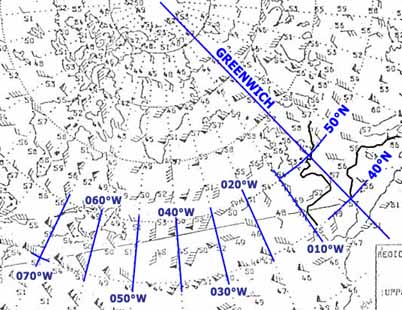
Nat regional supplementary procedures doc 7030 2192 flights operating predominantly in an east west direction 21923 the distance between significant points shall as far as possible not exceed one hour's flight time additional significant points should be established when deemed necessary due to aircraft speed or the angle at which the meridians are crossed eg a at intervals of 10 degrees of longitude between 5°w and 65°w for flights operating south of 70°n andb at intervals of 20 degrees of longitude between 10°w and 50°w for flights operating north of 70°n10° of longitude. 15° of longitude. 5° of longitude.
Question 231-15 : Long range flights and etopsair traffic services may require an aircraft to report position when flying east west south of 70°n between 5°w and 65°w every ?
10° of longitude.
Nat regional supplementary procedures doc 7030 2192 flights operating predominantly in an east west direction 21923 the distance between significant points shall as far as possible not exceed one hour's flight time additional significant points should be established when deemed necessary due to aircraft speed or the angle at which the meridians are crossed eg a at intervals of 10 degrees of longitude between 5°w and 65°w for flights operating south of 70°n andb at intervals of 20 degrees of longitude between 10°w and 50°w for flights operating north of 70°n5° of longitude. 20° of longitude. 15° of longitude.
Question 231-16 : An aeroplane is operated over water at a distance of 340 nm away from an aerodrome where an emergency landing could be performednormal cruising speed is 180 kt one engine out airspeed is 155 kt and it is capable to join the diversion aerodrome ?
Life jackets must be available for all occupants.
Catidea285The regulation does not require life jackets or rafts to be taken on board in this particular case. life jackets and rafts must be available for all occupants. life rafts must be available for all occupants.
Question 231-17 : An aeroplane whose maximum approved passenger seating configuration is 200 must be equipped with ?
3 hand fire extinguishers in the passenger compartment.
At least the following number of hand fire extinguishers must be conveniently located in the passenger compartment s 26285 hand fire extinguishers in the passenger compartment. 7 hand fire extinguishers in the passenger compartment. 4 hand fire extinguishers in the passenger compartment.
Question 231-18 : An aeroplane whose maximum approved passenger seating configuration is 301 to 400 seats must be equipped with at least ?
5 hand fire extinguishers conveniently located in the passenger compartment.
At least the following number of hand fire extinguishers must be conveniently located in the passenger compartment s 26284 hand fire-extinguishers conveniently located in the passenger compartment. 6 hand fire-extinguishers conveniently located in the passenger compartment. 3 hand fire-extinguishers conveniently located in the passenger compartment.
Question 231-19 : An aeroplane whose maximum approved passenger seating configuration is 401 to 500 seats must be equipped with at least ?
6 hand fire extinguishers conveniently located in the passenger compartment.
At least the following number of hand fire extinguishers must be conveniently located in the passenger compartment s 26285 hand fire-extinguishers conveniently located in the passenger compartment. 7 hand fire-extinguishers conveniently located in the passenger compartment. 8 hand fire-extinguishers conveniently located in the passenger compartment.
Question 231-20 : An aeroplane whose maximum approved passenger seating configuration is 501 to 600 seats must be equipped with at least ?
7 hand fire extinguishers conveniently located in the passenger compartment.
At least the following number of hand fire extinguishers must be conveniently located in the passenger compartment s 26288 hand fire-extinguishers conveniently located in the passenger compartment. 6 hand fire-extinguishers conveniently located in the passenger compartment. 5 hand fire-extinguishers conveniently located in the passenger compartment.
Question 231-21 : An aeroplane whose maximum approved passenger seating configuration is greater than 60 seats must be equipped including flight deck with at least ?
3 hafex fire extinguishers or equivalent.
Aircraft with greater than 60 seats require 3 fire extinguishers in the passenger compartment and at least 2 of which must be hafex or equivalent another hafex extinguisher is required in the cockpit2 + 1 = 3 hafex fire extinguishers or equivalent2 hafex fire-extinguishers or equivalent. 4 hafex fire-extinguishers or equivalent. 1 hafex fire-extinguisher or equivalent.
Question 231-22 : An aeroplane whose maximum approved passenger seating configuration is greater than 600 seats must be equipped with at least ?
8 hand fire extinguishers conveniently located in the passenger compartment.
At least the following number of hand fire extinguishers must be conveniently located in the passenger compartment s 26289 hand fire-extinguishers conveniently located in the passenger compartment. 7 hand fire-extinguishers conveniently located in the passenger compartment. 6 hand fire-extinguishers conveniently located in the passenger compartment.
Question 231-23 : An aircraft whose maximum approved seating configuration is 10 seats must be equipped with ?
One hand fire extinguisher in the cockpit and one in the passengers compartment.
At least the following number of hand fire extinguishers must be conveniently located in the passenger compartment s + one in the cockpit 2628One hand fire-extinguisher in the cockpit and two in the passengers compartment. three hand fire-extinguishers in the passengers compartment. two hand fire-extinguishers in the cockpit and two in the passengers compartment.
Question 231-24 : An operator can operate an aeroplane certificated to cs25 across an area in which search and rescue would be especially difficult without additional survival equipment if it flies away from an area suitable for making an emergency landing at a distance corresponding to no more than ?
90 minutes at cruising speed.
catidea305 an operator shall not operate an aeroplane across areas in which search and rescue would be especially difficult unless it is equipped with the following a signalling equipment to make the pyrotechnical distress signals described in icao annex 2 b at least one elt s capable of transmitting on the distress frequencies prescribed in icao annex 10 volume v chapter 2 and c additional survival equipment for the route to be flown taking account of the number of persons on board except that the equipment specified in sub paragraph c need not be carried when the aeroplane either 1 remains within a distance from an area where search and rescue is not especially difficult corresponding to i 120 minutes at the one engine inoperative cruising speed for aeroplanes capable of continuing the flight to an aerodrome with the critical power unit s becoming inoperative at any point along the route or planned diversions or ii 30 minutes at cruising speed for all other aeroplanesor 2 for aeroplanes certificated to cs 25 or equivalent no greater distance than that corresponding to 90 minutes at cruising speed from an area suitable for making an emergency landing 60 minutes at cruising speed. 30 minutes at cruising speed. 120 minutes at cruising speed.
Question 231-25 : An operator shall not operate an aeroplane first issued with an individual certificate of airworthiness on or after 1 april 1998 which has a maximum certificated take off mass over 5700 kg unless it is equipped with a cockpit voice recorder which records 1 voice communications transmitted from or ?
1 2 4 5 6.
Easa air opscatidea185 eu ops 1710 cockpit voice recorders 3 a an operator shall not operate any aeroplane with a maximum certificated take off mass over 5 700 kg first issued with an individual certificate of airworthiness before 1 april 1998 unless it is equipped with a cockpit voice recorder which records 1 voice communications transmitted from or received on the flight deck by radio 2 the aural environment of the flight deck 3 voice communications of flight crew members on the flight deck using the aeroplane's interphone system 4 voice or audio signals identifying navigation or approach aids introduced into a headset or speaker and 5 voice communications of flight crew members on the flight deck using the public address system if installed b the cockpit voice recorder shall be capable of retaining information recorded during at least the last 30 minutes of its operation c the cockpit voice recorder must start to record prior to the aeroplane moving under its own power and continue to record until the termination of the flight when the aeroplane is no longer capable of moving under its own power d the cockpit voice recorder must have adevice to assist in locating that recorder in water1, 2, 3, 5, 6. 2, 3, 4, 6. 2, 4, 5, 6.
Question 231-26 : Ops regulationan operator shall not operate an aeroplane first issued with an individual certificate of airworthiness on or after 1 april 1998 which has a maximum certificated take off mass over 5700 kg unless it is equipped with a cockpit voice recorder which shall be capable of retaining ?
2 hours of its operation.
Catidea185 cockpit voice recorders a an operator shall not operate an aeroplane first issued with an individual certificate of airworthiness on or after 1 april 1998 which 1 is multi engine turbine powered and has a maximum approved passenger seating configuration of more than 9 or 2 has a maximum certificated take off mass over 5 700 kgunless it is equipped with a cockpit voice recorder which with reference to a time scale records b the cockpit voice recorder shall be capable of retaining information recorded during at least the last 2 hours of its operation except that for those aeroplanes with a maximum certificated take off mass of 5 700 kg or less this period may be reduced to 30 minutesthe question states which has a maximum certificated take off mass over 5700 kg 30 minutes of its operation. 20 hours of its operation. 25 hours of its operation.
Question 231-27 : Long range flights and etopsduring a flight from europe scheduled in mnps minimum navigation performance specification airspace you expect to cross the 30°w meridian at 1330 utc you will normally be ?
In a day time organised track system.
Please download the guidance concerning air navigation in and above the north atlantic mnps airspace edition 2010 pdf675chapter 2 211 as a result of passenger demand time zone differences and airport noise restrictions much of the north atlantic nat air traffic contributes to two major alternating flows a westbound flow departing europe in the morning and an eastbound flow departing north america in the evening the effect of these flows is to concentrate most of the traffic unidirectionally with peak westbound traffic crossing the 30w longitude between 1130 utc and 1900 utc and peak eastbound traffic crossing the 30w longitude between 0100 utc and 0800 utc page 11 the hours of validity of the two organised track systems ots are normally as follows day time ots 1130 utc to 1900 utc at 30°wnight time ots 0100 utc to 0800 utc at 30°wIn a polar track system. in a night-time organised track system. outside the validity period of the organised track system.
Question 231-28 : During a special vfr flight the minimum visibility required is ?
1500 meters or more.
Sera5010 special vfr in control zones definitions 'special vfr flight' means a vfr flight cleared by air traffic control to operate within a control zone in meteorological conditions below vmcspecial vfr flights may be authorised to operate within a control zone subject to an atc clearance except when permitted by the competent authority for helicopters in special cases such as medical flights search and rescue operations and fire fighting the following additional conditions shall be applied a by the pilot 1 clear of cloud and with the surface in sight 2 the flight visibility is not less than 1500 m or for helicopters not less than 800 m 3 at speed of 140 kts ias or less to give adequate opportunity to observe other traffic and any obstacles in time to avoid a collision and b by atc 1 during day only unless otherwise permitted by the competent authority 2 the ground visibility is not less than 1500 m or for helicopters not less than 800 m 3 the ceiling is not less than 180 m 600 ft 5000 meters 3000 meters 1500 meters or 30 secondes of flight.
Question 231-29 : For a non pressurised aircraft 100% of passengers shall be supplied with supplemental oxygen during the entire flight time ?
At pressure altitudes above 13 000 ft.
supplemental oxygen for non pressurised aeroplanes 2624At pressure altitudes above 10 000 ft. after 30 minutes at pressure altitudes greater than 10 000 ft but not exceeding 13 000 ft. at pressure altitudes above 13 000 ft and for any period exceeding 30 minutes at pressure altitudes above 10 000 ft but not exceeding 13 000 ft.
Question 231-30 : For a non pressurised aircraft the supplemental oxygen is ?
Required to operate at pressure altitudes above 10 000 ft.
Supplemental oxygen non pressurised aeroplanes a general 1 an operator shall not operate a non pressurised aeroplane at altitudes above 10 000 ft unless supplemental oxygen equipment capable of storing and dispensing the oxygen supplies required is providedappendix 1supplemental oxygen for non pressurised aeroplanes com encom070 502pngAvailable for supply to passengers for physiological reasons. used for protection against smoke and carbon dioxide. therapeutical oxygen specially carried for certain passengers.
Question 231-31 : For a pressurised aircraft the supplemental oxygen is ?
The oxygen supplied to the aeroplane occupants in case of cabin pressurisation failure.
The oxygen supplied to a passenger who needs oxygen for physiological reasons. the oxygen used for protection against smoke and carbon dioxide. a therapeutic oxygen specifically carried for certain passengers.
Question 231-32 : If all long range navigation systems of an aircraft become unserviceable during a flight in mnps airspace and if no instructions are received from the air traffic c ontrol you must consider ?
Climbing or descending 500 feet.
Please download the guidance concerning air navigation in and above the north atlantic mnps airspace edition 2010 pdf675chapter 11 the remaining system fails after entering mnps airspace1128 the pilot should a immediately notify atc b make best use of procedures specified above relating to attempting visual sightings and establishing contact on vhf with adjacent aircraft for useful information c keep a special look out for possible conflicting aircraft and make maximum use of exterior lights d if no instructions are received from atc within a reasonable period consider climbing or descending 500 feet broadcasting action on 1215 mhz and advising atc as soon as possible note this procedure also applies when a single remaining system gives an indication of degradation of performance or neither system fails completely but the system indications diverge widely and the defective system cannot be determined Descend below the mnps space. return to departure airport. land at the nearest airport.
Question 231-33 : If installed the flight crew compartment door of all aeroplanes operated for the purpose of carrying passengers shall be capable of being ?
Locked from within the compartment.
Directly locked from outside the compartment. remotely locked by cabin crew operation from outside the compartment. remotely locked from either inside or outside the compartment.
Question 231-34 : During the passenger briefing for a flight requiring life jackets the passengers shall be instructed to inflate their life jackets ?
When outside the aircraft.
Immediately on the opening of the exits. immediately on ditching. as soon as ditching is prepared.
Question 231-35 : When required the number of life rafts to be carried on board an aeroplane must allow the transportation of the entire aeroplane occupants ?
In the case of a loss of one raft of the largest rated capacity.
Catidea285aeroplanes shall carry life rafts in sufficient numbers to carry all persons on board stowed so as to facilitate their ready use in an emergency and being of sufficient size to accommodate all the survivors in the event of a loss of one raft of the largest rated capacityPlus 10%. plus 20%. plus 30%.
Question 231-36 : 100% of the passengers in a non pressurised aircraft shall be supplied with supplemental oxygen for the entire flight time at pressure altitudes above ?
13000 ft.
supplemental oxygen for non pressurised aeroplanes 262411000 ft. 14000 ft. 15000 ft.
Question 231-37 : All occupants of flight deck seats on flight deck duty in a non pressurised aircraft shall be supplied with supplemental oxygen for the entire flight time at pressure altitudes above ?
10000 ft.
supplemental oxygen for non pressurised aircrafts 262413000 ft. 14000 ft. 15000 ft.
Question 231-38 : For a pressurised aeroplane during and following an emergency descent all occupants of flight deck seats on flight deck duty shall be supplied with a minimum supplemental oxygen quantity 1 in order to maintain a supply throughout the entire flight time where the cabin altitude pressure is greater ?
1 2 3 4.
oxygen minimum requirements for supplemental oxygen for pressurised aeroplanes 26251, 2. 1, 3, 4. 1,4.
Question 231-39 : Ops regulationin accordance with air ops a single deck aeroplane equipped with an approved seating capacity of 61 seats and carrying passengers must be equipped with at least ?
1 megaphone.
Eu ops 1810 megaphones a an operator shall not operate an aeroplane with a maximum approved passenger seating configuration of more than 60 and carrying one or more passengers unless it is equipped with portable battery powered megaphones readily accessible for use by crew members during an emergency evacuation to the following scales 1 for each passenger deck com encom070 309jpg 2 for aeroplanes with more than one passenger deck in all cases when the total passenger seating configuration is more than 60 at least 1 megaphone is required2 megaphones. 2 megaphones if there are more than 31 passengers on board. 3 megaphones.
Question 231-40 : In nat region a revised estimate should be transmitted to the ats when the estimated time for the next position has changed by ?
3 minutes or more.
5 minutes or more. 10 minutes or more. 2 minutes or more.
Exclusive rights reserved. Reproduction prohibited under penalty of prosecution.