A free Premium account on the FCL.055 website! Read here
Sign up to unlock all our services and 15164 corrected and explained questions.
Question 233-1 : For two engined aeroplanes not approved for etops the take off alternate if required shall be located in still air conditions within ? [ Formation assignment ]
One hour flight time at one engine inoperative cruising speed
Question 233-2 : Icao annex 6for three and four engined aeroplanes the take off alternate if required shall be located in still air conditions within ?
2 hours flight time at one engine inoperative cruising speed.
Icao annex 6 and easa air ops catopmpa180 selection of aerodromes aeroplanes2 hours flight time at cruising speed with all engines operating. 1 hour flight time at one-engine-inoperative cruising speed. 1 hour flight time at cruising speed with all engines operating.
Question 233-3 : An operator must ensure that the mdh for a vordme approach is not lower than ?
250 ft.
At landing two types of procedures exist non precision approach rnavlnav ndb ndbdme vor vordme llz llzdme vdf sra and precision approach ils gls mls par for a non precision approach we use the word mdh a minimum descent height altitude for a precision approach we use the word dh a decision height altitude at mdh a you are able to level your aircraft at the minimum descent height until reaching a specific point wich can be based on time or distance from a facility offering you opportunity to established visual contact with the runway to perform a landingat dh a you must initiate a go around procedure minimum descent height mdh for an ils approach without the glidepath localizer only 250 ftfor a for a vordme approach 250 ftfor a vor approach 300 ftfor a ndb approach 350 ftfor a rnavlnav approach 300 ftdecision height dh for ils cat ii 100 ftfor ils cat i 200 ftfor a gls gnss landing system similar to traditional category i approaches200 ft. 300 ft. 350 ft.
Question 233-4 : Ops regulationin accordance with easa air ops a commander shall ensure that the amount of usable fuel remaining in flight is not less than the fuel required to proceed to an aerodrome where a safe landing can be made with ?
Final reserve fuel remaining.
Ecqb03 september 2016easa air opsregulation eu no 9652012catopmpa230 ln flight fuel management aeroplanesthe operator shall establish a procedure to ensure that in flight fuel checks and fuel management are carried out according to the following criteria a in flight fuel checks 1 the commander shall ensure that fuel checks are carried out in flight at regular intervals the usable remaining fuel shall be recorded and evaluated to i compare actual consumption with planned consumption ii check that the usable remaining fuel is sufficient to complete the flight in accordance with b and iii determine the expected usable fuel remaining on arrival at the destination aerodrome 2 the relevant fuel data shall be recorded b in flight fuel management 1 the flight shall be conducted so that the expected usable fuel remaining on arrival at the destination aerodrome is not less than i the required alternate fuel plus final reserve fuel or ii the final reserve fuel if no alternate aerodrome is required 2 if an in flight fuel check shows that the expected usable fuel remaining on arrival at the destination aerodrome is less than i the required alternate fuel plus final reserve fuel the commander shall take into account the traffic and the operational conditions prevailing at the destination aerodrome at the destination alternate aerodrome and at any other adequate aerodrome in deciding whether to proceed to the destination aerodrome or to divert so as to perform a safe landing with not less than final reserve fuel or ii the final reserve fuel if no alternate aerodrome is required the commander shall take appropriate action and proceed to an adequate aerodrome so as to perform a safe landing with not less than final reserve fuel 3 the commander shall declare an emergency when the calculated usable fuel on landing at the nearest adequate aerodrome where a safe landing can be performed is less than final reserve fuel 4 additional conditions for specific procedures i on a flight using the rcf procedure to proceed to the destination 1 aerodrome the commander shall ensure that the usable fuel remaining at the decision point is at least the total of a trip fuel from the decision point to the destination 1 aerodrome b contingency fuel equal to 5% of trip fuel from the decision point to the destination 1 aerodrome c destination 1 aerodrome alternate fuel if a destination 1 alternate aerodrome is required and d final reserve fuel15 minutes of remaining fuel. fuel to hold 30 minutes at 1500 ft above the aedrodrome. fuel to fly 20 minutes at best range speed.
Question 233-5 : An operator must ensure that the lowest mdh for a ndb approach is ?
350 ft.
At landing two types of procedures exist 'non precision approach procedures' rnavlnav ndb ndbdme vor vordme llz llzdme vdf sra and 'precision approach procedures' ils gls mls par for a 'non precision approach procedures' we use the word mdh a minimum descent height altitude for a 'precision approach procedures' we use the word dh a decision height altitude at mdh a you are able to level your aircraft at the minimum descent height until reaching a specific point wich can be based on time or distance from a facility offering you opportunity to established visual contact with the runway to perform a landingat dh a you must initiate a go around proceduremdh are for an ils approach without the glidepath localizer only 250 ftfor a for a vordme approach 250 ftfor a vor approach 300 ftfor a ndb approach 350 ft 300 ft before 16 july 2011 for a rnavlnav approach 300 ftdh are for ils cat ii 100 ftfor ils cat i 200 ftfor a gls gnss landing system similar to traditional category i approaches200 ft. 250 ft. 400 ft.
Question 233-6 : For a pressurised aircraft the definition of supplemental oxygen is ?
Oxygen supplied to the aeroplane occupants in the case of cabin pressurisation failure.
Oxygen supplied to a passenger who needs oxygen for physiological reasons. oxygen used for protection against smoke and carbon dioxide. oxygen specifically carried for therapeutic purposes.
Question 233-7 : The commander of a turbojet engine aeroplane should have a final reserve fuel for ?
30 minutes of flight at holding speed at 1500 ft above aerodrome elevation in standard conditions.
Part cat catopmpa150 fuel policy45 minutes of flight at holding speed at 1500 ft above aerodrome elevation in standard conditions. 30 minutes of flight at cruising speed at fl140. 45 minutes of flight at cruising speed at fl140.
Question 233-8 : Due to a cabin pressurisation defect the maximum differential pressure is limited to 3 psi assuming the oxygen masks will be deployed at 14000 feet the maximum achievable flight altitude is approximately 2631 ?
24500 ft.
263222500 ft. 27000 ft. 29000 ft.
Question 233-9 : Due to a cabin pressurisation defect the maximum differential pressure is limited to 2 psi assuming you don't want the cabin altitude being greater than 10000 feet the maximum achievable flight altitude is approximately 2631 ?
15100 ft.
163814000 ft. 12000 ft. 5000 ft.
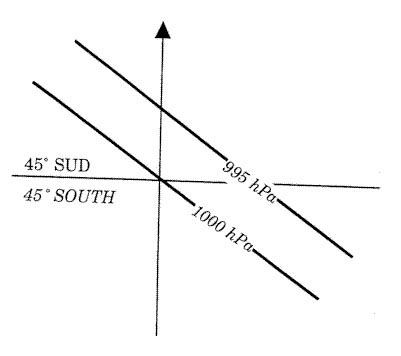
Question 233-10 : Long range flights and etopson the diagram where tn = true northmn = magnetic northgn = grid northif the magnetic variation is equal to 65°w and if the grivation is equal to 4°e the correct arrangement of the different north is err a 070 424 ?
3.
If magnetic north is on the right of the grid north grivation >0 or eastif magnetic north is on the left of the grid north grivation4 1 2
Question 233-11 : Long range flights and etopsat reference the inertial navigation system ins indicates position 71° 551'n 094°553'wdrift 6°l left the route followed in order to return to the vor station is the meridian of the vor station used resolute bay 74°436'n 094°553w this vor has north set on the local ?
2.
Distance between the two points 74º 436' 71º 551' = 1685 nmthe top of the display shows the grid heading true heading is 000° we are following the meridian + west longitude = 095 + 6° drift left = 101°true track 000° to reach the vor since the vor is lined up on the local meridian3 4 1
Question 233-12 : Long range flights and etopsa pilot is using a polar stereographic chart whose grid is parallel to the zero meridian with grid north in the direction of the north geographic pole in polar regions the pilot stops navigation in free gyro mode after leaving the 6 microteslas zone and the grid heading ?
5°.
Aircraft position 76°n 180°w grid heading 045°grid is parallel to the zero meridian with grid north in the direction of the north geographic pole the true heading is equal to the grid heading +180° aircraft's longitude then true heading is 225°with a true heading of 225° 10°e magnetic variation our magnetic heading is 215°when the pilot will shift the compass to magnetic mode compass heading is 220° magnetic heading is 215° compass shift is 5°+5°. -15°. +15°.
Question 233-13 : Long range flights and etopsan aircraft flying at flight level 370 fl 370 in mnps airspace is unable to continue flight in accordance with its air traffic control clearance but is able to maintain its assigned level fl 370 and due to a total loss of communications capability cannot obtain a revised ?
Climb or descend 500 ft.
Please download the guidance concerning air navigation in and above the north atlantic mnps airspace edition 2010 pdf675 123 special procedures 1231 the general concept of these oceanic in flight contingency procedures is whenever operationally feasible to offset from the assigned route by 15 nm and climb or descend to a level which differs from those normally used by 500 ft if below fl410 or by 1000 ft if above fl410 initial action 1232 the aircraft should leave its assigned route or track by initially turning at least 45° to the right or left whenever this is feasible the direction of the turn should where appropriate be determined by the position of the aircraft relative to any organised route or track system eg whether the aircraft is outside at the edge of or within the system other factors which may affect the direction of turn are direction to an alternate airport terrain clearance levels allocated on adjacent routes or tracks and any known slop off sets adopted by other nearby traffic subsequent action 1233 an aircraft that is able to maintain its assigned flight level after deviating 10 nm from its original cleared track centerline and therefore clear of any potentially conflicting traffic above or below following the same track should a climb or descend 1000 ft if above fl410b climb or descend 500 ft when below fl410 c climb 1000 ft or descend 500 ft if at fl410 thus you turn 45° to the right or left to acquire and maintain in either direction a track laterally separated by 15 nm from your assigned route after deviating 10 nm from your original route you can start to climb or descend Climb or descent 1000 ft. climb or descent 1000 ft or descend 500 ft. climb 500 ft or descend 1000 ft.
Question 233-14 : With the exception of amphibians and seaplanes the carriage of a life jacket for each person on board is compulsory when the aeroplane is 1 cruising at such a distance from the shore that it would not be able to return in the case of an engine failure2 is flying over a water surface at more than ?
2 3.
Ops 1825 life jackets a land aeroplanes an operator shall not operate a land aeroplane 1 when flying over water and at a distance of more than 50 nautical miles from the shore or 2 when taking off or landing at an aerodrome where the take off or approach path is so disposed over water that in the event of a mishap there would be a likelihood of a ditching unless it is equipped with life jackets equipped with a survivor locator light for each person on boardeach life jacket must be stowed in a position easily accessible from the seat or berth of the person for whose use it is provided life jackets for infants may be substituted by other approved flotation devices equipped with a survivor locator lightnotice statement n°1 cruising at such a distance from the shore that it would not be able to return in the case of an engine failure is not allowed in public transportation1, 2, 3, 4. 1, 2. 3, 4.
Question 233-15 : In the event of a contingency which required an en route diversion to an alternate aerodrome across the direction of the prevailing 'nat' traffic flow and if prior atc clearance cannot be obtained an aircraft not able to maintain its assigned flight level should ?
Minimise its rate of descent while acquiring a 15 nm offset track.
Jomargra before commencing any diversion across the flow of adjacent traffic aircraft should whilst maintaining the 30 nm offset track expedite climb above or descent below the vast majority of nat traffic ie to a level above fl410 or below fl285 and then maintain a flight level which differs from those normally used by 1000 ft if above fl410 or by 500 ft if below fl410 however if the pilot is unable or unwilling to carry out a major climb or descent then any diversion should be carried out at a level 500 ft different from those in use within mnps airspace until a new atc clearance is obtainedno you have an older version of the mnps guidance the value has changed in 2007please download the guidance concerning air navigation in and above the north atlantic mnps airspace edition 2010 pdf675123 special procedures 1234 an aircraft that is unable to maintain its assigned flight level should whenever possible initially minimise its rate of descent when leaving its original track centreline and then when expected to be clear of any possible traffic following the same track at lower levels expedite descent to an operationally feasible flight level which differs from those normally used by 500 ft if below fl410 or by 1000 ft if above fl410 1235 before commencing any diversion across the flow of adjacent traffic aircraft should whilst maintaining the 15 nm offset track expedite climb above or descent below the vast majority of nat traffic ie to a level above fl410 or below fl280 and then maintain a flight level which differs from those normally used by 1000 ft if above fl410 or by 500 ft if below fl410 however if the pilot is unable or unwilling to carry out a major climb or descent then any diversion should be carried out at a level 500 ft different from those in use within mnps airspace until a new atc clearance is obtainedMinimise its rate of descent while acquiring a 60 nm offset track. immediatelly descend below fl280 and then acquire a 15 nm offset track. immediatelly descend below fl280 and then acquire a 60 nm offset track.
Question 233-16 : The minimum requirements for supplemental oxygen to be supplied in pressurised aeroplanes during and following an emergency descent are that for pilots it shall be available for the entire flight time that the cabin pressure altitude exceeds a minimum of x feetthat minimum of x feet is ?
13000 ft.
oxygen minimum requirements for supplemental oxygen for pressurised aeroplanes 262514000 ft. 15000 ft. 25000 ft.
Question 233-17 : When establishing an instrument approach procedure five aeroplane categories are determined according to their speed at the threshold vat this speed is equal to the stalling speed in the landing configuration at the maximum certified landing mass multiplied by a factor of ?
13.
Classification of aeroplanes the criteria taken into consideration for the classification of aeroplanes by categories is the indicated airspeed at threshold vat which is equal to the stalling speed vso multiplied by 13 or vs1g multiplied by 123 in the landing configuration at the maximum certificated landing mass if both vso and vs1g are available the higher resulting vat shall be used the aeroplane categories corresponding to vat values are in the table below 26271.45 1.5 1.15
Question 233-18 : At least one of the following hand fire extinguishers must be conveniently located on the flight deck ?
A hafex fire extinguisher or equivalent.
hafex 'halon alternative fire extinguisher'A powder fire-extinguisher. a water fire-extinguisher. a foam fire-extinguisher.
Question 233-19 : A crew member is allowed to carry safety matches 1 on himself2 in his hand baggage3 in his checked baggage4 for his own usethe combination regrouping all the correct statements is ?
1 4.
The crew or the passengers may only carry on their person one box of safety matches or one refillable cigarette lighter for personal use these must be carried on the person and are not permitted in hand baggage disposable lighters and strike anywhere matches are not permitted to be carried either in the aircraft cabin on your person or in hand baggage under any circumstances1, 2, 3, 4. 1, 2, 4. 2, 3.
Question 233-20 : According to air ops and assuming the following circumstances for a category a airplane and aerodrome equipped with runway edge lighting and centre line lighting and multiple rvr information an acceptable alternate aerodrome is available the minimum rvrvisibility required for take off ?
150 m.
Eu ops 1455 low visibility operations operating procedures a an operator must establish procedures and instructions to be used for low visibility take off and category ii and iii operations these procedures must be included in the operations manual and contain the duties of flight crew members during taxying take off approach flare landing roll out and missed approach as appropriate b the commander shall satisfy himself that 1 the status of the visual and nonvisual facilities is sufficient prior to commencing a low visibility take off or a category ii or iii approach 2 appropriate lvps are in force according to information received from air traffic services before commencing a low visibility take off or a category ii or iii approach and 3 the flight crew members are properly qualified prior to commencing a low visibility take off in an rvr of less than 150 m category a b and c aeroplanes or 200 m cat d aeroplanes or a category ii or iii approach200 m. 300 m. 250 m.
Question 233-21 : The number of spare fuses available for use in flight must be ?
10% of the number of fuses of each rating or at least 3 for each rating.
Catidea110 spare electrical fusesa aeroplanes shall be equipped with spare electrical fuses of the ratings required for complete circuit protection for replacement of those fuses that are allowed to be replaced in flightb the number of spare fuses that are required to be carried shall be the higher of 1 10 % of the number of fuses of each rating or 2 three fuses for each rating5% of the number of fuses of each rating or at least 3 for each rating. 20% of the number of fuses of each rating or at least 2 for each rating. at least 2 for each rating.
Question 233-22 : During an ils procedure if the information transmitted by the appropriate services and received by the crew contains parameters below the crew's operational minimums the point beyond which the approach must not be continued is ?
The outer marker om .
The faf. the middle marker. the start final descent point (glide slope intersection).
Question 233-23 : The number of crash axes or crowbars on board an aeroplane whose maximum approved configuration of passenger seats is 201 is ?
2.
Catidea255 crash axe and crowbar a aeroplanes with a maximum certificated take off mass mctom exceeding 5 700 kg or having a maximum approved passenger seating configuration mopsc of more than 9 seats shall be equipped with at least one crash axe or crowbar located in the flight crew compartment b if the maximum approved passenger seating configuration mopsc is more than 200 an additional crash axe or crowbar shall be installed in or near the most rearmost galley area c crash axes and crowbars located in the passenger compartment shall not be visible to passengers1. 3. 4.
Question 233-24 : Ops regulationan operator shall not operate an aeroplane unless it is equipped with a cockpit voice recorder which starts to record automatically ?
Prior to the aeroplane moving under its own power until the termination of the flight when the aeroplane is no longer capable of moving under its own power.
eu ops 17000510 cockpit voice recorders c the cockpit voice recorder must start to record prior to the aeroplane moving under its own power and continue to record until the termination of the flight when the aeroplane is no longer capable of moving under its own power in addition depending on the availability of electrical power the cockpit voice recorder must start to record as early as possible during the cockpit checks prior to the flight until the cockpit checks immediately following engine shutdown at the end of the flightWhen the parking brake is released until the termination of flight when the parking brake is set. when full thrust is applied until the termination of the flight when the aeroplane is no longer capable of moving under its own power. prior to the aeroplane moving under its own power until the termination of flight when the parking brake is set.
Question 233-25 : Long range flights and etopsif a pilot has connected the automatic pilot to the gyro compass which is assumed to be operating correctly and the latter is fitted with a rate correction device which is properly corrected by astronomical precession the course followed by the aircraft in still air ?
Great circle.
If the gyro compass is corrected for astronomical precession in still air conditions = without wind the course is an orthodromic track a great circle track at constant heading this is a rhumb lineRhumb line. curve of some type or other. spherical flight segment.
Question 233-26 : An aeroplane with 8 passengers on board is operated at fl 270 the supply of undiluted oxygen carried on board shall be sufficient for at least ?
1 passenger for the remainder of the flight after cabin depressurisation when the cabin altitude exceeds 8000 ft.
Eu ops 1760 first aid oxygen a an operator shall not operate a pressurised aeroplane above 25 000 ft when a cabin crew member is required to be carried unless it is equipped with a supply of undiluted oxygen for passengers who for physiological reasons might require oxygen following a cabin depressurisation the amount of oxygen shall be calculated using an average flow rate of at least 3 litres standard temperature pressure dry stpd minuteperson and shall be sufficient for the remainder of the flight after cabin depressurisation when the cabin altitude exceeds 8 000 ft but does not exceed 15 000 ft for atleast 2% of the passengers carried but in no case for less than one person there shall be a sufficient number of dispensing units but in no case less than two with a means for cabin crew to use the supplythe dispensing units may be of a portable type2% of 8 passengers is 016 passenger ==> 1 passengerNo first aid required. 1 passenger for the remainder of the flight after cabin depressurisation when the cabin altitude exceeds 14000 ft. 2 passengers for the remainder of the flight after cabin depressurisation when the cabin altitude exceeds 10000 ft.
Question 233-27 : The route of a twin engine aircraft non etops with a maximum certificated take off mass exceeding 45360 kg or a maximum seating configuration of 20 passengers or more must be planned in such a way that on one engine an adequate aerodrome can be reached within ?
60 minutes at the cruise speed one engine inoperative.
Catopmpa140 maximum distance from an adequate aerodrome for two engined aeroplanes without an etops approval a unless approved by the competent authority in accordance with annex v part spa subpart f the operator shall not operate a two engined aeroplane over a route that contains a point further from an adequate aerodrome under standard conditions in still air than 1 for performance class a aeroplanes with either i a maximum operational passenger seating configuration mopsc of 20 or more or ii a maximum take off mass of 45360 kg or morethe distance flown in 60 minutes at the one engine inoperative oei cruising speed determined in accordance with b 2 for performance class a aeroplanes with i an mopsc of 19 or less and ii a maximum take off mass less than 45360 kgthe distance flown in 120 minutes or subject to approval by the competent authority up to 180 minutes for turbo jet aeroplanes at the oei cruise speed determined in accordance with b 3 for performance class b or c aeroplanes i the distance flown in 120 minutes at the oei cruise speed determined in accordance with b or ii 300 nm whichever is less b the operator shall determine a speed for the calculation of the maximum distance to an adequate aerodrome for each two engined aeroplane type or variant operated not exceeding vmo maximum operating speed based upon the true airspeed that the aeroplane can maintain with one engine inoperative c the operator shall include the following data specific to each type or variant in the operations manual 1 the determined oei cruising speed and 2 the determined maximum distance from an adequate aerodrome d to obtain the approval referred to in a 2 the operator shall provide evidence that 1 the aeroplaneengine combination holds an extended range operations with two engined aeroplanes etops type design and reliability approval for the intended operation 2 a set of conditions has been implemented to ensure that the aeroplane and its engines are maintained to meet the necessary reliability criteria and 3 the flight crew and all other operations personnel involved are trained and suitably qualified to conduct the intended operation30 minutes at the cruise speed, one engine inoperative. 90 minutes at the cruise speed, one engine inoperative. 120 minutes at the cruise speed, one engine inoperative.
Question 233-28 : An ifr flight with no alternate aerodrome can be undertaken only if the minimum weather conditions vmc are effective for at least ?
1 hour before to at least 1 hour after the expected time of arrival.
Question 233-29 : You intend to operate a public transport aeroplane land aeroplane with 60 persons on board the track will overfly water at 80 nautical miles from the shorethe minimum number of approved life jackets to be on board is ?
60.
Ops 1825 life jackets a land aeroplanesan operator shall not operate a land aeroplane 1 when flying over water and at a distance of more than 50 nautical miles from the shore or 2 when taking off or landing at an aerodrome where the take off or approach path is so disposed over water that in the event of a mishap there would be a likelihood of a ditchingunless it is equipped with life jackets equipped with a survivor locator light for each person on board each life jacket must be stowed in a position easily accessible from the seat or berth of the person for whose use it is provided life jackets for infants may be substituted by other approved flotation devices equipped with a survivor locator light66. 0. none if equipped with life rafts.
Question 233-30 : An operator shall ensure that each cabin crew member is at least ?
18 years of age.
21 years of age. 17 years of age. 20 years of age.
Question 233-31 : Which of the following is the correct definition of 'wet lease' ?
The aircraft is operated under the aoc of the lessor.
Easa air ops regulation eu no 3792014 amending regulation eu no 9652012 annex i definitions for terms used in annexes ii viidry lease agreement without crew means an agreement between undertakings pursuant to which the aircraft is operated under the air operator certificate aoc of the lessee or in the case of commercial operations other than cat under the responsibility of the lesseewet lease agreement crew included means an agreement in the case of cat operations between air carriers pursuant to which the aircraft is operated under the aoc of the lessor or in the case of commercial operations other than cat between operators pursuant to which the aircraft is operated under the responsibility of the lessorThe aircraft is operated under the aoc of the lessee. the aircraft is operated overseas. the aircraft is leased from a non-easa operator.
Question 233-32 : For a flight from paris to washington withetops authorisation 105 minutes at 420 kt the track to be chosen for a twin engine aircraft will be 2633 ?
Track c.
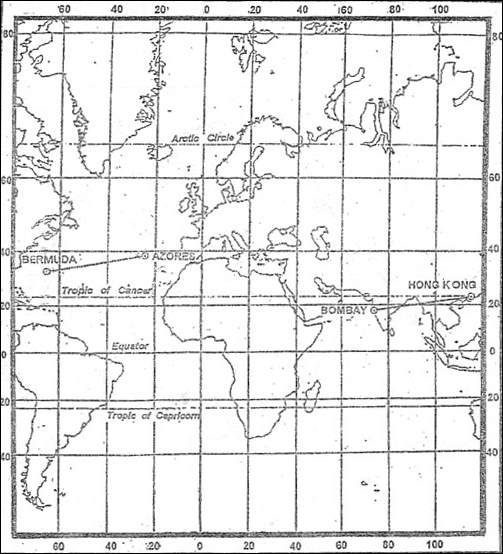
Tracks c and d are etops compliant in every point of the route in case of engine failure we will be at less than 1h45 735nm from an alternate airport in commercial transport we are looking for the shortest track so answer c will be the best choiceTrack a. track d. track b.
Question 233-33 : An operator must select a take off alternate ?
If it would not be possible to return to the aerodrome of departure for meteorological or performance reasons.
Storch it is probably more likely to be 'landing alternate' instead of 'take off' in the question i doubt it is possible to take off from an other location without taking off from the initial one thank you for you feedbacka 'take off alternate' is an alternate airport for departure for cruise you select 'en route alternate airports' on arrival you select at least one 'destination alternate airport'eu ops 1295 b an operator must select and specify in the operational flight plan a take off alternate aerodrome if it would not be possible to return to the departure aerodrome for meteorological or performance reasons the take off alternate aerodrome in relation to the departure aerodrome shall be located within 1 for two engined aeroplanes either i one hour flight time at a one engine inoperative cruising speed according to the aircraft flight manual afm in still air standard conditions based on the actual take off mass or ii the operator's approved etops diversion time subject to any mel restriction up to a maximum of two hours at the one engine inoperative cruising speed according to the afm in still air standard conditions based on the actual take off mass for aeroplanes and crews authorised for etopsWhen conducting a flight over water of more than 2 hours or 400 nm, whichever is the lesser. when the flight duration exceeds 6 hours. for an ifr flight with a single-engine aeroplane.
Question 233-34 : Ops regulationunder what circumstances may an operator introduce alternative procedures to those prescribed in air ops maintenance ?
When needed and when an equivalent safety case has first been approved by the authority and supported by easa member authorities.
When needed and when an equivalent safety case has been established. no prior approval is needed from the authority. when needed to expedite maintenance procedures. never.
Question 233-35 : The minimum number of hand fire extinguishers to be located in the passenger compartment of an aircraft with a maximum approved passenger seating configuration of 31 is ?
2.
At least the following number of hand fire extinguishers must be conveniently located in the passenger compartment s 26281. 3. 0.
Question 233-36 : According to annex 6 'rnp type' is defined as a containment value expressed as a distance in i from the intended position within which flights would be for at least ii of the total flying time ?
I nautical miles ii 95%.
Icao annex 6 defines two kinds of navigation specifications rnp specification a navigation specification based on area navigation that includes the requirement for performance monitoring and alerting designated by the prefix rnp eg rnp 4 rnp apchand rnav specification a navigation specification based on area navigation that does not include the requirement for performance monitoring and alerting designated by the prefix rnav eg rnav 5 rnav 1note the performance based navigation manual doc 9613 volume ii contains detailed guidance on navigation specificationsicao doc 9613 volume ii system performance monitoring and alerting accuracy during operations in airspace or on routes designated as basic rnp 1 the lateral total system error must be within ±1 nm for at least 95 per cent of the total flight time the along track error must also be within ±1 nm for at least 95 per cent of the total flight time(i) nautical miles (ii) 90% (i) kilometers (ii) 95% (i) kilometers (ii) 90%
Question 233-37 : Unless sufficient life rafts to carry all persons on board are carried on overwater flights an operator shall not operate an aeroplane at a distance away from land which is suitable for making an emergency landing greater than that corresponding to i minutes at cruising speed or ii nautical miles ?
I 120 minutes ii 400 nautical miles.
(i) 90 minutes (ii) 300 nautical miles (i) 45 minutes (ii) 200 nautical miles (i) 30 minutes (ii) 100 nautical miles
Question 233-38 : Ops regulationaccording to air ops the minimum number of crash axes or crowbars on board an aeroplane whose maximum approved passenger seating configuration is more than 200 is ?
2.
easa air ops catidea255 crash axe and crowbar a aeroplanes with a maximum certificated take off mass mctom exceeding 5 700 kg or having a maximum approved passenger seating configuration mopsc of more than 9 seats shall be equipped with at least one crash axe or crowbar located in the flight crew compartment b if the maximum approved passenger seating configuration mopsc is more than 200 an additional crash axe or crowbar shall be installed in or near the most rearmost galley area c crash axes and crowbars located in the passenger compartment shall not be visible to passengers1. 3. 4.
Question 233-39 : For two engined aeroplanes in performance class b or c without an etops approval the maximum distance from an adequate aerodrome is the distance flown in i minutes at the one engine inoperative cruise speed or ii nm ?
I 120 ii 300.
Easa air opsregulation eu no 9652012catopmpa140 maximum distance from an adequate aerodrome for two engined aeroplanes without an etops approval a unless approved by the competent authority in accordance with annex v part spa subpart f the operator shall not operate a two engined aeroplane over a route that contains a point further from an adequate aerodrome under standard conditions in still air than 1 for performance class a aeroplanes with either i a maximum operational passenger seating configuration mopsc of 20 or more or ii a maximum take off mass of 45360 kg or morethe distance flown in 60 minutes at the one engine inoperative oei cruising speed determined in accordance with b 2 for performance class a aeroplanes with i an mopsc of 19 or less and ii a maximum take off mass less than 45360 kgthe distance flown in 120 minutes or subject to approval by the competent authority up to 180 minutes for turbo jet aeroplanes at the oei cruise speed determined in accordance with b 3 for performance class b or c aeroplanes i the distance flown in 120 minutes at the oei cruise speed determined in accordance with b or ii 300 nm whichever is less b the operator shall determine a speed for the calculation of the maximum distance to an adequate aerodrome for each two engined aeroplane type or variant operated not exceeding vmo maximum operating speed based upon the true airspeed that the aeroplane can maintain with one engine inoperative c the operator shall include the following data specific to each type or variant in the operations manual 1 the determined oei cruising speed and 2 the determined maximum distance from an adequate aerodrome d to obtain the approval referred to in a 2 the operator shall provide evidence that 1 the aeroplaneengine combination holds an extended range operations with two engined aeroplanes etops type design and reliability approval for the intended operation 2 a set of conditions has been implemented to ensure that the aeroplane and its engines are maintained to meet the necessary reliability criteria and 3 the flight crew and all other operations personnel involved are trained and suitably qualified to conduct the intended operation(i) 60 (ii) 300 (i) 60 (ii) 200 (i) 120 (ii) 200
Question 233-40 : An operator must select two destination alternates when the appropriate weather reports or forecasts for the destination or any combination thereof indicate that during a period commencing i hour s before and ending ii hour s after the expected iii the weather conditions will be below the ?
I one ii one iii time of arrival.
Eu ops 1295 d an operator must select two destination alternate when 1 the appropriate weather reports or forecasts for the destination or any combination thereof indicate that during a period commencing one hour before and ending one hour after the estimated time of arrival the weather conditions will be below the applicable planning minima or 2 no meteorological information is available(i) two (ii) two (iii) time of arrival (i) one (ii) one (iii) time of departure (i) two (ii) two (iii) time of departure
Exclusive rights reserved. Reproduction prohibited under penalty of prosecution.