A free Premium account on the FCL.055 website! Read here
Sign up to unlock all our services and 15164 corrected and explained questions.
Question 7-1 : Visual flight rulesexcept when a clearance is obtained from an atc unit vfr flights shall not take off or land at an aerodrome within a ctr of airspace class c or d or enter the aerodrome traffic zone or traffic pattern when the ? [ Practice protocol ]
Ceiling is less than 1500 ft or the ground visibility is less than 5 km
Question 7-2 : Visual signalsin flight the pilot of an aircraft observes a series of projectiles discharged from the ground at intervals of 10 seconds each showing on bursting red and green lights or stars the meaning of this signal is ?
The unauthorised aircraft is flying in or about to enter a restricted prohibited or danger area and the aircraft is to take such remedial action as may be necessary.
Img708icao annex 2 rules of the air 3 visual signals used to warn an unauthorized aircraft flying inor about to enter a restricted prohibited or danger areaby day and by night a series of projectiles discharged from the ground at intervals of 10 seconds each showing on bursting red and green lights or stars will indicate to an unauthorized aircraft that it is flying in or about to enter a restricted prohibited or danger area and that the aircraft is to take such remedial action as may be necessaryThe aerodrome nearby you have chosen for landing is unsafe, do not attempt to land. proceed to your alternate. notwithstanding any previous instructions, stay in the circuit, do not land for the time being. give way to other aircraft and continue circling.
Question 7-3 : When two aircraft are approaching head on or approximately so and there is a danger of collision each shall ?
Alter its heading to the right.
Alter its heading to the left. descent. climb.
Question 7-4 : Whenever unlawful interference with an aircraft is suspected and where automatic distinct display of ssr mode a code 7500 and code 7700 is not provided the radar controller shall attempt to verify this suspicion by ?
Setting the ssr decoder to mode a code 7500 and thereafter to code 7700.
doc 4444 1513 unlawful interference and aircraft bomb threat15132 whenever unlawful interference with an aircraft is suspected and where automatic distinct display of ssr mode a code 7500 and code 7700 is not provided the controller shall attempt to verify any suspicion by setting the ssr decoder to mode a code 7500 and thereafter to code 7700note an aircraft equipped with an ssr transponder is expected to operate the transponder on mode a code 7500 to indicate specifically that it is the subject of unlawful interference the aircraft may operate the transponder on mode a code 7700 to indicate that it is threatened by grave and imminent danger and requires immediate assistance an aircraft equipped with other surveillance system transmitters including ads b and ads c might send the emergency andor urgency signal by all of the available meansSetting the ssr decoder to mode a 7500 then to standby and thereafter to code 7700. setting the ssr decoder to mode a 7700 then to standby and thereafter to code 7500. setting the ssr decoder to mode a code 7000 and thereafter to code 7500.
Question 7-5 : While taxiing an aircraft receives from the airport controller the following light signal a series of green flashes this signal means that the aircraft ?
May continue to taxy towards the take off area.
Img708Is cleared for take-off. must stop. must return to its point of departure.
Question 7-6 : While taxying an aircraft receives the following light signal from the control tower series of red flashes this signal means that the aircraft ?
Must vacate the landing area in use.
Img708May continue to taxi to the take-off area. must stop. must return to its point of departure.
Question 7-7 : Whilst flying in an aerodrome's traffic circuit an aircraft receives a series of green flashes from the tower the aircraft ?
Must come back to land and the landing clearance will be sent in due time.
Img708Must give way to another aircraft. is cleared to land. must land immediately and clear the landing area.
Question 7-8 : Vfr flights shall not be operated above ?
Fl 195.
Sera5005 visual flight rules d unless authorised by the competent authority in accordance with regulation ec no 7302006 vfr flights shall not be operated 1 above fl 195 2 at transonic and supersonic speedsFl 165. fl 205. fl 145.
Question 7-9 : Which fl can be used to perform a vfr flight on a magnetic track of 200° ?
Fl 085.
Img713Fl 050. fl 100. fl 095.
Question 7-10 : Which fl can be used to perform a vfr flight on a magnetic track of 170° ?
Fl 095.
Img713Fl 100. fl 050. fl 045.
Question 7-11 : Except when necessary for take off or landing a vfr flight over congested areas of cities towns or settlements or over an open air assembly of persons shall not be flown at a height less than ?
300 m above the highest obstacle within a radius of 600 m from the aircraft.
Icao annex 2chapter 4 visual flight rules46 except when necessary for take off or landing or except by permission from the appropriate authority a vfr flght shall not be flown a over congested areas of cities towns or settlements or over an open air assembly of persons at a height less than 300 m 1000 ft above the highest obstacle within a radius of 600 m from the aircraft b elsewhere than as specified in 46 a at a height less than 150 m 500 ft above the ground or water600 m above the highest obstacle within a radius of 300 m from the aircraft. 300 m above the highest obstacle. 300 m above the highest obstacle within a radius of 600 ft from the aircraft.
Question 7-12 : Outside congested areas of cities towns or settlements or over an open air assembly of persons a vfr flight shall not be flown at a height less than ?
500 ft.
Icao annex 2chapter 4 visual flight rules46 except when necessary for take off or landing or except by permission from the appropriate authority a vfr flght shall not be flown a over congested areas of cities towns or settlements or over an open air assembly of persons at a height less than 300 m 1000 ft above the highest obstacle within a radius of 600 m from the aircraft b elsewhere than as specified in 46 a at a height less than 150 m 500 ft above the ground or water1000 ft. 2000 ft. 150 ft.
Question 7-13 : Interceptionthe standard phrase with the meaning position unknown for use by intercepted aircraft is ?
Am lost.
Icao annex 2 rules of the air appendix 2 'interception of civil aircraft' 3 radiocommunication during interception if radio contact is established during interception but communication in a common language is not possible attempts shall be made to convey instructions acknowledgement of instructions and essential information by using the phrases and pronunciations in table below and transmitting each phrase twice 711Navigation lost. position lost. orientation lost.
Question 7-14 : Interceptionif radio contact is established during interception but communication in a common language is not possible attempts shall be made to convey instructions and essential information by using standard phrases and pronunciations transmitting each phrase twice the standard phrase with the ?
You land.
Icao annex 2 rules of the air appendix 2 'interception of civil aircraft' 3 radiocommunication during interception if radio contact is established during interception but communication in a common language is not possible attempts shall be made to convey instructions acknowledgement of instructions and essential information by using the phrases and pronunciations in table below and transmitting each phrase twice 711Land here. land now. proceed landing.
Question 7-15 : A glider and an aircraft towing a banner are on a converging course which has right of way ?
Glider regardless of position.
Rights of way have been established and agreed internationally to ensure that aircraft in proximity with each other in vmc know which aircraft has right of way over the other and what action must be taken to avoid collisionicao annex 2 rules of the air 321 right of way the aircraft that has the right of way shall maintain its heading and speed3221 an aircraft that is obliged by the following rules to keep out of the way of another shall avoid passing over under or in front of the other unless it passes well clear and takes into account the effect of aircraft wake turbulence3222 approaching head on when two aircraft are approaching head on or approximately so and there is danger of collision each shall alter its heading to the right3223 converging when two aircraft are converging at approximately the same level the aircraft that has the other on its right shall give way except as follows a power driven heavier than air aircraft shall give way to airships gliders and balloons b airships shall give way to gliders and balloons c gliders shall give way to balloons d power driven aircraft shall give way to aircraft which are seen to be towing other aircraft or objects 3224 overtaking an overtaking aircraft is an aircraft that approaches another from the rear on a line forming an angle of less than 70 degrees with the plane of symmetry of the latter ie is in such a position with reference to the other aircraft that at night it should be unable to see either of the aircraft's left port or right starboard navigation lights an aircraft that is being overtaken has the right of way and the overtaking aircraft whether climbing descending or in horizontal flight shall keep out of the way of the other aircraft by altering its heading to the right and no subsequent change in the relative positions of the two aircraft shall absolve the overtaking aircraft from this obligation until it is entirely past and clearTowing aircraft when the glider is on its left. glider if the aircraft is on its left. towing aircraft regardless of position.
Question 7-16 : When two or more aircraft are approaching an aerodrome for landing ?
Usually the lower aircraft has right of way.
Sera3210 right of wayIf the higher aircraft is closer to the runway than the lower aircraft, it has the right of way. a lower aircraft that is faster may cut in front of a slower, higher aircraft. the lower aircraft must give way to the higher aircraft.
Question 7-17 : You are on an ifr flight executing a circling approach a descend below the mda should not be made until 1 the pilot has the landing threshold in sight2 visual reference has been established and can be maintained3 the required obstacle clearance can be maintained and a landing can be madethe ?
1 2 3.
During a non precision approach you must remain at or above the minimum descent altitude mda until visual reference to the landing threshold has been established and can be maintained2, 3. 1, 3. 1, 2.
Question 7-18 : A glider and a power driven aircraft are on the approach to land the glider is higher than the power driven aircraft the right of way is for ?
The glider.
Rights of way have been established and agreed internationally to ensure that aircraft in proximity with each other in vmc know which aircraft has right of way over the other and what action must be taken to avoid collisionicao annex 2 rules of the air 321 right of way the aircraft that has the right of way shall maintain its heading and speed3221 an aircraft that is obliged by the following rules to keep out of the way of another shall avoid passing over under or in front of the other unless it passes well clear and takes into account the effect of aircraft wake turbulence3222 approaching head on when two aircraft are approaching head on or approximately so and there is danger of collision each shall alter its heading to the right3223 converging when two aircraft are converging at approximately the same level the aircraft that has the other on its right shall give way except as follows a power driven heavier than air aircraft shall give way to airships gliders and balloons b airships shall give way to gliders and balloons c gliders shall give way to balloons d power driven aircraft shall give way to aircraft which are seen to be towing other aircraft or objects 3224 overtaking an overtaking aircraft is an aircraft that approaches another from the rear on a line forming an angle of less than 70 degrees with the plane of symmetry of the latter ie is in such a position with reference to the other aircraft that at night it should be unable to see either of the aircraft's left port or right starboard navigation lights an aircraft that is being overtaken has the right of way and the overtaking aircraft whether climbing descending or in horizontal flight shall keep out of the way of the other aircraft by altering its heading to the right and no subsequent change in the relative positions of the two aircraft shall absolve the overtaking aircraft from this obligation until it is entirely past and clear3225 landing32251 an aircraft in flight or operating on the ground or water shall give way to aircraft landing or in the final stages of an approach to land32252 when two or more heavier than air aircraft are approaching an aerodrome for the purpose of landing aircraft at the higher level shall give way to aircraft at the lower level but the latter shall not take advantage of this rule to cut in in front of another which is in the final stages of an approach to land or to overtake that aircraft nevertheless power driven heavier than air aircraft shall give way to gliders 32253 emergency landing an aircraft that is aware that another is compelled to land shall give way to that aircraft3226 taking off an aircraft taxiing on the manoeuvring area of an aerodrome shall give way to aircraft taking off or about to take offThe slower aircraft. the faster aircraft. the power-driven aircraft.
Question 7-19 : Over congested areas of cities towns or settlements or over an open air assembly of persons a vfr flight shall not be flown at a height less than ?
1000 ft.
Read carefully 'over' or 'outside' at the beginning of the question over congested areas 1000 ftoutside congested areas 500 fticao annex 2chapter 4 visual flight rules46 except when necessary for take off or landing or except by permission from the appropriate authority a vfr flght shall not be flown a over congested areas of cities towns or settlements or over an open air assembly of persons at a height less than 300 m 1000 ft above the highest obstacle within a radius of 600 m from the aircraft b elsewhere than as specified in 46 a at a height less than 150 m 500 ft above the ground or water600 ft. 2000 ft. 150 ft.
Question 7-20 : Annex 2 rules of the air general rulesa time check shall be obtained ?
Prior to operating a controlled flight and at such other times during the flight as may be necessary.
Ecqb04 october 2017 annex 2 rules of the air general rules 35 time351 coordinated universal time utc shall be used and shall be expressed in hours and minutes and when required seconds of the 24 hour day beginning at midnight352 a time check shall be obtained prior to operating a controlled flight and at such other times during the flight as may be necessary353 wherever time is utilized in the application datalink communications it shall be accurate to within 1 second of utcFrom atc only before a controlled flight. after take-off but before the first position report. before any flight.
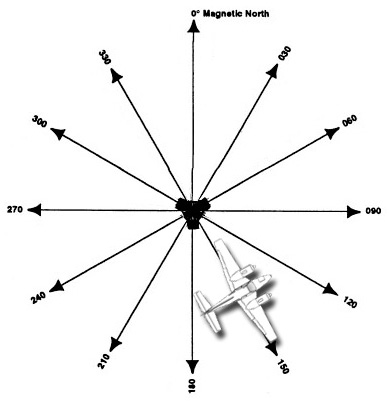
Question 7-21 : While flying at night another aircraft reports that you are on his 100° relative bearing assuming you are on converging courses you should see his ?
Green navigation light.
Ecqb04 november 2017if you are on his 100º relative bearing that means that you are at his approx 3 o'clock position + a few degrees = you will see his right wing = green lightGreen and white navigation lights. red navigation light. white navigation light.
Question 7-22 : Interceptionif radio contact is established during interception but communication in a common language is not possible attempts shall be made to convey instructions and essential information by using standard phrases and pronunciations transmitting each phrase twice the standard phrase with the ?
Call sign.
Icao annex 2 rules of the air appendix 2 'interception of civil aircraft' 3 radiocommunication during interception if radio contact is established during interception but communication in a common language is not possible attempts shall be made to convey instructions acknowledgement of instructions and essential information by using the phrases and pronunciations in table below and transmitting each phrase twice 711What call sign. call number. ident ident.
Question 7-23 : Where two or more closely spaced aerodromes are located so that coordinated procedures are required a common transition altitude shall be established this common transition altitude shall be ?
The highest that would be required if the aerodromes were considered separately.
Icao doc 8168 212 transition altitude2122 where two or more closely spaced aerodromes are located so that coordinated procedures are required a common transition altitude shall be established this common transition altitude shall be the highest that would be required if the aerodromes were considered separately2124 the height above the aerodrome of the transition altitude shall be as low as possible but normally not less than 900 m 3 000 ft 2125 the calculated height of the transition altitude shall be rounded up to the next full 300 m 1 000 ft An average of each transition altitude. the lower that would be required if the aerodromes were considered separately. 2000 ft above the highest aerodrome.
Question 7-24 : The calculated height of the transition level shall be rounded up to the next full ?
500 ft.
Transition level shall be rounded up to the next full 500 ft transition altitude shall be rounded up to the next full 1000 ft200 ft. 100 ft. 1500 ft.
Question 7-25 : Visual signalswhilst flying in an aerodrome's traffic circuit the pilot of an aircraft observes a series of white flashes from the tower the meaning of this signal is ?
Land at this aerodrome and proceed to apron.
Img708Aerodrome unsafe, do not land. continue circling and wait for further instructions. airfield closed temporarily, continue circling.
Question 7-26 : After an aircraft has been intercepted in flight the intercepted aircraft is rocking its wings this means ?
Will comply.
No. understood you are not to enter this airspace.
Question 7-27 : Complete the following statement the objective of the standardised european rules of the air sera is ?
To establish the common rules of the air and operational provisions regarding services and procedures in air navigation that shall be applicable to general air traffic within the scope of regulation ec no 5512004.
Standardised european rules of the air sera article 1 subject matter and scope the objective of this regulation is to establish the common rules of the air and operational provisions regarding services and procedures in air navigation that shall be applicable to general air traffic within the scope of regulation ec no 5512004To establish common requirements for the provision of air traffic management and air navigation services (‘atm/ans’) and other air traffic management network functions. to lay down detailed rules for commercial air transport operations with aeroplanes and helicopters, including ramp inspections of aircraft of operators under the safety oversight of another state when landed at aerodromes located in the territory subject to the provisions of the treaty. to lay down common requirements for the competent authorities, and the qualified entities acting on their behalf, which exercise certification, oversight and enforcement tasks.
Question 7-28 : Who is responsible for the operation of the aircraft in compliance with the rules of the air ?
The pilot in command.
Icao annex 2chapter 2 applicability of the rules of the air23 responsibility for compliance with the rules of the air231 responsibility of pilot in commandthe pilot in command of an aircraft shall whether manipulating the controls or not be responsible for the operation of the aircraft in accordance with the rules of the air except that the pilot in command may depart from these rules in circumstances that render such departure absolutely necessary in the interests of safetyThe atc controller, if the aircraft is flying in controlled airspace. the aircraft operator. the aircraft owner.
Question 7-29 : The final authority as to the disposition of the aircraft is with the ?
Pilot in command.
Icao annex 2chapter 2 applicability of the rules of the air24 authority of pilot in command of an aircraftthe pilot in command of an aircraft shall have final authority as to the disposition of the aircraft while in commandAtc controller whenever the aircraft is flying in controlled airspace. operator. aircraft owner.
Question 7-30 : On a vmc day can the pilot in command elect to fly in accordance with the instrument flight rules despite being in visual conditions ?
Yes the pilot may choose to do so if desired.
Icao annex 2chapter 2 applicability of the rules of the air22 compliance with the rules of the airthe operation of an aircraft either in flight or on the movement area of an aerodrome shall be in compliance with the general rules and in addition when in flight either with a the visual flight rules orb the instrument flight rulesnote 1— information relevant to the services provided to aircraft operating in accordance with both visual flight rules and instrument flight rules in the seven ats airspace classes is contained in 261 and 263 of annex 11note 2— a pilot may elect to fly in accordance with instrument flight rules in visual meteorological conditions or may be required to do so by the appropriate ats authority a pilot may elect to fly ifr independent of the weather it is up to the himhe if heshe wants to fly ifr in vmc or vfr in vmcNo, if the filed cruise level is below 5000 ft amsl. no, the pilot must fly in accordance with the visual flight rules. it is mandatory, if the pilot and the aircraft are ifr-approved.
Question 7-31 : When undertaking a simulated instrument flight in accordance with icao annex 2 rules of the air what specific requirements are applicable the aircraft shall be equipped with… ?
Dual flight controls and a qualified pilot acting as a safety pilot shall occupy one of the control seats.
Icao annex 2chapter 3 general rules324 simulated instrument flights an aircraft shall not be flown under simulated instrument flight conditions unless a fully functioning dual controls are installed in the aircraft andb a qualified pilot occupies a control seat to act as safety pilot for the person who is flying under simulated instrument conditions the safety pilot shall have adequate vision forward and to each side of the aircraft or a competent observer in communication with the safety pilot shall occupy a position in the aircraft from which the observer’s field of vision adequately supplements that of the safety pilotA complete set of flight instruments at each control seat, and a competent observer shall occupy one of these seats. a complete set of flight instruments at each control seat, and a qualified flight instructor must occupy one of these seats. dual flight controls, and a competent observer shall occupy one of the control seats.
Question 7-32 : When performing a flight in accordance with icao provisions an air traffic control clearance is necessary ?
If the flight is operated totally or partially as a controlled flight.
Icao annex 2chapter 3 general rules36 air traffic control service361 air traffic control clearances3611 an air traffic control clearance shall be obtained prior to operating a controlled flight or a portion of a flight as a controlled flight such clearance shall be requested through the submission of a flight plan to an air traffic control unitWhen operating a vfr flight into an advisory airspace. prior to pass through a dangerous area. prior to enter into an airspace class a, b, c, d, e, or f.
Question 7-33 : If it becomes evident that a controlled vfr flight cannot be continued in vmc according with the provisions of icao annex 2 rules of the air it shall… ?
Request authorisation to operate as a special vfr flight if the flight is operated within a control zone.
Icao annex 236 air traffic control service3624 weather deterioration below vmc when it becomes evident that flight in vmc in accordance with its current flight plan will not be practicable a vfr flight operated as controlled flight shall a request an amended clearance enabling the aircraft to continue in vmc to destination or to an alternative aerodrome or to leave the airspace within which an atc clearance is required orb if no clearance in accordance with a can be obtained continue to operate in vmc and notify the appropriate atc unit of the action being taken either to leave the airspace concerned or to land at the nearest suitable aerodrome orc if operated within a control zone request authorization to operate as a special vfr flight ord request clearance to operate in accordance with the instrument flight rulesContinue to operate in imc and inform the appropriate atc unit of the action being taken either to leave the airspace concerned or to land at the nearest suitable aerodrome. continue to operate in vmc and inform the appropriate atc unit after landing. continue the flight in vmc as far as practicable and land at the nearest airport.
Question 7-34 : A sailplane flying in vmc conditions is approaching a light aeroplane towing an object at approximately the same altitude and on a converging course which aircraft has the right of way ?
The sailplane regardless of its position in relation to the aeroplane.
Icao annex 2 32 avoidance of collisions 322 right of way3223 converging when two aircraft are converging at approximately the same level the aircraft that has the other on its right shall give way except as follows a power driven heavier than air aircraft shall give way to airships gliders and balloons b airships shall give way to gliders and balloons c gliders shall give way to balloons d power driven aircraft shall give way to aircraft which are seen to be towing other aircraft or objects oder of priority ballons => gliderssailplanes => airships => towing aircraft => power driven heavier than air aircraftThe sailplane, if the aeroplane is on its left side. the aeroplane towing an object, regardless of its position in relation to the sailplane. the aeroplane towing an object, if the sailplane is on its right side.
Question 7-35 : In accordance with icao annex 2 rules of the air a controlled flight operated in vmc which encounters a communication failure shall ?
Continue to fly in vmc to the nearest suitable aerodrome and after landing inform the appropriate atc unit as soon as possible.
Icao annex 2365 communications3652 communication failureif a communication failure precludes compliance with 3651 the aircraft shall comply with the voice communication failure procedures of annex 10 volume ii and with such of the following procedures as are appropriate the aircraft shall attempt to establish communications with the appropriate air traffic control unit using all other available means in addition the aircraft when forming part of the aerodrome traffic at a controlled aerodrome shall keep a watch for such instructions as may be issued by visual signals 36521 if in visual meteorological conditions the aircraft shall a continue to fly in visual meteorological conditions land at the nearest suitable aerodrome and report its arrival by the most expeditious means to the appropriate air traffic services unit b if considered advisable complete an ifr flight in accordance with 36522Use the emergency frequency to inform the atc unit about the failure and land at the nearest aerodrome. make use of the specific provisions for visual signals and set the transponder code for communication failure. continue to fly in vmc to the destination aerodrome and after landing inform the appropriate atc unit.
Question 7-36 : An aeroplane and a glider are approaching to land at an aerodrome which one of them shall give way to the other ?
The aeroplane regardless of the altitude of the glider.
Icao annex 2322 right of way3225 landing32251 an aircraft in flight or operating on the ground or water shall give way to aircraft landing or in the final stages of an approach to land32252 when two or more heavier than air aircraft are approaching an aerodrome for the purpose of landing aircraft at the higher level shall give way to aircraft at the lower level but the latter shall not take advantage of this rule to cut in in front of another which is in the final stages of an approach to land or to overtake that aircraft nevertheless power driven heavier than air aircraft shall give way to glidersThe aeroplane, if it is able to carry out a missed approach procedure. the glider, if their trajectories are converging and the aeroplane is on its left side. the glider, if the aeroplane is flying at a lower altitude.
Question 7-37 : An aircraft taxiing on the manoeuvring area of an aerodrome shall give way to ?
Aircraft taking off or about to take off.
Icao annex 2322 right of way3226 taking off an aircraft taxiing on the manoeuvring area of an aerodrome shall give way to aircraft taking off or about to take offConverging aircraft from the left. emergency vehicles. all vehicles on the taxiways except the “follow me” vehicle.
Question 7-38 : If a flight plan has been submitted a report of arrival shall be made when closing the flight plan which of the items listed below shall be included in the arrival report ?
Time of arrival.
Icao annex 2335 closing a flight plan3355 arrival reports made by aircraft shall contain the following elements of information a aircraft identification b departure aerodrome c destination aerodrome only in the case of a diversionary landing d arrival aerodrome e time of arrivalPersons on board remaining fuel time of departure
Question 7-39 : According to icao annex 2 in the event that a controlled flight inadvertently deviates from its current flight plan the appropriate ats unit has to be informed ?
If the average true air speed varies by plus or minus 5% of the true air speed given in the flight plan.
Icao annex 236 air traffic control service3622 inadvertent changes in the event that a controlled flight inadvertently deviates from its current flight plan the following action shall be taken a deviation from track if the aircraft is off track action shall be taken forthwith to adjust the heading of the aircraft to regain track as soon as practicableb variation in true airspeed if the average true airspeed at cruising level between reporting points varies or is expected to vary by plus or minus 5 percent of the true airspeed from that given in the flight plan the appropriate air traffic services unit shall be so informedc change in time estimate if the time estimate for the next applicable reporting point flight information region boundary or destination aerodrome whichever comes first is found to be in error in excess of 2 minutes from that notified to air traffic services or such other period of time as is prescribed by the appropriate ats authority or on the basis of air navigation regional agreements a revised estimated time shall be notified as soon as possible to the appropriate air traffic services unitAbout any deviation in tas. about any track deviation from the centre line of an established ats route only when that deviation exceeds 2 nm for more than one minute. if the time estimate for the next reporting point is found to be in error in excess of more than one minute from the time notified to ats.
Question 7-40 : A pilot is performing visual patterns at a controlled aerodrome when heshe notices that the radio is unserviceable the aircraft forms part of the aerodrome traffic – of the items listed below which answer correctly lists the light signals coming from the tower that a pilot may spot in flight 1 ?
1 3 and 4.
Refer to figure icao annex 2 appendix 1 4 signals for aerodrome traffic41 light and pyrotechnic signalsfrom aerodrome control to aircraft in flightsteady green cleared to landsteady red give way to other aircraft and continue circlingseries of green flashes return for landing*series of red flashes aerodrome unsafe do not landseries of white flashes land at this aerodrome and proceed to apron*red pyrotechnic notwithstanding any previous instructions do not land for the time being* clearances to land and to taxi will be given in due course1, 2, 3 and 4 1, 3, 4 and 5 1, 2, 3, 4 and 5
Exclusive rights reserved. Reproduction prohibited under penalty of prosecution.