A free Premium account on the FCL.055 website! Read here
Sign up to unlock all our services and 15164 corrected and explained questions.
Question 83-1 : The regulated take off mass is ? [ Control visibility ]
The lower of performance limited take off mass and maximum structural take off mass
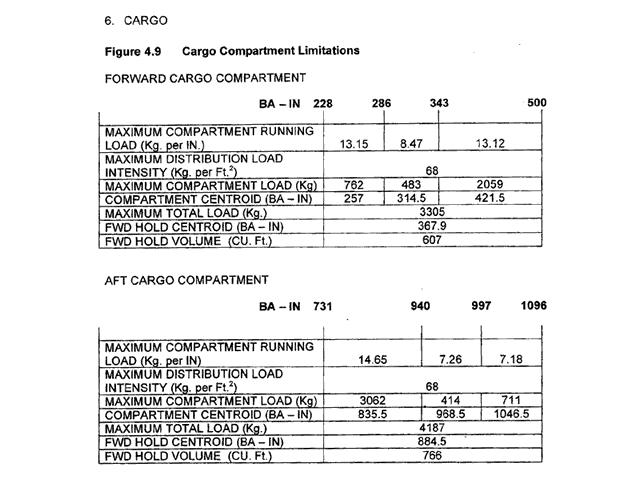
Question 83-2 : Given container size length x width x height 08 x 08 x 08 mcontainer has 2 supports 02 m each in longitudinal direction maximum running load 1915 kgmcalculate the maximum total mass of the loaded container without exceeding the maximum permissible running load ?
766 kg.
If the maximum running load is 1915 kg 1915 kg per 1 m in longitudinal direction we need to convert this value down to both ground supports 2 x 02 m = 04 mthe total length of both ground supports is 04 m = the total load is pressing down on a running load length of 04 m 1915 kg x 04m = 766 kg383 kg. 1532 kg. 2393 kg.
Question 83-3 : From the pilot's flight manual determine the maximum total volume of fuel which can be loaded into the standard tank version 1064 ?
2367 l.
Read the question carefully if it is asking for mass or volume total volume of fuel 487 + 405 + 236 + 324 + 246 + 423 + 246 = 2367 litrestotal mass of fuel 2367 x 079 = 1870 kg1868 l. 8240 l. 2121 l.
Question 83-4 : The basic advantage of standard size containers ?
Standard size containers are designed to fit and lock into the cargo compartment for maximum space efficiency.
Maximum mass of cargo loaded in the containers is always limited by the mtom. with the cargo loaded in containers one does not have to observe the maximum floor loading limit. maximum mass of cargo loaded in the containers is often limited by the g-forces in flight.
Question 83-5 : From the pilot's flight manual determine the maximum total mass of fuel which can be loaded into the standard tank version 1064 ?
1870 kg.
Read the question carefully if it is asking for mass or volume total volume of fuel 487 + 405 + 236 + 324 + 246 + 423 + 246 = 2367 litrestotal mass of fuel 2367 x 079 = 1870 kg2367 kg. 2996 kg. 8240 kg.
Question 83-6 : The maximum floor loading of the cargo compartment is specified to be 732 kgm²which is the smallest given pallet size acceptable to load a box of 826 kg ?
12 m x 12 m.
Floor loading limit 732 kgm² ==> you can put maximum 732 kg to 1 m² that's the limityou have 826 kg to load so yo need more than 1 m² space and it's ==> 826732= 113 m²if you put 826 kg evenly on 113 m² it will be okso minimum pallet size should be 113 m²pallets 125 m x 125 m ==> 156 m² ==> acceptable13 m x 13 m ==> 169 m²==> acceptable12 m x 12 m ==> 144 m²==> acceptable105 m x 105 m ==> 110 m²==> not acceptablequestion asks smallest palletsmallest one among acceptable pallets is ==> 12 m x 12 m ==> 144 m²1.25 m x 1.25 m. 1.3 m x 1.3 m. 1.05 m x 1.05 m.
Question 83-7 : The term 'landing mass' at destination is defined as ?
Final reserve fuel alternate fuel contingency fuel plus zero fuel mass.
Final reserve fuel, trip fuel plus zero fuel mass. final reserve fuel, alternate fuel, contingency fuel plus landing mass at alternate. final reserve fuel, trip fuel, contingency fuel plus zero fuel mass.
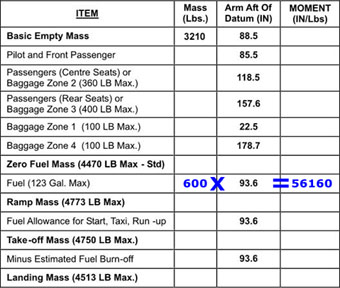
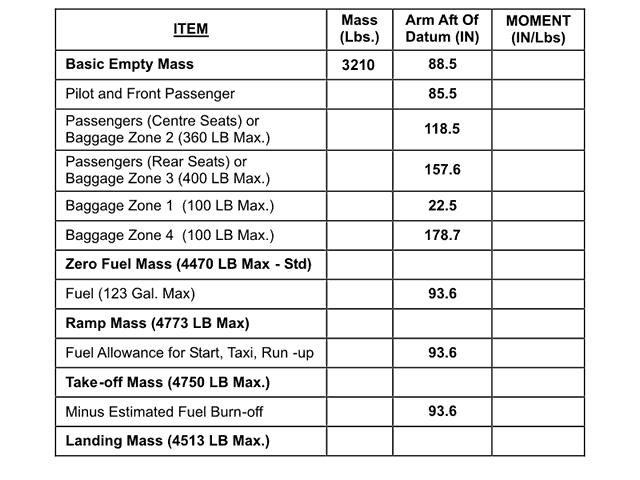
Question 83-8 : Determine the take off mass tom for the following single engine aeroplanestandard empty mass 1764 lbsoptional equipment 35 lbspilot + front seat passenger 300 lbscargo mass 350 lbsfuel quantity at brakes release 60 galtrip fuel 35 galfuel density 6 lbsgal ?
2809 lbs.
Take off mass = 1764 + 35 + 300 + 350 + 6 x 60 take off mass = 2809 lbs2764 lbs. 2799 lbs. 2659 lbs.
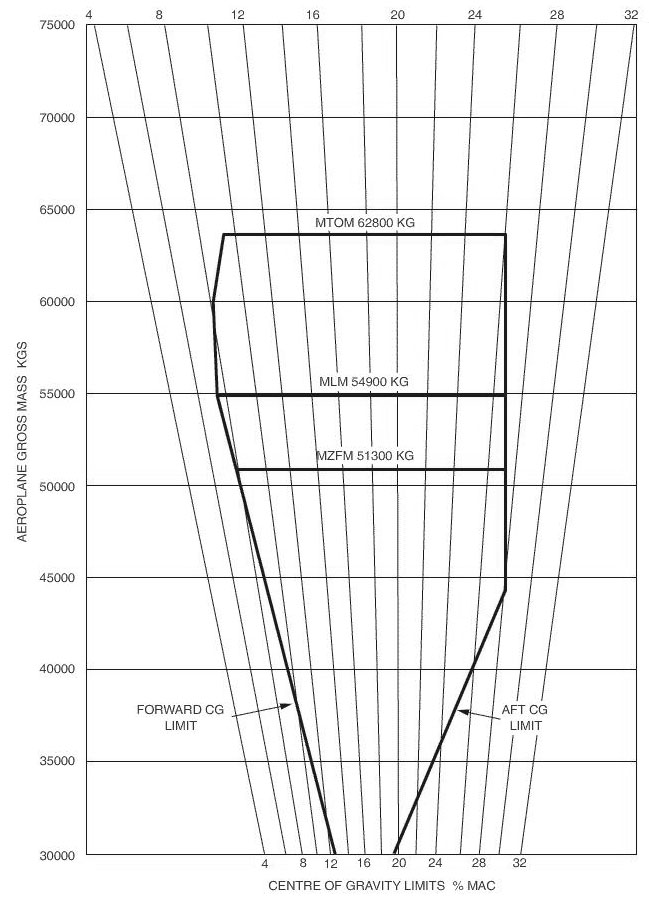
Question 83-9 : Refer to figure 031 15calculate the maximum fuel mass for the centre tank in pounds ?
15450 lbs.
The maximum mass of fuel in the centre tank is 7008 kg convert this value into pounds to get 15450 lbs 1kg = 22 lbs 3178 lbs. 15680 lbs. 8640 lbs.
Question 83-10 : What is the reason for cargo loads to be tied down ?
Preventing such loads from moving and to remain within the cg limits of the aircraft.
Maximising the space and increasing the maximum payload of the aircraft. maximising the performance of the aircraft during take-off and landing procedures. maintaining enough space in the compartment hold in case of evacuation.
Question 83-11 : The structural limitation of a baggage compartment is 50 lbft a load has a mass of 320 kg and has to be distributed over an area of at least ?
131 m².
1 m = 328 ft therefore 1 m² = 1076 ft²convert the limitation of 50 lbft² to kg and m²50 lb = 2268 kg1076 ft² x 2268 kg = 244 kg1076 ft² or 244 kgm²the mass given by the question is 320 kg to find the distribution we need to use the rule of proportion to find the aera for a mass of 320 kg 1m² 244 kg x 320 kg = 131 m²6.4 m². 0.76 m². 14.11 m².
Question 83-12 : The maximum structural landing mass means the maximum permissible… ?
Total aeroplane mass upon landing under normal circumstances.
Maximum structural landing mass mslm is the maximum permissible total aeroplane mass on landing in normal circumstances it generally depends on the landing gear strength or the landing impact loads on certain parts of the wing structurethe maximum landing weight is typically designed for 10 feet per second 600 feet per minute sink rate at touch down with no structural damagemaximum structural take off mass mstom is the maximum permissible total aeroplane mass at the start of the take off runmaximum structural taxi mass is the structural limitation of the mass of the aeroplane at commencement of taximaximum zero fuel mass mzfm is the maximum permissible mass of an aeroplane with no usable fuelZero fuel mass on landing with a specific crosswind component defined in the operations manual. zero fuel mass on landing under normal circumstances. total aeroplane mass on landing with a specific crosswind component defined in the operations manual.
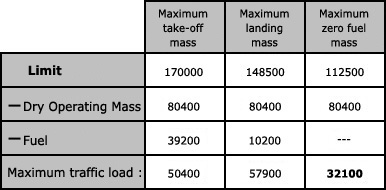
Question 83-13 : An aircraft dry operating mass is 3000 kgthe maximum take off landing and zero fuel mass are identical at 5200 kg ramp fuel is 650 kg the taxi fuel is 50 kgthe maximum traffic load is ?
1600 kg.
Maximum traffic load = 5200 kg 600 kg at take off 3000 kg = 1600 kg2200 kg. 1550 kg. 2150 kg.
Question 83-14 : Which of the following corresponds to zero fuel mass ?
The take off mass of an aeroplane minus all usable fuel.
Zero fuel mass zfm of an aircraft is the total mass of the airplane and all its contents minus the total mass of the usable fuel on boardzero fuel mass include 1 dry operating mass2 traffic loadOperating mass plus luggage of passengers and cargo. operating mass plus passengers and cargo. take-off mass minus fuel to destination and alternate.
Question 83-15 : Which person is entitled to request the uplift of extra fuel ?
The commander.
Important note the modifications resulting from the updated fuel policy regulations which came into effect on october 30 2022 are only changes in wording but nothing really new the terminology 'extra fuel' has been replaced with 'discretionary fuel' easa has clarified that the calculations and procedures pertaining to fuel calculations will remain unchanged and there will be no inquiries regarding the 'new extra fuel' concept extra fuel include anticipated delays or specific operational constraints that can be predicted discretionary fuel include a quantity at the sole discretion of the commanderfor reference additional information can be found in easa's air ops documentation it appears that easa has not yet revised this question please inform us if you encounter it in your official exam in such instances based on the previous regulation the commander is responsible for reviewing the mass and balance of the airplane before takeoff and ensure the safety of the flight he can request uplifting of extra fuel onboard if he see theres is a need for thatThe operator. the flight dispatcher. the head of flight operations.
Question 83-16 : Given dry operating mass 29 800 kg maximum take off mass 52 400 kg maximum zero fuel mass 43 100 kg maximum landing mass 46 700 kg trip fuel 4000 kg fuel quantity at brakes release 8000 kgthe maximum traffic load is… ?
12 900 kg.
To determine the maximum traffic loadwe need to identify the actual takeoff mass the smallest of maximum take off mass 52 400 kgmaximum landing mass + trip fuel 46 700 + 4000 = 50 700 kgmaximum zero fuel mass + takeoff fuel 43 100 + 8000 = 51 100 kg taxi fuel not mentioned so we have to consider block fuel as take off fuel maximum allowable take off mass = 50700 kgtake off mass = dom + traffic load + takeoff fueltraffic load = takeoff mass — dom — takeoff fueltraffic load = 50 700 — 29 800 — 8000 = 12 900 kg14 600 kg 9300 kg 13 300 kg
Question 83-17 : The dry operating mass includes… ?
Crew and crew baggage catering removable passenger service equipment potable water and lavatory chemicals.
Dry operating mass dom it is the total mass of the aeroplane ready for a specific type of operation excluding usable fuel and traffic loadbeside the bem dom includes items such as 1 crew and crew baggage2 catering and removable passenger service equipment3 potable water and lavatory chemicals4 food and beveragesUnusable fuel and reserve fuel. passengers baggage and cargo. fuel and passengers baggage and cargo.
Question 83-18 : The operating mass of an aircraft is… ?
Dry operating mass plus the take off fuel mass.
Operating mass om it is the dom plus takeoff fuel but without traffic load it can be thought of as wet operating mass as opposed to domtraffic load it is the total mass of passengers baggage and cargo including any non revenue load like spare parts etcBasic empty mass plus the special operational equipment. take-off mass minus the trip fuel mass. dry operating mass plus the trip fuel mass.
Question 83-19 : Traffic load is the… ?
Zero fuel mass minus dry operating mass.
Traffic load the total mass of passengers baggage and cargo including any 'non revenue' loadtraffic load = zero fuel mass — dry operating massTake-off mass minus zero fuel mass. dry operating mass minus the disposable load. dry operating mass minus the variable load.
Question 83-20 : Determine the take off mass for the following single engine aeroplane given basic empty mass 1799 lb pilot + front seat passenger 300 lb cargo mass 350 lb ramp fuel = block fuel 60 galtrip fuel 35 galfuel density 6 lbgaltaxi fuel 10 lb ?
2799 lb.
Take off mass = basic empty mass + crew + traffic load + take off fueltake off fuel = block off fuel taxi fuel in this question only taxi fuel is given in pounds convert block off fuel volume to mass 60 gallon = 60 x 6 = 360 lbtake off fuel = block off fuel taxi fueltake off fuel = 360 10 = 350 lbtake off mass = 1799 + 300 + 350 + 350 = 2799 lb2809 lb 2534 lb 2449 lb
Question 83-21 : Given basic empty mass 1799 lb pilot + front seat passenger 300 lb cargo mass 350 lb ramp fuel = block fuel 60 galtrip fuel 35 galfuel density 6 lbgaldetermine the zero fuel mass ?
2449 lb.
Dom = bem + crew mass = 1799 + 300 = 2099 lbzfm = dom + traffic load = 2099 + 350 = 2449 lb2659 lb 2414 lb 2589 lb
Question 83-22 : Given basic empty mass 1799 lbpilot + passenger 300 lbcargo 350 lb ramp fuel block fuel 60 galtrip fuel 35 galtaxi fuel 17 galfinal reserve fuel 18 galfuel density 6 lbgalwhat is the expected landing mass ?
2589 lb.
Takeoff fuel volume = block off fuel — taxi fuel = 60 — 17 = 583 us gallontakeoff fuel mass = volume x density = 583 x 6 = 350 lbtrip fuel mass = 35 x 6 = 210 lblanding fuel = takeoff fuel — trip fuel = 350 — 210 = 140 lblanding mass = bem + pilot & passenger + cargo + landing fuellanding mass = 1799 + 300 + 350 + 140 = 2589 lb2557 lb 2472 lb 2599 lb
Question 83-23 : With respect to aeroplane loading in the planning phase which of the following statements is always correct lm = landing mass tom = take off mass mtom = maximum take off mass zfm = zero fuel mass mzfm = maximum zero fuel mass dom = dry operating mass ?
Lm = tom – trip fuel.
Lets analyse options to get the correct answer 1 mzfm = tl + dom wrong that will be true in case of zfm not mzfm as tl + dom doesn't have to be equal to mzfm every time2 lm = tom — trip fuel correct always landing mass in normal conditions equal the mass of airplane at takeoff minus the fuel consumed during the flight3 mtom = zfm + full tank fuel mass wrong zfm + fuel tank mass will equal tom not mtom4 reserve fuel = tom — trip fuel wrong tom trip fuel = landing massMzfm = traffic load + dom mtom = zfm + full tank fuel mass reserve fuel = tom – trip fuel
Question 83-24 : For a particular aeroplane the structural maximum mass without any fuel on board other than unusable quantities is… ?
A fixed value which is stated in the aeroplane operating manual.
Maximum zero fuel mass mzfm is the maximum mass allowed before usable fuel and other specified usable agents engine injection fluid and other consumable propulsion agents are loaded in defined sections of the aircraft as limited by strength and airworthiness requirements defined by the manufacturer and listed in the operating manual as fixed valuethe mzfm is a structural limit based on the bending moments of the wing rootA variable value which may limit the traffic load carried. a variable value which is governed by the traffic load carried. a fixed value which will limit the amount of fuel carried.
Question 83-25 : Traffic load is the difference between… ?
The take off mass and the operating mass.
Traffic load is the total mass of passengers baggage cargo and any non revenue load the mass of passengers and their baggage can be found by using actual weights or standard masses the mass of the cargo and non revenue load must be determined by weighingtraffic load is the difference between take off mass and the operating massThe take-off mass and the basic empty mass. the operating mass and the basic empty mass. the take-off mass and the basic empty mass plus trip fuel.
Question 83-26 : The flight preparation of a turbojet aeroplane provides the following data take off runway limitation 185 000 kg landing runway limitation 180 000 kg planned trip fuel 11 500 kg take off fuel 20 000 kg knowing that maximum take off mass mtom 212 000 kg maximum landing mass mlm 174 000 kg ?
54 000 kg.
To tidy up the information given in the question the regulated take off mass is the lowest of the structural and performance limits in the same way the regulated landing mass is the lowest of the structural and performance limits take off fuel is 20 000 kg no mention of block or taxi fuelusing the regular table rtom rlm 174 000 kg mzfm 164 000 kg + trip fuel 11 500 kg + take off fuel 20 000 kg 185 000 kg 185 500 kg 184 000 kg 184 000 kg is our limiting take off mass take off mass dry operating mass dom take off fuel = traffic load 184 000 kg 110 000 kg 20 000 kg = 54 000 kg available for traffic loadnote in this question the answer ultimately is maximum traffic load = maximum zero fuel mass dry operating massthis is not always the case and for these questions as in real life you should always create the table with the 3 potential take off masses55 000 kg 55 500 kg 61 500 kg
Question 83-27 : The traffic load is defined as… ?
The total mass of passengers baggage and cargo including any non revenue load.
Traffic load the total mass of passengers baggage and cargo including any non revenue loadafter the fuel required has been decided for a particular flight the traffic load may be calculated taking into account the following aircraft structural limitations dry operating massmaximum structural take off massmaximum structural landing massmaximum zero fuel massThe total mass of passengers, baggage, cargo and usable fuel the total mass of crew and passengers excluding any baggage or cargo the total mass of flight crew, passengers, baggage, cargo and usable fuel
Question 83-28 : Given basic empty mass = 5300 kg dry operating mass = 5500 kg zero fuel mass = 5980 kg take off mass = 7980 kgwhat is the traffic load ?
480 kg.
Traffic load = zero fuel mass — dry operating mass traffic load = 5980 — 5500 = 480 kg2680 kg 2000 kg 2480 kg
Question 83-29 : Given maximum structural take off mass 8350 kg maximum structural landing mass 8350 kg zero fuel mass 6210 kg taxi fuel 10 kg contingency fuel 90 kg alternate fuel 300 kg final reserve fuel 400 kg trip fuel 780 kgthe expected landing mass at destination will be… ?
7000 kg.
1 take off fuel = 780 trip + 90 conti + 300 alternate + 400 final res => 1570 kg2 take off mass tom = 6210 zfm + 1570 take off fuel => 7780 kg3 expected landing mass lm = 7 780 tom 780 trip fuel => 7000 kg8350 kg 7780 kg 7790 kg
Question 83-30 : Given zero fuel mass 4920 kg trip fuel 880 kg block fuel 1330 kg taxi fuel 25 kgthe actual take off mass is equal to… ?
6225 kg.
The actual take off mass is the mass of the aircraft at the start of the take off run and equal to the zero fuel mass zfm plus the take off fuelthe take off fuel is the fuel mass of the aircraft at the start of the take off run and equal to the block ramp fuel minus the taxi fuel 1330 kg 25 kg = 1305 kgthus the actual take off mass is zfm + take off fuel = 4920 kg + 1305 kg = 6225 kg6810 kg 6360 kg 6250 kg
Question 83-31 : Given zero fuel mass 4770 kg trip fuel 1040 kg block fuel 1960 kg taxi fuel 20 kgthe actual take off mass is equal to… ?
6710 kg.
Take off fuel = block fuel — taxi fuel = 1960 — 20 = 1940 kgtake off mass = zero fuel mass + take off fuel = 4770 + 1940 = 6710 kg6730 kg 4970 kg 5890 kg
Question 83-32 : Given zero fuel mass 6660 kg trip fuel 990 kg block fuel 1540 kg taxi fuel 25 kgthe actual take off mass is equal to… ?
8175 kg.
From the question we can calculate the take off fuel block fuel taxi fuel = take off fuel 1540 kg 25 kg = 1515 kgthe trip fuel of 990 kg is not needed for this question actual take off mass = zfm + take off fuelactual take off mass = 6660 + 1515 = 8175 kg7210 kg 8200 kg 8110 kg
Question 83-33 : Take off mass minus trip fuel mass results in the… ?
Landing mass.
Landing mass equal takeoff mass minus the fuel consumed during flight trip fuel remember we only minus the trip fuel not any other fuel for calculationcorrect answer landing massReserve fuel mass. taxi mass. zero fuel mass.
Question 83-34 : The following data for a flight of a twin engine jet aircraft are provided for the calculation maximum landing mass = 51 300 kg maximum allowable take off mass = 56 300 kg dry operating mass = 29 100 kg load = 11 700 kg trip fuel = 3000 kg cont fuel = 215 kg final reserve fuel = 1250 kg ?
7735 kg.
Zfm = dom 29 100 kg + load 11 700 kg = 40 800 kgtake off fuel tof = tf 3000 kg + cf 215 kg + fr 1250 kg + af 1300 kg = 5765 kgtom = zfm 40 800 kg + tof 5765 kg = 46 565 kgmaximum landing mass 51 300 kg + tf 3000 kg = 54 300 kg this mass must not be exceeded 54 300 kg is lower than the maximum allowable tom of 56 300 kg therefore 54 300 kg is limitingpossible extra fuel = 54 300 kg 46 565 kg = 7735 kgnote don't forget that the taxi fuel is not part of the take off fuel the take off fuel is the fuel contained at the beginning of the take off on the runway at this location taxi fuel has already been burned off if you add the taxi fuel your result would be 7535 kg one of the wrong answers 5765 kg. 9735 kg. 7535 kg.
Question 83-35 : The landing mass at destination is defined as the sum of… ?
Zero fuel mass final reserve fuel alternate fuel and contingency fuel.
At the beginning of the take off run the mass of the airplane equal dry operating mass + traffic load + take off fuel trip + contingency + alternate + final reserve during the flight in normal circumstances trip fuel is burned which leave us on landing with the rest of masses included in the takeoff dry operating mass + traffic load + contingency fuel + alternate fuel + final reserve fueldry operating mass + traffic load = zero fuel masssolanding mass = zero fuel mass + contingency fuel + alternate fuel + final feserve fuelLanding mass at alternate, final reserve fuel, alternate fuel and contingency fuel. zero fuel mass, final reserve fuel, trip fuel and contingency fuel. zero fuel mass, final reserve fuel and alternate fuel.
Question 83-36 : During the pre flight preparation the pilot calculates an amount of 275 us gallons for refuelling which equals… ?
104 litres.
1 us gallon = 3785 l275 us gallons = 275 x 3785 = 104 litres7 litres. 6 litres. 125 litres.
Question 83-37 : During the pre flight preparation the pilot calculates a take off fuel of 53 us gallons considering a fuel density of 6 lb per us gallon this equals… ?
144 kg.
Fuel volume = 53 us gallonfuel mass in pounds = 53 x 6 = 318 lb1 kg = 2205 lbx kg = 318 lbmass in kg = 318 2205 = 144 kg701 kg. 24 kg. 318 kg.
Question 83-38 : Which of the following statements best describes the 'regulated landing mass' ' ?
The lowest of the performance limited landing mass and structural limited landing mass.
Performance limited landing mass pllm is the landing mass subject to the destination aerodrome limitationsmaximum structural landing mass mslm is the maximum permissible total aeroplane mass on landing in normal circumstancesregulated landing mass rlm is the lowest of the 'performance limited' and 'structural limited' landing massThe maximum landing mass as determined by the aircraft manufacturer. the greatest of the performance limited landing mass and structural limited landing mass. the maximum landing mass as approved by the aircraft's state of registration.
Question 83-39 : Given fuel volume 3800 us gallons fuel density 079 kglthe fuel mass is… ?
11 364 kg.
First we change from us gallon to litres 1 us gallon = 3785 litres3800 us gallon = 3800 x 37855 = 14 385 litresmass = volume x densityfuel mass = 14 385 x 079 = 11 364 kg14 383 kg. 18 206 kg. 13 647 kg.
Question 83-40 : Considering only structural limitations on long distance flights at the aeroplane maximum range the traffic load is normally limited by… ?
The maximum take off mass.
For long distance flights airplanes are usually mstom as it has high amount of trip fuel which force us to decrease the zfm so it's not mzfm limited and also not mslm limited as after that huge amount of trip fuel consumption airplane will be below it's mslm at landingcorrect answer maximum take off massThe maximum landing mass. the maximum zero fuel mass plus the take-off mass. the maximum zero fuel mass.
Exclusive rights reserved. Reproduction prohibited under penalty of prosecution.