A free Premium account on the FCL.055 website! Read here
Sign up to unlock all our services and 15164 corrected and explained questions.
Question 92-1 : An aircraft has a total mass of 1 508 kg with a cg of 368 m aft of the datum line before departure the ground crew discovers that they overlooked loading some additional cargo onto the aircraft at 482 m aft of datum to ensure the aircraft stays within the aft cg limit of 379 m what is the maximum ? [ Diploma registration ]
161 kg
Question 92-2 : The cg centre of gravity of an aicraft is 58 inches forward of the datum with a total mass of 2609 lb if a last minute load of 128 lb occurs and it is placed 32 inches aft of the datum where is the new cg located ?
5379 inches forward of the datum.
1st method mass change new total mass = change of cg distance from mass to old cg mass change 128 lb new total mass 2 609 lb + 128 lb = 2 737 lb change of cg distance from mass to old cg 58 in + 32 in = 90 in128 lb 2 737 lb = change of cg 90 in change of cg = 128 2 737 x 90 = 4208 insince the initial cg position is forward of the datum and the last minute load is added aft of the datum the new position of cg will be shifted closer to the datum and will be new cg position = old cg position + change of cg = 58 inches 42 in = 5379 inches forward of datum2nd method moment the turning force created by the mass over a distance or lever arm moment = mass x armremember that by convention the items aft of the datum have a positive arm and consequently a positive moment and those which are forward of the datum have a negative arm and momentgenerally the centre of gravity cg can be found by adding all the moments and then dividing by the total mass cg = total moment total mass initially the aircraft's moment was 2 609 lb x 58 in = 151 322 lb in after adding the last minute load the aircraft's moment became 151 322 lb in + 128 lb x 32 in = 147 226 lb inthus the new position of the cg after loading the last minute load will be cg = total moment total mass = 147 226 lb in 2 609 lb + 128 lb = 5379 inthe minus symbol implies that the new cg position is 5379 in forward of the datum55.29 inches aft of the datum. 53.58 inches forward of the datum. 56.50 inches aft of the datum.
Question 92-3 : An aircraft has its datum at the nose the front seats are 65 inches aft of datum the passenger seats are 105 inches aft and the separate baggage compartment is 137 inches aft the aft limit is 139 inches aft the current mass is 2530 lbthree passengers are in the rear seats with the baggage ?
103 lb.
Learning objective 03105030201 calculate the amount of additional load or ballast to be loaded at or removed from a given position or compartment to establish a defined cg positioncurrent situation the aft cg limit is 139 inches aft of the datumhowever due to the current arrangement of passengers the cg exceeds the aft cg limits by 3 inches making the current cg at 142 inches aft of the datum how may we bring the cg forward by 3 inches to meet the cg aft limit without re arranging the passengers we will use an extra ballast mass forward of the aircraft front seats to bring the cg to the aft limithow much extra ballast cg is 3'' behind the aft limit therefore the cg is 142'' aft of datum old total moment = 2530 x 142 lbinto bring the cg forward to within limits a ballast 'm' must be added to the front seat the front seat is located at 65'' aft of datum ballast moment = m x 65 lbinthe new total mass will be new total mass = 2530 + mthis will result in a new total moment new total moment = 2530 + m x 139 lbinnow apply the formula old total moment + moment of the ballast = new total moment2530 x 142 + m x 65 = 2530 + m x 1392530 x 142 + m x 65 = 2530 x 139 + m x 139m = 1026 lb = 103 lbalternatively simply apply the following formula new mass x new cg = old mass x old cg ± mass x arm 2530 + m x 139 = 2530 x 142 + 65 x m 351 670 + 139 m = 359 260 + 65 m74 m = 7590m = 1026 lb 103 lb100 lb 106 lb 109 lb
Question 92-4 : You are departing for a flight with a planned landing fuel of 3000 kg according to aircraft limitations the centre tank fuel must be used prior to the wing tank fuelgiven the following information the location of the cg on landing will be how many metres aft of the datum maximum take off mass 99 800 ?
1595.
These are the formulas we will need to solve this exercise moment = mass x arm cg = total moment total massfor this question we are looking for the cg on landing thus the moment and mass of the burnt fuel must be subtracted from the take off moment and take off mass correspondingly so as to find the landing moment and landing massthe cg on landing is given by the formula landing cg = landing moment landing mass 1 determine the landing moment landing moment = take off moment centre tank fuel moment wings tanks fuel burnt moment take off moment = actual take off mass x take off cg location take off moment = 59 500 kg x 1626 m = 967 470 kgm centre tank fuel moment = fuel in centre tank x centre fuel tank centroid centre tank fuel moment = 16 000 kg x 1538 m = 246 080 kgm wing tanks fuel burnt moment = wing tanks fuel burnt at landing x wing fuel tank centroid wing tanks fuel burnt moment = 18 000 3000 kg x 1779 m = 266 850 kgm landing moment = 967 470 kgm 246 080 kgm 266 850 kgm = 454 540 kgm 2 determine the landing mass landing mass = actual take off mass fuel centre tank burnt wing tanks fuel burnt landing mass = 59 500 kg 16 000 kg 18 000 3000 kg = 28 500 kg 3 determine the landing cg landing cg = landing moment landing mass landing cg = 454 540 kgm 28 500 kg landing cg = 1595 m15.74 16.08 15.88
Question 92-5 : Prior to departure the load controller informs the pilot about a lmc of 4763 kg loaded in the aft cargo compartment can the pilot accept it take off fuel 8000 kg take off cg 44% take off mass 60 000 kg underload 5687 kg bigger than the lmc cg limit 16% 46% operating mass 55 000 kgmac length 4 m arm ?
No because it will be outside of the cg limits.
1 find old cg the old cg position is 44% relative to mac and it should be converted into distance meters from the datumcg distance from leading edge = cg position % relative to mac x mac length cg distance from leading edge = 44% x 4 m = 176 mdistance of mac trailing edge 16 m aft of the datumlength of mac 4 mdistance of mac leading edge 16 m 4 m = 12 m aft of the datumold cg is 12 m + 176 m = 1376 m aft of datum 2 find new cg 1st method mass change new total mass = change of cg distance from mass to old cg mass change 4763 kgnew total mass 60 000 kg + 4763 kg = 64 763 kgchange of cg distance from mass to old cg 155 m 1376 m = 174 m4763 kg 64 763 kg = change of cg 174 m change of cg = 4763 64 763 x 174 = 013 msince the initial cg position is aft of the datum and the lmc is added aft of the datum the new position of cg will be shifted away from the datum and will be new cg position = old cg position + change of cg = 1376 m + 013 m = 1389 m aft of datum2nd method cg = total moment total mass moment = mass x armtotal moment = old moment + lmc moment = 60 000 kg x 1376 m + 4763 kg x 155 m = 825 600 + 73 827 = 899 427 kg mtotal mass = old mass + lmc mass = 60 000 kg + 4763 kg = 64 763 kgcg = 899 427 kg m 64 763 kg = 1389 msince the initial cg position is aft of the datum and the lmc is added aft of the datum the new position of cg will be shifted away from the datum and will be 1389 m aft of datum 3 check if the new cg is within limits cg limit 16% 46% new cg position 1389 m aft of datumthe new cg position needs to be converted into % mac to check whether it is within the cg limitations cg position % relative to mac = cg distance from leading edge mac lengthnew cg distance from leading edge = 1389 m 12 m = 189 mmac lenth = 4 mnew cg position % relative to mac = 189 m 4 m = 4725 %the cg limit is 16% 46% and the new cg position is at 4725% which means that the new cg is out of limits and the lmc cannot be loadedNo, because only the passengers can accept lmc. yes, because the lmc is lower than the underload. yes, because it will exceed the aft limit only by 1% and it is acceptable.
Question 92-6 : After the weighing procedure of an aircraft with the results given below what is the cg position of the bem with reference to the main landing gear nose landing gear jack point 4350 kg each main landing gear jack point 15 505 kg longitudinal distance between the nose landing gear and the main ?
15 m forward of datum.
Learning objective 03105010101 calculate the cg position of an aircraft by using the formula cg position = sum of moments total massmoment is the turning force created by the mass over a distance or lever arm moment = mass x armremember that by convention the items aft of the datum have a positive arm and consequently a positive moment and those which are forward of the datum have a negative arm and momentthus since the nose landing gear jack point is forward of the datum main landing gears jack points both its arm and moment will be negativegenerally the centre of gravity cg can be found by adding all the moments and then dividing by the total mass cg = total moment total massthe total mass of the aircraft is 4350 kg + 2 x 15 505 kg = 35 360 kgand its total moment 4350 kg x 122 m + 2 x 15 505 kg x 0 = 53 070 kgmtherefore the cg position of the bem will be 53 070 kgm 35 360 kg = 15 mthe minus symbol implies that the cg position is 15 m forward of the main landing gears3.5 m aft of datum 1.5 m aft of datum 3.5 m forward of datum
Question 92-7 : The pilot of an aircraft is planning a flight carrying a bridal pair both sitting on the rear seats the calculated cg is out of limits and the pilots decides to load some ballast at the front seats to move the cg within limits the aircraft total mass is 2570 lb given the following data how much ?
336 lb.
The cg is currently rear of the aft limit and needs to move forwards this distance is 160 in to 149 in = 11 inin order to move the cg into limits the pilot will load ballast on to the front seat the arms for the rear seats and the compartment are not required in this questionstep 1 establish the parameters m = mass to be added m = total mass 2570 lbs d = cg movement required 11 in d = relevant distance between the target cg position and the front seat being loaded distance between 149 in and 65 in = 84 in step 2 time for the formula mm = ddm2570 = 1184m = 3365 lbsby adding 3365 lbs on the front seat the cg is moved into limits92 lb 119 lb 84 lb
Question 92-8 : The cg limits of an aircraft are between 408 m and 432 m aft of the datum the take off mass of an aircraft is 3195 kg and the calculated cg is at 435 m aft of the datum if a mass of 84 kg can be moved what is the distance the mass should be moved in order to get a cg at the aft limit ?
114 cm forward.
Use the formula mass change total mass = change of cg distancemass change 84 kgtotal mass 3195 kgchange of cg 435 m 432 m = 003 m = 3 cmdistance 84 kg 3195 kg = 3 distance distance = 3195 kg x 3 cm 84 kg distance = 114 cmthe cg has to be moved forward from 435 m aft of datum to 432 m aft of datum so the mass must be moved 114 cm forward10 cm aft 88 cm forward 152 cm aft
Question 92-9 : The calculated cg before take off is 8 cm beyond the cg limit the aircraft has a total mass of 7132 kg in order to have a cg within limits a mass of 320 kg can be shifted within the hold how much should you move this mass ?
1783 m.
Use the formula mass change total mass = change of cg distancemass change 320 kgtotal mass 7132 kgchange of cg 8 cm = 008 mdistance 320 kg 7132 kg = 008 m distance distance = 7132 kg 320 kg x 008 m distance = 1783 mthe mass of 320 kg has to be moved by 1783 m0.358 m 170.3 cm 186.3 cm
Question 92-10 : A pallet of 1 500 kg needs to be removed from the cargo hold situated at the position of 1 650 cm the new total mass after removal of the pallet will be 19 340 kg and the new cg at 1 270 cm the cg forward cg limit is at 860 cm and the aft limit is at 1 360 cm by mistake another package of 1 500 kg ?
15 cm forward of the aft cg limit.
1 calculate the old cg before removing the pallet from the position of 1 650 cmmass change old total mass = change of cg distance from mass to new cg mass change 1 500 kg old total mass 19 340 kg + 1 500 kg = 20 840 kg change of cg distance from mass to new cg 1 650 cm 1 270 cm = 380 cm1 500 kg 20 840 kg = change of cg 380 cm change of cg = 1500 kg 20 840 kg x 380 cm change of cg = 27 cmthe pallet would be removed from a position of 1 650 cm and the new cg after removal is 1 270 cm this means that the old cg before removing the pallet would be further backwards old cg = 1270 cm + 27 cm = 1 297 cm 2 calculate the final cg after removing the wrong pallet from a position of 680 cmmass change new total mass = change cg position distance from mass to old cg mass change = 1 500 kg new total mass = 20 840 kg 1 500 kg = 19 340 kg change of cg = distance from mass to old cg = 1 297 cm 680 cm = 617 cm1 500 kg 19 340 kg = change of cg 617 cm change of cg = 1 500 kg 19 340 kg x 617 cm change of cg = 48 cmthe pallet is removed from a position of 680 cm and the old cg before removal is 1 297 cm this means that the new cg after removing the pallet would be further backwards new cg = 1 297 cm + 48 cm = 1 345 cm 3 determine the distance between the final cg and the aft cg limitthe aft cg limit is at 1 360 cm the cg of the aircraft after removing the wrong pallet is 1 345 cm this means that the final cg is located 1 360 cm 1 345 cm = 15 cm forward of the aft cg limitnote both formulas mass change old total mass = change of cg distance from mass to new cg and mass change new total mass = change cg position distance from mass to old cg can be used for these calculations the choice between the two formulas depends on the available data every time40 cm aft of the aft cg limit. 15 cm aft of the aft cg limit. 40 cm forward of the aft cg limit.
Question 92-11 : Given total mass 2900 kgcentre of gravity location station 115aft cg limit station 116the maximum mass that can be added at station 130 is ?
207 kg.
In this question we want to add mass at an aft location station 130 without taking the cg out of limits the cg is currently at station 115 and the limit is station 116use the formula added mass total mass = cg movement distance relevant distance added mass total mass 2900 kg cg movement distance from 115 location station to aft limit 116 = 1 relevant distance mass being added at station 130 to aft limit 116 = 14added mass 2900 = 1 14added mass = 2900 x 1 14 = 207 kgby adding 207 kg at station 130 the cg will move from station 115 to 116 but will still be in limits note the distances do not need units317 kg. 140 kg. 14 kg.
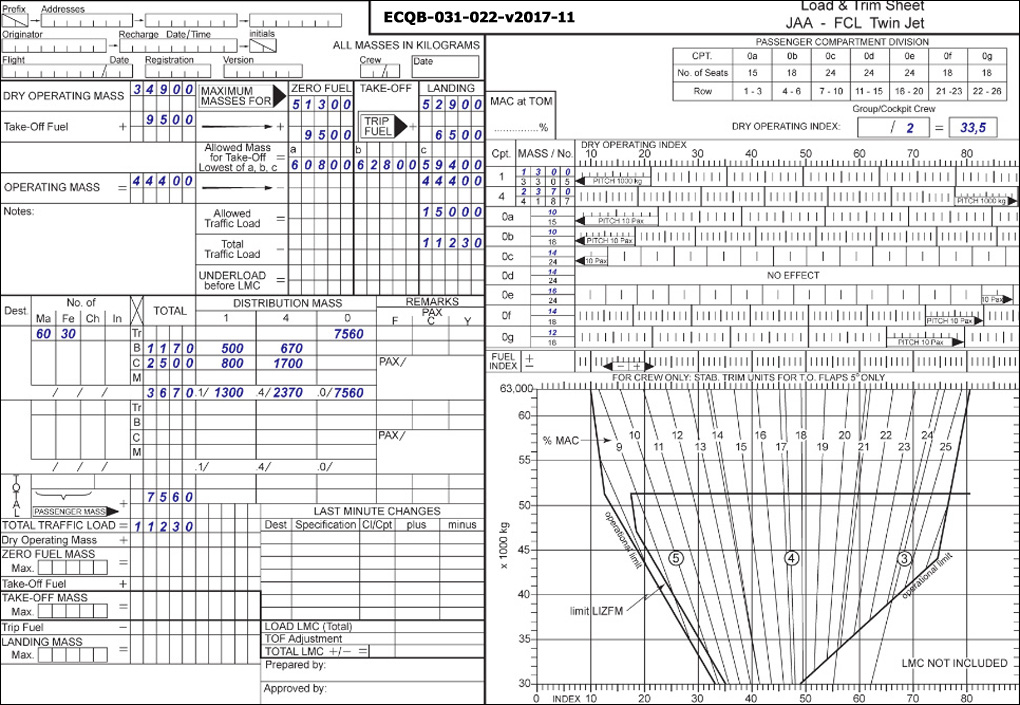
Question 92-12 : You are tasked with determining the takeoff mass cg with the following data provided takeoff fuel 9400 lbs actual takeoff mass 56 800 lbs fuel index chart for 9360 lbs 03 for 9600 lbs 09 for 9850 lbs 11 instruction if the fuel mass does not match the chart values use the next higher ?
09.
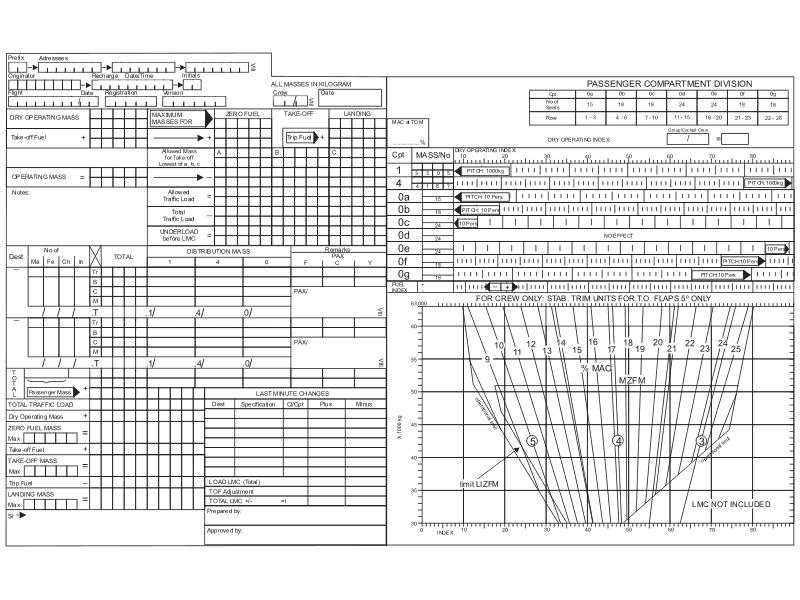
This question is testing knowledge of the fuel index technique as used with the mrjt on the final page of cap 696the question states if the fuel mass does not match the chart values use the next higher masstakeoff fuel 9400 lbs which does not match so the next higher mass is 9600 lbs with an index of 09for 9360 lbs 03 for 9600 lbs 09 for 9850 lbs 11when completing load sheets particularly for large aircraft it is convenient to use an index to represent the large numbers involved and to simplify the calculationsgenerally an index is a non dimensional figure ie a figure without unit of measurement that is a scaled down value of a moment and the effect of reducing the magnitude of the moment to one that is much easier to usea loading index li is simply a moment load mass x cg arm divided by a constant li = load mass x cg arm constant = load moment constant-0.3 -1.1 0
Question 92-13 : During dispatch you perform the mass and balance calculations given the following information calculate the zero fuel mass cg in inches aft of the datumbasic empty mass 2635 lb basic empty mass moment 204 3975 inlb front seat occupant's mass 93 lb front seat occupant's arm 78 in aft seat occupant's ?
8022.
This question is a newer development of question 319614 now asking for the zfm cg rather than the tom cga moment is the turning force created by the mass over a distance or lever arm moment = mass x armgenerally the centre of gravity cg can be found by adding all the moments and then dividing by the total mass cg = total moment total massstep 1 calculate the zero fuel mass zfm = bem + front seat occupant's mass + aft seat occupant's mass no fuel zfm = 2635 lb + 93 lb + 186 lb = 2914 lbstep 2 calculate the moments at the zero fuel mass bem = 204 3975 inlbfront seat occupant's moment = 93 lb x 78 in = 7254 inlbaft seat occupant's moment = 186 lb x 119 in = 22 134 inlbtotal moment = 204 3975 + 7254 + 22 134 = 233 7855 inlbstep 3 calculate cg position at zero fuel mass centre of gravity = total moment total mass centre of gravity = 233 7855 lbin 2914 = 8022 in aft of datum79.84 81.35 84.76
Question 92-14 : Length of the mean aerodynamic chord 1 mmoment arm of the forward cargo 050 mmoment arm of the aft cargo + 250 mthe aircraft mass is 2 200 kg and its centre of gravity is at 25% macto move the centre of gravity to 40% which mass has to be transferred from the forward to the aft cargo hold ?
110 kg.
Change in mass total mass = change in cg total distance movedchange in cg = 015 m 25%mac to 40%mac of 1 metre total distance moved = distance between front forward cargo and aft cargo = 05 m to 25 m = 3 mchange in mass = total mass x change in cg total distance movedchange in mass = 2200 x 015 3 = 110 kg183 kg. 165 kg. 104 kg.
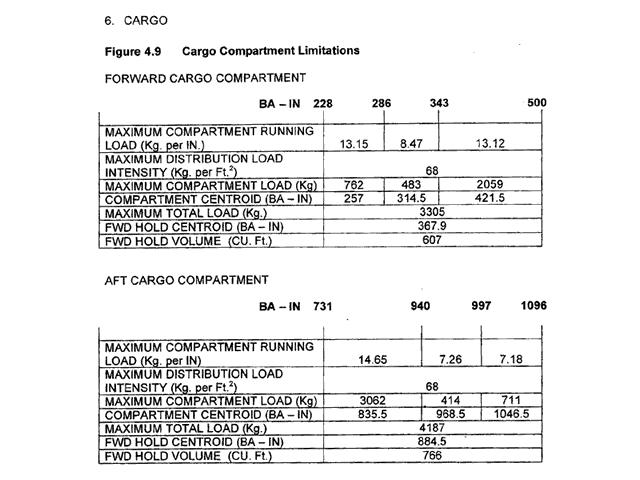
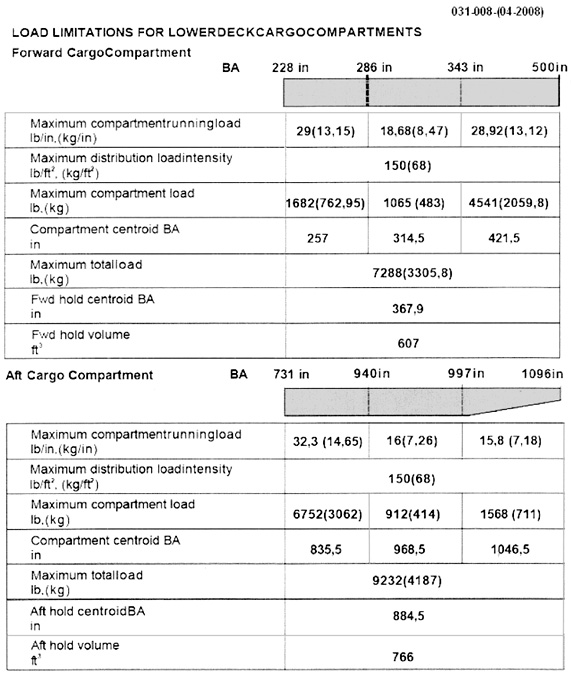
Question 92-15 : For the transport aeroplane the moment balance arm for the forward hold centroid is 210 ?
3679 inches.
Img149257 inches. 314.5 inches. 421.5 inches.
Question 92-16 : Referring to the loading manual for the transport aeroplane the maximum load intensity for the lower forward cargo compartment is 211 ?
68 kg per square foot.
Img150150 kg per square foot. 68 lbs per square metre. 68 kg per square meter.
Question 92-17 : The maximum intensity floor loading for an aeroplane is given in the flight manual as 650 kg per square metrewhat is the maximum mass of a package which can be safely supported on a pallet with dimensions of 80 cm by 80 cm ?
416 kg.
The max floor loading is 650 kg per square metrethe area of the pallet is 08m x 08m = 064 m²650 kg x 064 = 416 kg1015.6 kg 41.6 kg 101.6 kg
Question 92-18 : A pallet having a freight platform which measures 200 cm x 250 cm has a total mass of 300 kgthe pallet is carried on two ground supports each measuring 20 cm x 200 cmusing the loading manual for the transport aeroplane calculate how much mass may be added to or must be off loaded from the pallet in ?
2855 kg may be added.
Surface contact area = 02 m x 2 m x 2 ground supports = 08m²maximum permitted distribution load intensity 1m² converted in feet = 328 x 328 = 1076 ft²08 x 1076 = 861 ft²reference states that we can load 68 kg per ft² thus 68 x 861 = 5853 kg5853 300 kg of the current pallet mass 2855 kg may be added158.3 kg must be off loaded. 28.5 kg must be off loaded. 28.5 kg may be added.
Question 92-19 : From the loading manual for the jet transport aeroplane the maximum floor loading intensity for the aft cargo compartment is 213 ?
68 kg per square foot.
On the line of the aft cargo compartment table we read maximum distribution load intensity kg per ft² 68150 kg per square foot. 3305 kg in forward compartment and 4187 kg in aft compartment. 7288 kg in forward compartment and 9232 kg in aft compartment.
Question 92-20 : From the loading manual for the transport aeroplane the aft cargo compartment has a maximum total load of 214 ?
4187 kg.
Img1519232 kg. 1568 kg. 3062 kg.
Question 92-21 : From the loading manual for the transport aeroplane the maximum load that can be carried in that section of the aft cargo compartment which has a balance arm centroid at 215 ?
8355 inches is 3062 kg.
Img152421.5 inches is 2059 lbs. 421.5 inches is 4541 kg. 835.5 inches is 6752 kg.
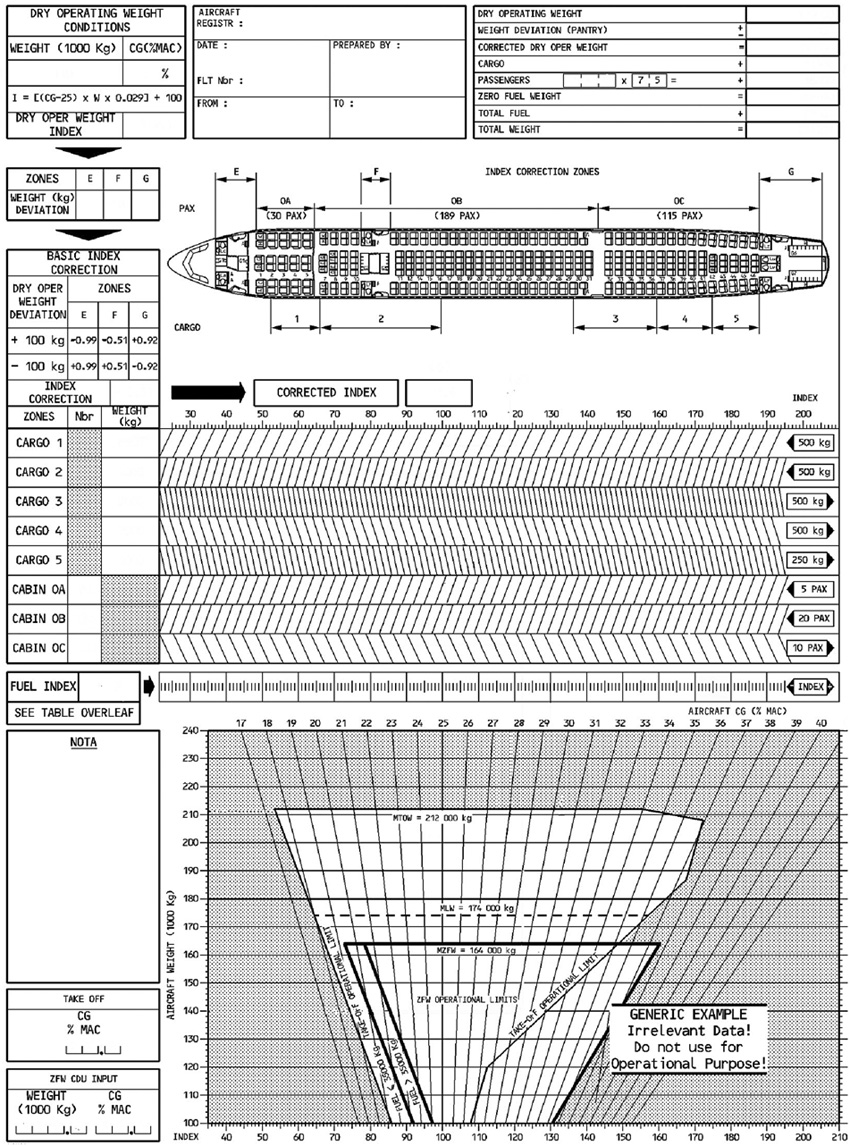
Question 92-22 : An aeroplane whose specific data is shown in the annex has a planned take off mass of 200 000 kg with its centre of gravity cg located at 1538 m rearward of the reference point representing a cg location at 30% mac mean aerodynamic cord the current cargo load distribution is front cargo 6 500 kgrear ?
Front cargo 3 740 kg rear cargo 6 760 kg.
Mean aerodynamic cord lenght = 186 m 14 m = 46 mcentre of gravity modification = 30% to 33% = 3%3% of mac lenght = 3% of 46 m = 0138 mmass change total mass = change of cg total distance movedmass change = change of cg x total mass total distance movedmass change = 0138 m x 200000 kg 10 mmass change = 2760 kgwe have to transfer 2760 kg from the front cargo to the rear cargo in order to move the cg aft front cargo = 6500 kg 2760 kg = 3740 kgrear cargo = 4000 kg + 2760 kg = 6760 kgFront cargo: 9 260 kg, rear cargo: 1 240 kg front cargo: 6 760 kg, rear cargo: 3 740 kg front cargo: 4 550 kg, rear cargo: 5 950 kg
Question 92-23 : The floor limit of an aircraft cargo hold is 5 000 nm2it is planned to load up a cubic container measuring 04 m of sideit's maximum gross mass must not exceed assume g=10ms2 ?
80 kg.
Weight in kg = 5000 nm² 10 = 500 kg500 x 04 x 04 = 80 kg800 kg. 32 kg. 320 kg.
Question 92-24 : The floor of the main cargo hold is limited to 4000 nm2it is planned to load a cubic container each side of which measures 05 mits maximum gross mass must not exceed assume g = 10ms2 ?
100 kg.
Footprint of one cubic container is 05 x 05 = 025 m²4000 nm² x 025 m² = 1000 n10 n = 1 kgmaximum gross mass must not exceed 100 kg per container1000 kg. 500 kg. 5000 kg.
Question 92-25 : Given actual mass 116 500 lbs original cg station 4350 compartment a station 2855 compartment b station 7925if 390 lbs of cargo is moved from compartment b aft to compartment a forward what is the station number of the new cg ?
4333.
Note that this is the only answer that moves the center of gravity forward change in mass total mass = change in cg total distance movedchange in mass = 390 lbschange in cg = total distance moved = distance between a and b = 7925 2855 = 507change in mass = total mass x change in cg total distance moved390 = 116500 x 507 change in cgchange in cg = 507 x 390 116 500 = 170station number of the new cg 4350 17 = 4333463.7 506.3 436.7
Question 92-26 : Pallet ground base 144 m²the pallet is carried on two ground supports each measuring 12 m x 02 m eachusing the maximum floor loading intensity for the cargo compartment of 732 kgm² calculate the maximum mass which can be loaded onto the pallet ?
351 kg.
Area in contact with surface = 2 x 12 x 02 = 048 m²732 x 048 = 351 kg508 kg. 175 kg. 1054 kg.
Question 92-27 : The maximum floor loading for a cargo compartment in an aircraft is given as 750 kg per square metrea package with a mass of 600 kg is to be loadedassuming the pallet base is entirely in contact with the floor which of the following is the minimum size pallet that can be used ?
40 cm by 200 cm.
The minimum size that can be used 600 04 x 2 = 750 kgm²or600 kg = 80% of 750 kg80% of 1 m² = 08 m²40 x 200 = 800 cm² 08 m² 30 cm by 300 cm. 30 cm by 200 cm. 40 cm by 300 cm.
Question 92-28 : Given the following data how much cargo must be moved from the forward hold to the aft hold to achieve a cg at 33% mac take off mass 200000 kgforward hold cargo 6500 kgaft hold cargo 4000 kgdistance between holds 10 mcurrent cg 30%macmac 46 m ?
2760 kg.
Mean aerodynamic cord lenght = 186 m 14 m = 46 mcentre of gravity modification = 30% to 33% = 3%3% of mac lenght = 3% of 46 m = 0138 mmass change total mass = change of cg total distance movedmass change = change of cg x total mass total distance movedmass change = 0138 m x 200000 kg 10 mmass change = 2760 kg2904 kg. 6000 kg. 1467 kg.
Question 92-29 : What is the maximum running load in the aft section of the forward lower compartment 232 ?
1312 kgin.
Img17413.15 kg/in. 14.65 kg/in. 7.18 kg/in.
Question 92-30 : Palletised cargo ?
Consists of different cargo box on pallets stored in the cargo holds.
Can be loaded without specific loading equipment. consists of passenger baggage on pallets stored in the cargo holds. has fallen out of use due to the lack of protection.
Question 92-31 : Bulk cargo ?
Can be loaded without specific loading equipment.
Bulk cargo loose unpackaged non containerized cargo such as cement grains ores Consists of different cargo box on pallets stored in the cargo holds. consists of passenger baggage on pallets stored in the cargo holds. has fallen out of use due to the lack of protection.
Question 92-32 : Containerised cargo ?
Consists of baggage and cargo loaded into standard size containers stored in the cargo holds.
Containerised cargo baggage and cargo can be loaded into standard size containers designed to fit and lock into the cargo compartment the containers have an individual maximum mass limit and an individual floor loading limit mass per unit aera Consists of different cargo box on pallets stored in the cargo holds. can be loaded without specific loading equipment. has fallen out of use due to the lack of protection.
Question 92-33 : Bulk cargo ?
Consists of cargo box baggage loosely loaded in the cargo holds.
Bulk cargo can be loaded without specific loading equipmentConsists of different cargo box on pallets stored in the cargo holds. consists of passenger baggage on pallets stored in the cargo holds. has fallen out of use due to the lack of protection.
Question 92-34 : Define the maximum load distribution ?
Load divided by smallest area.
Mass per unit area. load divided by largest area. maximum admissible g-force load.
Question 92-35 : A pallet having a freight platform which measures 100 cm x 150 cm has a total mass of 300 kgthe pallet is carried on two ground supports each measuring 20 cm x 100 cm using the maximum floor loading intensity for the cargo compartment of 800 kgm²calculate how much mass may be added to or must be off ?
20 kg may be added.
Area in contact with surface = 02 m x 1 m x 2 = 04m²maximum floor loading = 800 kgm²therefore max load for 04m² is 800 x 04 = 320 kg20 kg may be added to a 300 kg pallet140 kg must be off loaded. 900 kg may be added. 14 kg must be off loaded.
Question 92-36 : A container that measure 142m² is to be loaded the maximum floor loading is 720 kgm² the maximum load that can be put in the container is ?
1022 kg.
142 x 720 = 10224 kg507 kg. 511 kg. 720 kg.
Question 92-37 : An aircraft has a mass of 5000 lbs and the cg is located at 80 inches aft of the datumthe aft cg limit is at 805 inches aft of the datumwhat is the maximum mass that can be loaded into a hold situated 150 inches aft of the datum without exceeding the limit ?
3597 lbs.
Mass added old total mass = change of cg distance from hold to new cgmass added = change of cg distance from hold to new cg x old total massmass added = 05 150 805 x 5000mass added = 3597 lbs58.15 lbs. 39.50 lbs. 23.15 lbs.
Question 92-38 : An aircraft has a loaded mass of 5500 lbs the cg is 22 inches aft of the datuma passenger mass 150 lbs moves aft from row 1 to row 3 a distance of 70 incheswhat will be the new position of the cg assuming all dimensions aft of the datum ?
239 inches.
Mass moved total mass = change of cg distance movedchange of cg = mass moved x distance moved total masschange of cg = 150 x 70 5500 = 19 inchesnew cg location 22 + 19 = 239 inches21.1 inches. 26.3 inches. 22.9 inches.
Question 92-39 : The cg limits of an aircraft are from 83 inches to 93 inches aft of the datumthe cg as loaded is found to be at 81 inches aft of the datum the loaded mass is 3240 lbshow much mass must be moved from the forward hold 25 inches aft of the datum to the aft hold 142 inches aft of the datum to bring the ?
5538 lbs.
Mass moved total mass = change of cg distance movedmass moved = change of cg x total mass distance movedmass moved = 2 x 3240 142 25 mass moved = 5538 lbs74.96 lbs. 82.09 lbs. 22.49 lbs.
Question 92-40 : An aircraft has three holds situated 10 inches 100 inches and 250 inches aft of the datum identified as holds a b and c respectivelythe total aircraft mass is 3500 kg and the cg is 70 inches aft of the datumthe cg limits are from 40 inches to 70 inches aft of the datumhow much load must be removed ?
500 kg.
Mass change total mass = change of cg total distance movedmass change = change of cg x total mass total distance movedmass change = 70 40 x 3500 250 40 mass change = 30 x 3500 210mass change = 500 kg250 kg. 400 kg. 350 kg.
Exclusive rights reserved. Reproduction prohibited under penalty of prosecution.